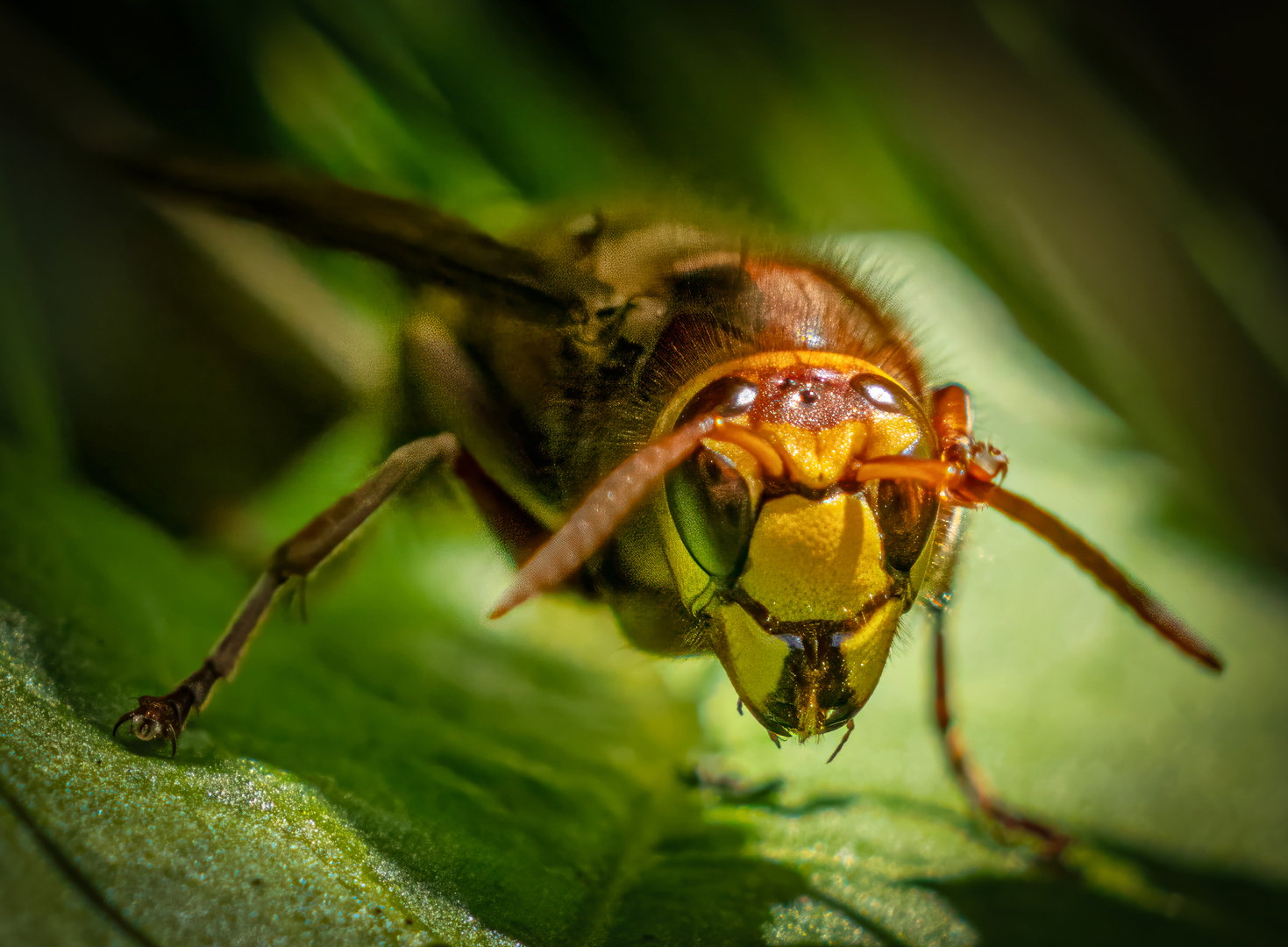
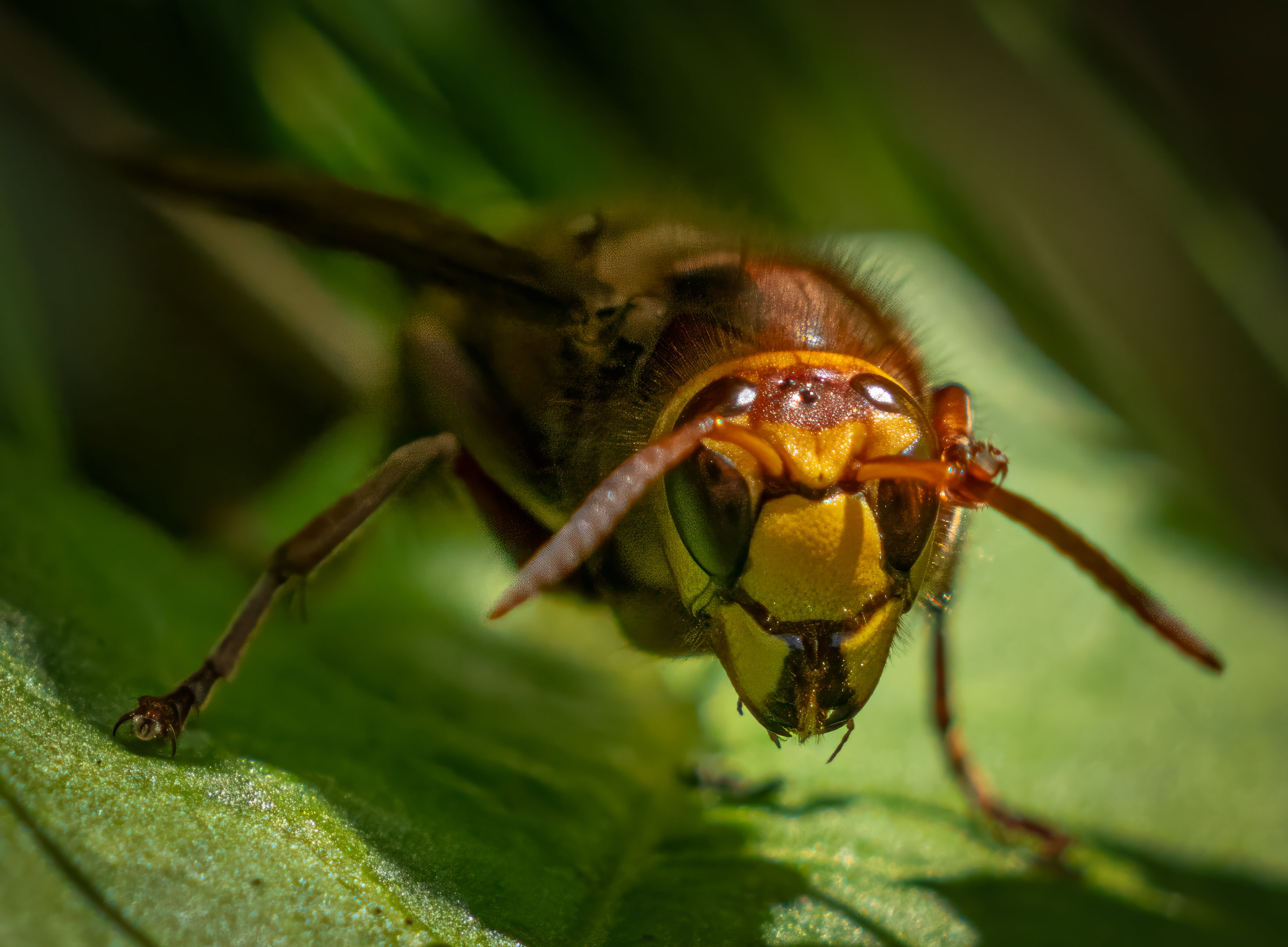
What changed: Opened up the shadows on the face and increased vignette.
Improved things slightly, painted on a bit of colour on the OOF antenna - all part of a learning process
Added after receiving feedback from the community.
Superb depth of field and perspective. It appears to me that you have been bugged quite a bit lately. Keep up the good work. I also have this lens and it is outstanding. But I find my x2 extender doesn’t have the same image quality as the 1.4.
Just an observation.
@David_Schoen Thanks for your kind comments.
I will ask Santa for the 1.4 if I can. I’m quite happy with the 2x but I have also heard the 1.4 is optically better and obviously doesn’t slow the lens so much.
Because I enjoy shooting into the sun I need to experiment how far I can under-expose and still get the shadow detail. Winter coming will surely force the iso up
Unfortunately with macro, shooting into the sun can be challenging for sure. I find the shadows on the face of the hornet to be a slight distraction in the comp. Next time, go with f16 and cut your shutter speed in half for better DOF. The 2x TC reduced the micro-contrast slightly and that can be recovered in post-processing. Otherwise, you captured a nice pose and the off-centered comp worked well for this photo. Well done…Jim
Huw: Not sure I want to get up close and personal with one of these guys but still a fine capture. I’m going to be lazy (I’m exceptionally good at that) and just ditto @Jim_Zablotny regarding DOF and using a 2x. Nicely done. >=))>
In this case, I really like the dof you had, Huw, as it focuses my attention on nothing but the face. If so inclined, you might look at a crop that puts the hornets face a bit higher in the frame so it gives more of an impression of staring the viewer straight in their face. I think you could achieve a bit more menacing look that way.
Huw, the pose looks good and you’ve got great detail in the head and face. The specular relfections off the top of the eyes and the head can be many times brighter the the colors of the surroundings, which makes them nearly impossible to fix or remove in processing without cloning. Using a polarizer can dramatically reduce (0r even remove) specular reflections. When the chip is hit with a specular reflection there is “spill over” of charges into the neighboring pixels which often takes on particular colors. I do think that a bit more depth-of-field (so that the bases of it’s antenna are sharp woulg be a subtle, but nice improvement. The eyes and mouthparts look great.