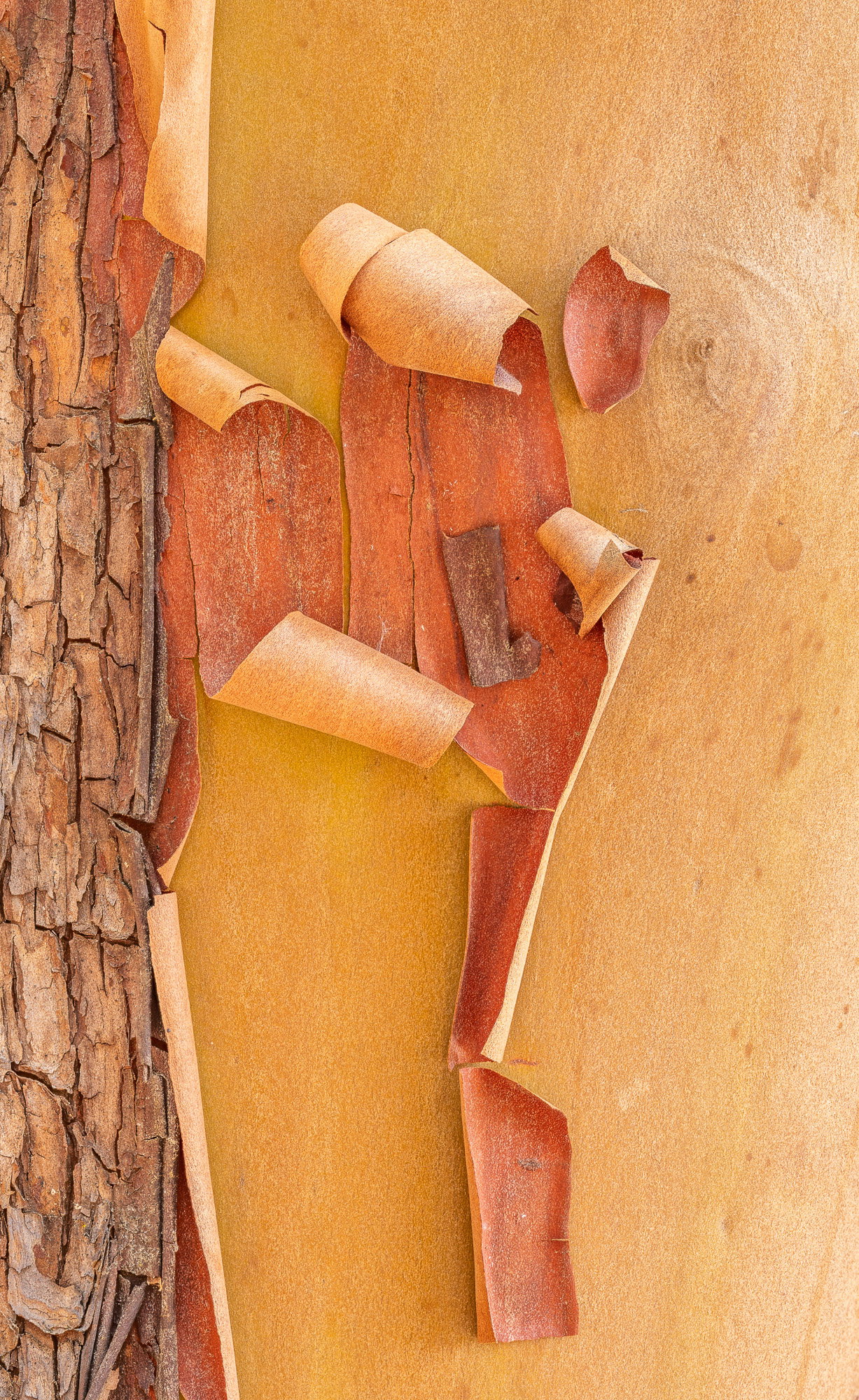
The photographer is looking for thoughtful feedback on the image as a whole, especially around the areas noted below.
Feedback Focus: Artistic + Technical
About This Image
On newer branches, Madrone bark peels in late summer and can make some interesting patterns. Older branches or trunks develop more conventional bark. In this image the older bark on the left is adjacent to the peeling area on the same limb. I almost missed the show this year – this was shot 2 weeks ago.
Feedback Requested
All comments welcome!
Technical Details
Camera: Canon EOS R5
Lens: EF100mm f/2.8L Macro IS USM
Focal length: 100mm
Shutter speed: 1/10s
Aperture: f/5.6
ISO: 100
Focus stack in Zerene, then into PS for some cleanup and about a 50% crop. With sloping ground and a strange-shaped tree (more of a very robust bush), I couldn’t get the tripod closer. Should have used the 1000 mm macro.
This is very nice, Diane. I think the textures and color work nicely together. It does appear to be brighter on the right side just beyond the bark curls, so you might want to try balancing that a bit.
Here in our Sierra Foothills, we have Manzanita, a close relative of Madrone. Manzanita bark does shed in a similar way, but the replacement bark is smooth and quite dark; almost maroon in color.
Excellent, especially the colors. It’s the sort of shot I’d definitely experiment with rotating too, according to taste. To me it also looks good rotated through 90 degrees. Great stacking for the 3D effect.
Diane -My first impression of this image is how you have portrayed three stages of the bark of this tree all in one section-mature bark on the left edge, peeling bark in the middle and no bark on the right. And different shades of orange throughout. Very nice.
Thanks, @David_Schoen , @Preston_Birdwell , @Bill_Fach , @Mike_Friel and @Ted_Forman ! I’m surprised there isn’t Manzanita up in the foothills – it seems to like hot dry climates. We have Manzanita too, and the bark peels in a similar fashion but on a much smaller scale. (They are bushes here, and the Madrones pass muster as actual trees, although not huge ones.) Mike, I’ll have a look at a rotation but knowing how it was will probably make it look strange to me. There is a subtle vertical-ness to the way it peels.
The textures and the curled-up portions of the bark caught my eye. The lighting is very nice and the overall warm colors work well in the comp. Well done…Jim
First I love the composition, the amount of bark texture showing on the left is just right without dominating or competing with the curled bark. Second is the crispness in the detail, really showing off the curls!
I said this in another image critique and it fits here as well. The old me would have cranked up the vibrance or saturation but the new me is less is more and I think this is a perfect case. Well done Diane!
Manzanita is quite prevalent in our foothills here in Tuolumne County. Some of the bushes are quite large, and some are very old.
Manzanita likes a drier climate, but not necessarily a hot one. There is a species of Manzanita that I have seen growing nicely at nearly 10,000 feet in the Sierra in the Sonora Pass country on the west side of the crest. The bushes are small, almost dwarf with very small dark green leaves. They are likely low-growing due to being under snow for long periods during the winter.
-P
Diane, this is a lovely warm and inviting look at this Madrone bark/trunk. The textural shift from the mature to the new bark looks good and I like how the peels of bark move across the frame to that little knot hole, for some extra “spice”.
Madrone has such cool bark and you found a very fine composition for this one. I think I’ve seen a species of manzanita on one of the Cascade peaks I used to hike and there’s a small nursery in Portland that has some cultivars that do reasonably well in our Pacific Northwest lowlands.
Great find. I look for things like this when out and about. Wish I found them more frequently. You have something very nice with a mix of colors, shapes, and textures working to good effect here.