Salad days

Critique Style Requested: In-depth

The photographer has shared comprehensive information about their intent and creative vision for this image. Please examine the details and offer feedback on how they can most effectively realize their vision.

Self Critique

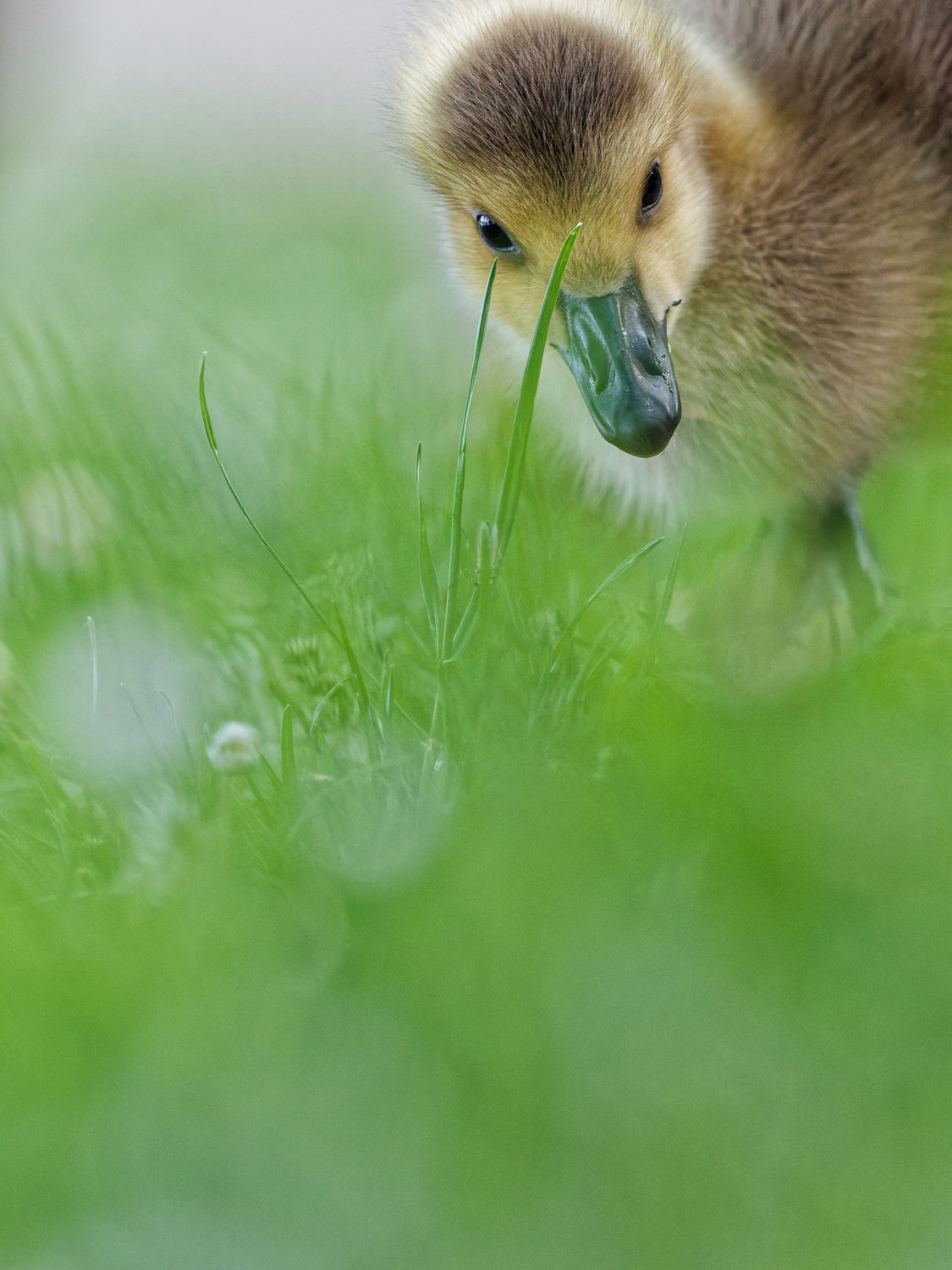
I would love some thoughts from the community on the composition of this little gosling, because I have been staring at it for so long that I have lost all objectivity and started to wonder whether the bird is even still in the frame.
A few specific things I am turning over in my head. The gosling sits firmly in the upper right corner, with a generous wash of soft green grass filling the rest of the frame. I was going for a sense of the small creature observing its world, with the negative space giving room for the imagination to wander, but I am genuinely uncertain whether it works as intended or whether it just leaves the viewer feeling that the bird is trying to escape the photograph.
I also went quite tight on the crop, showing only the head and a hint of the body. Does that feel intimate, or does it feel amputated. I keep flipping between the two readings depending on the time of day and how much coffee I have had.
Then there is the blade of grass that crosses right in front of the eye and beak. I quite like it as a small narrative element, the gosling considering its breakfast, but I can also see how some might find it a distraction from the gaze. Would you leave it, clone it out, or reframe to avoid it entirely.
Finally, the low angle puts the viewer down in the grass with the bird, which I felt was the right perspective for the subject. But I wonder whether the very soft foreground grass occupies a touch more of the frame than it earns, and whether a slight crop from the bottom might tighten things up without losing the intimacy.
Any thoughts welcome, including the unflattering ones. I have made my peace with the possibility that I have been admiring an empty corner of grass for the past two hours.

Creative direction

My creative vision for this one is built around a single feeling: the smallness and tenderness of new life set against a vast, slightly bewildering world.My creative vision for this one is built around a single feeling: the smallness and tenderness of new life set against a vast, slightly bewildering world. I wanted the gosling to feel like a tiny visitor on the edge of the frame, peering down into a green ocean of grass that is probably its entire universe at that age. The negative space on the left is doing the heavy lifting there, suggesting the world the little one has yet to explore, while the tight crop on the bird itself keeps the intimacy close.
Stylistically, I lean toward soft, painterly, low angle work for subjects like this. I find that getting down to their level rather than looking down on them changes everything about the emotional register. From above, a gosling becomes a cute decoration. From eye level, it becomes a character. I was after the second of those, with a quiet pastoral mood rather than a sharp, documentary feel.
In terms of message, I suppose I am trying to convey something close to wonder. Not a dramatic kind of wonder, just the quiet sort, where everything is new and a single blade of grass is worth a long look. I would like the viewer to feel a touch of tenderness, perhaps a small smile, and ideally the sense that they are sharing a private moment with a creature who has no idea anyone is watching.
That said, I will happily admit my vision is not fully resolved. I am uncertain whether the negative space truly feels like a world or simply feels like an empty frame. I am also unsure whether the crop achieves intimacy or just clips the subject inelegantly. Any thoughts that could sharpen the concept, or even gently redirect it toward something I had not considered, would be very welcome.

Specific Feedback

Any insights you may have on how to improve this shot would be most welcomed

Technical Details

OM-1 - Olympus 300mm
f4 - 1/1600 s - iso 5000

Description

Here is the story behind this one. I had set out at an embarrassingly early hour with my heart set on photographing terns. I had researched the location, packed the long lens, mentally rehearsed the dramatic diving shots I was about to capture, and generally walked toward the water with the smug confidence of a man who has clearly never met a tern.
The terns, of course, had read no part of my plan. They were either entirely absent, or present in the meteorological sense only, briefly visible as distant white smudges that vanished the moment I raised the camera. I waited. They taunted. I waited some more. They taunted from a slightly different angle. After a respectable amount of time spent pretending I was about to nail the shot, I conceded defeat with as much dignity as one can muster while wearing damp shoes, and began the slow walk back to the car, muttering quietly to my equipment.
That is when I rounded a corner and walked straight into a family of Canada geese. Two stoic parents, a small fleet of fluffy goslings tumbling around them, and the kind of pastoral scene that almost feels like the universe apologizing. I lowered myself into the wet grass, much to the geese’s mild concern and my trousers’ lasting disappointment, and started photographing at their level. The terns were forgotten. The morning was rescued. The goslings, blissfully unaware that they were Plan B, went about their business of nibbling, wobbling, and generally being the cutest possible consolation prize.
This particular frame came from one of those quiet moments when one of the little ones stopped to investigate a blade of grass with the seriousness of a scholar examining a rare manuscript. I had been hoping for terns, and the morning gave me a gosling philosopher instead. As trades go, I came out ahead.

2 Likes

Love the photo! I really like the position of the duckling in the upper right and like that just his head and just part of his body are in the frame. Definitely tells a story of the duckling just peering in. I’m not sure about the blades of grass in front of his beak. I’m not sure how much it adds to the story and might be cleaner without. Overall a great shot.

The image is splendid - I love the colors, the softness and the contrast between the ethereal grass and the duckling. Not sure about the two grass blades in front of the head - one of the blades ends in the eye of the duck, and that one I found particularly worrisome… I see the point of having those two blades, but not fully convinced. True that without them the photo may be less interesting… Nice and personal vision, in any case. The position of the duckling is perfect.

Thank you so much for the kind words and the thoughtful read. I am genuinely glad the composition works, especially the upper right placement and the partial framing. I had been agonizing over both, so it is a relief to hear they read as intentional rather than accidental.

You make a fair point about the grass blades. They are doing a small narrative job in my head, the gosling considering its breakfast options with the seriousness of a tiny scholar, but I can absolutely see how they could read as visual clutter rather than story. I will try a clean version with them tidied away and see whether the gaze feels more direct without them. It may well be one of those cases where the photographer has fallen in love with a detail that the image itself does not strictly need.

I should also gently confess that the little fellow is actually a gosling rather than a duckling, a Canada goose baby in his fluffy yellow phase before the elegant gray and black uniform arrives. An easy mix up given how thoroughly fuzzy and round all baby waterfowl are at this age. Frankly he probably does not know the difference himself yet either.

Thanks again for taking the time to look closely and share your thoughts.

Thank you so much for the warm and thoughtful response. I am really glad the colors, the softness and that contrast between ethereal grass and fluffy little subject came through, because that was very much the feeling I was reaching for. And it is a relief to hear that the placement reads as intentional. I had stared at it long enough to start doubting my own eyes.

Your point about the grass blades, and especially the one that lands right in the eye, is well taken. I had not quite registered how that single line meets the eye until you mentioned it, and now of course I cannot unsee it. You are absolutely right that there is a tension between what those blades add narratively, the little fellow contemplating his salad, and what they cost compositionally by intruding on the gaze. I will experiment with two versions, one fully clean and one perhaps with just a single softer blade left in, and see which carries the mood better. It may indeed be one of those moments where the image gains coherence by losing a charming distraction.

I should also gently note that the little one is in fact a gosling rather than a duckling, a baby Canada goose in his yellow fluffball phase before the more formal gray and black plumage arrives. Easy to confuse at this age, when all baby waterfowl seem to be made of the same fuzzy round material. He probably does not mind the mix up either. He has bigger things on his mind, like that blade of grass.

Thanks again for the careful look and the kind words.

Thanks Sebastien! Yes of course, gosling! absolutely! Thanks for pointing this out!!!

I like this sentence… :slight_smile:

Hi Sebastien, I really like this unique composition with the gosling peering down from the upper right corner. Critical sharpness is where it needs to be and the fuzziness of the bird is well rendered. The longer grass blades work for me as we see the young one exploring its new world. Well done.

I can’t believe I missed this one earlier! I think it is fantastic – the crop, the negative space and the grass blades! I can’t imagine a better Second Prize! You have a cutie with a perfect story! And the grass blades are an excellent small imperfection that adds to reality. Normally my instinct is to avoid too much negative space but I think that is probably because most of my images don’t have that strong a subject. In this case, I love all that room to show a hint of the big world! I wonder if your mixed feelings about it would be reduced by a subtle gradient burn from the bottom, angled a bit toward the upper right?

Thank you both for the wonderfully generous reads. It is a real comfort to hear that the composition lands rather than feels like an accident, because I had genuinely been wavering on every single decision in the frame, from the placement to the crop to those infamous grass blades.

@Allen_Sparks , I am especially glad the rendering works for you. I was hoping the contrast between the crisp eye and the soft halo of fluff would carry the sense of fragile newness, and your read of the longer blades as part of his exploration is exactly the story I had in mind. Hearing it described back to me almost word for word from your end is genuinely encouraging. Thank you.

@Diane_Miller, your comment made me grin from start to finish. The phrase excellent small imperfection that adds to reality is one I am going to quietly tuck into my pocket for future use, because it captures something I struggle to articulate when I am trying to decide whether a stray detail is a flaw or a friend. You are absolutely right that negative space only works when the subject can carry it, and I am relieved to hear this little fellow earned his keep on that front.

Your suggestion of a subtle gradient burn from the bottom angled toward the upper right is a really lovely idea, and I think it might be exactly what would resolve my mixed feelings. A gentle darkening there would push the eye more firmly toward the gosling and give the grass a touch more atmospheric depth without losing the airy openness of the frame. I am going to try it tonight and see how it sits. Thank you for the elegant nudge.

And thanks again to both of you for the time and care. Comments like these are what make sharing worth it.

I really like the slightly unusual composition in this one Sebastien. It fits the title very well. The semi-focused white flower or seedhead helps a lot in bringing the viewer’s eye from the gosling into the rest of the frame.

Thank you Dennis, honesty compels me to confess that I borrowed the title from Shakespeare :slightly_smiling_face:

That was Shakespeare??? (The things I learn here…) And I got behind again – a hearty congratulations on the EP – very well-deserved!!

Hi Sebastien
Congratulations on receiving the editors-pick of the week.
Peter

1 Like