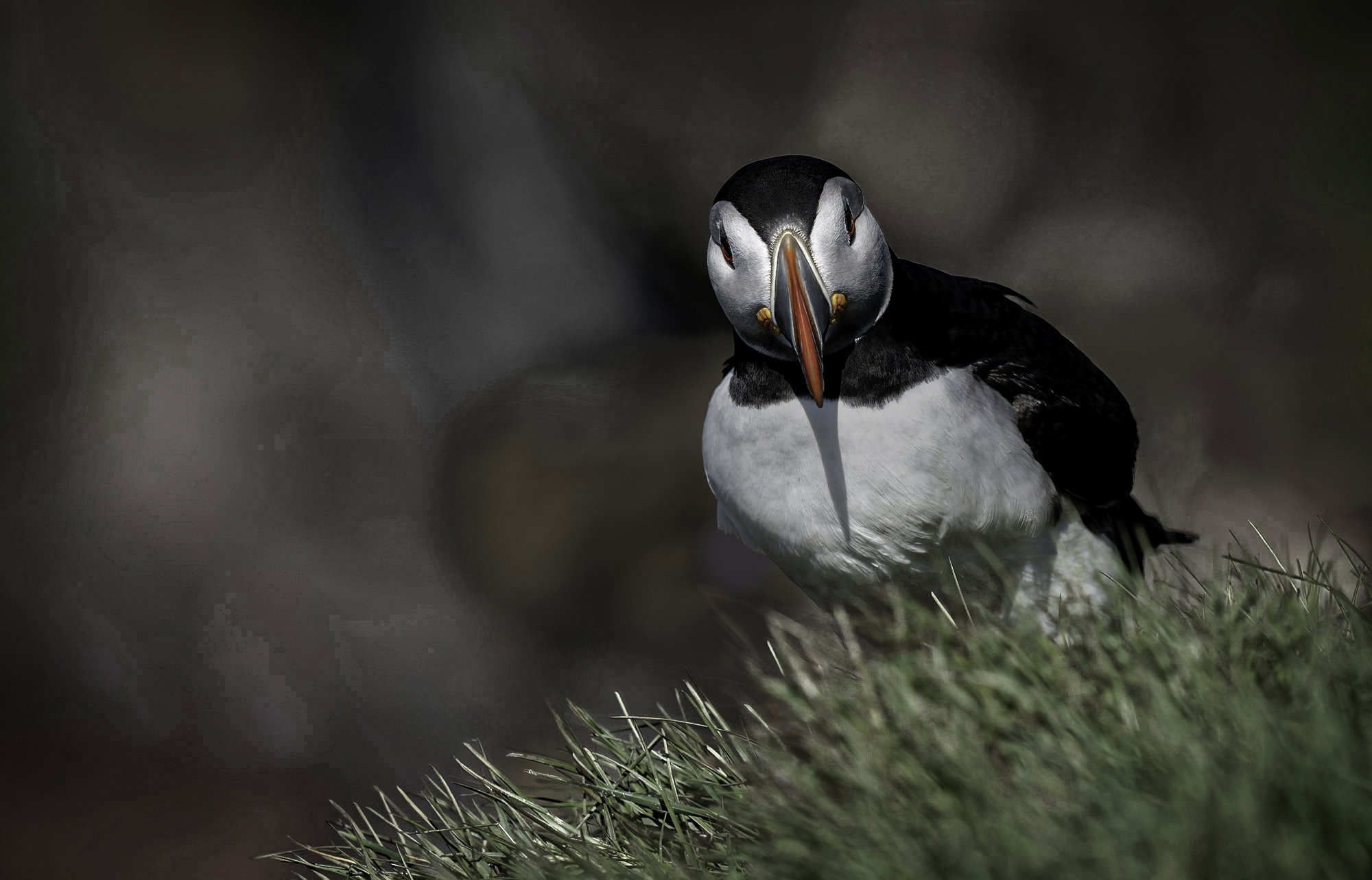
here’s a very simple AI image. I’ll post both the original image and the AI image. The AI image had one direction for modification. The original image was taken in Iceland several years ago and was taken a time when the puffins were not breeding. The only feed their young and had fish in their mouths during the breeding season.
It appears to me that this program firefly Gemini flash, took my directions and not only that, but it appears that the background is somewhat more blurry than the original, and the image was straightened out.
I find this a little scary
I’ve spent the last several days fooling around with several different approaches to AI. This includes firefly, links to AI from Photoshop, and several other approaches, including copilot.
It appears that the simplest most direct directions are easiest to follow. I had some difficulty with copilot and some of the Photoshop related AI approaches. I got quite frustrated, but I would say it is worth playing around with to know what’s out there. I hope this will stimulate an interesting discussion and perhaps some new posting rules regarding images that have been altered through AI.
Honestly, I believe AI is and will increasingly be dangerous. Using it to create a ‘reality’ that is untrue to real events or original thought will not end well since it can be very easily abused.
To my pea-sized brain, photography has always served to tell an immediate truth. Photographs and video altered through AI are very simply spreading falsehoods.
In terms of NPN, if AI is used, it should be disclosed in detail, including the platform used to generate the image. e.g. PS or ACR similar to what @David_Schoen describes here.
I am very interested in what others have to say about this as I believe it’s a very important discussion to have here.
-P
AI is here to stay whether we like it or not. That’s my belief. Once it’s available you can’t put it back. It’s like the hesitations we had over all the gadgets that came from Silicon Valley, even Facebook. I don’t think you can moralize AI.
But I’m personally irked by AI. Recently it has become popular to create AI videos of wildlife stories. For example a leopard will chase a mountain goat up a steep cliff only to fall as it is inches from grasping the animal. Fine and dandy. What is disturbing is reading the posts from viewers. Some are relieved that the prey has escaped the leopard. Others comment on how the leopard should done so and so at this critical moment and would not have fallen. There are gasps and applause from the posts. What is clear is that these people can’t tell AI from reality and assume they are witnessing reality. And that’s what’s so disturbing. They are being duped. Maybe it’s my Judeo Christian upbringing but that just grates on me.
It’s not that AI is false. Most art since the mid 19 century is not realistic. It’s that it is taken to be real.
There is also the problem that AI isn’t very good yet. To this day I still prefer the chariot race in Ben Hur to the modern action movies. Authenticity. That’s what’s missing.
AI is also click bait. It’s being used to get your attention much like misinformation is used today. For example, I read many provocative news stories that are false. Misinformation. They’re being created solely for the purpose of you reading them. One has to search the web to find out if there is truth to it. The intent of most AI videos is the same. They are being created solely for the purpose of being viewed.
But I feel that AI will become as normal to us in the future as movies are now compared to what people thought of them at the turn of the 20th century. I just don’t see a revolt against it. People will adapt to the new technology and have a different outlook.
Just my thought about AI in general. But in photography I think in the future there will be two camps. Accounts or websites dedicated to AI and the rest. And the images will not be mixed. You will know when you are in AI world and when you’re not. In fact that would not be a bad idea for NPN. Segregation of sorts.
This is the danger I was referring to. And yes, it grates on me, as well.
I am not so sure AI generated images would be segregated from straight photography because there will be people who will try to “pull the wool over our eyes” for nefarious purposes, or just because they can. If that segregation could be achieved, I would be happy about that because I could then choose not to view them.
As far as NPN: AI images would need their own tag, e.g. “AI Generated” and the photographer would be required to disclose such action in their image description, as I mentioned in my post above. Even ‘minimal’ use of AI would need to be disclosed.
What also saddens me about AI is the suspicion it creates. John McWhorter touched on this in his latest NYT article - that now, every piece of writing he encounters makes him wonder if a person really did create the whole of it. With his students at Columbia, he now just assumes that at least some of it came from some LLM and how the heck to you grade that? Most creative use of an LLM? Least percentage of use of an LLM? Most blatant use of an LLM? It’s in the mix and can’t be taken out now for better or worse. As a result, I question basically everything I read (online for now, it hasn’t drifted into my novels or other books), but also about photographs and other artworks. Some you can tell, some aren’t so easy, especially with illustration. The suspicion and doubt is the thing that brings me down. I don’t want to approach art in this way, but now I have to.
How very true. I hadn’t thought of that. The stress of having to figure out whether you’re being lied to and insecurity of never knowing if you are. Yeah, those are big issues. That’s just not healthy.
One other thought I had in mind about AI and NPN. How do you critique an AI image? What does an AI author want? Since most of us don’t yet know how AI images are created how can we provide advice on how to improve such an image. Most of us can provide photoshop advice on how to improve an image but what can we say about AI? Again, I suppose this is all in the future. It’s probably coming as AI settles in and becomes part of our fabric.
I believe that the minimal use of AI to aid in editing a photo is fine, as long as the original nature of the photo is not changed. Most programs today use AI to accomplish that. Adding something to the image that was not there to begin with is where you lose me. The whole point with nature photography is to create a final image that gives the viewer a sense of what the personal experience and emotions that the photographer, a human being, had when taking the shot. AI is none of that, as it is totally devoid of any personal involvement from those who created the image. This is my personal opinion, for whatever it’s worth.
@Kris_Smith I had to look up what LLM (Large Language Model) meant. I did not know such a thing existed until you mentioned it. I retired from teaching in 2013 and so it was easy to tell if a student wrote something that was not of their own thinking. I am happy that I do not have to deal with it in an academic setting.
@Igor_Doncov as far as critiquing an AI image I think all one could really do is point out obvious flaws in the rendering. Other than that, what else could one say? Serious question.
That would be acceptable, I think. However, as I said above, the use of AI should be disclosed even if the use of it is minimal.
Same here, Ted. Doing so would mean we are being lied to, as Kris said.
@David_Kingham: What are your thoughts on this subject. No hurry.
-P
This is a really important discussion, and I’m glad we’re having it. AI has become incredibly powerful for creating and modifying images, and the fact that it’s now built directly into Photoshop and Lightroom makes things even more complicated for photography moving forward.
I’ve tried to keep our guidelines around AI simple and clear, which you can view here: AI-Generated Images
I don’t see a reason to allow fully AI-generated images on NPN. That’s not photography, it’s computer-generated art. Where things get more nuanced is in cases like David’s example above. It’s not fully generated, but it goes well beyond what I’d consider normal cleanup. In situations like that, it should absolutely be disclosed, and I think it raises a valid question about where the line should be. That’s worth discussing as a community.
Another area we’ve started to see is the use of AI for writing critiques. Since images can be uploaded to an LLM and analyzed automatically, it’s something we need to be mindful of. We’ve only run into this once so far, but it prompted me to add this section to the guidelines: Authenticity in Critique (AI Use)
The reality is that it’s getting harder to identify AI-generated content, and that’s not going to change. It will only become more convincing over time. We’re in a strange moment with all of this, but if anything, it makes authentic photographic work even more meaningful.
That’s what we’ll continue to prioritize here. I don’t expect this to become a major issue for NPN. We may see the occasional bad actor, but so far this community tends to attract people who are genuinely interested in growing their craft, not just chasing attention. That culture goes a long way in keeping things grounded.
I realize I am coming to this discussion a month late. Hopefully not too late. What has struck me recently is that Ai / LLM has invaded both the visual arts as well as the written word. The hard labor of producing art from a blank canvas, capturing a moment in the outdoors, or sitting down to compose a literary piece is being superseded by how easy it is to create with Ai and how fast. No effort. No sweat and tears. No crumpled notes in the garbage bin. Just a few sentences and poof, out comes what is perceived by so many as art. I realize that I could be thought of as having ‘dark’ thoughts but I’m afraid humans often take the path of least resistance and whoever finishes the race first is typically the one who is rewarded. For these reasons and more I could not be more put off by Ai in photography because it does more than help you improve an image, such as dodge and burning does, it eliminates the need to know anything about what the “user” is doing.
Thanks for sharing these links. I think the AI info is important for all of us to review. Sometimes I forget a rule and it’s always good to refresh my memory. I recently replied with an image of my own as an illustration of a funny story. Good to know that’s to be avoided. It is a distraction like changing the subject mid conversation.
First, I agree with all of the sentiment shared so far especially that around the broken trust between creator and viewer.
In my opinion, an AI-augmented image destroys the most important quality of a photograph and that is its realism.
Unlike other mediums (painting, sculpture, music, etc…) photography starts with the capture of reality.
Working with reality (ie. the scene in front of the photographer) is what makes photography challenging and ultimately what leads us to being creative and making creative work.
The moment you add elements to a photograph in a realistic way (like in David’s example) you are destroying that which makes photography creative, expressive and beautiful. You destroy the intrinsic quality of the medium itself.
At that point, it’s not (nor should it be passed off as) a photograph.