This is a term I’ve got used to hearing but I’m not sure what it means.
What Is Intimate Landscape Photography?
Intimate landscape photography captures smaller scenes from the natural world. It can involve standing close to nearby subjects or zooming in tight to something in the distance. One prevailing theme is that intimate landscape photos usually do not include the horizon or the sky in the photo. Instead, they show a smaller part of the larger landscape.
That said, there’s a bit of a blurred line between typical landscape photography and intimate landscape photography. Is the photo an intimate landscape if it zooms in on a towering waterfall? What about photographing a single tree branch with the sky behind it in the background? It’s hard to say. I go back to the word “intimate,” though, and would say that an intimate landscape photo simply feels closer than other landscape photos do. https://photographylife.com/intimate-landscape-photography
Maybe its worth thinking about the masters of the Intimate landscape:
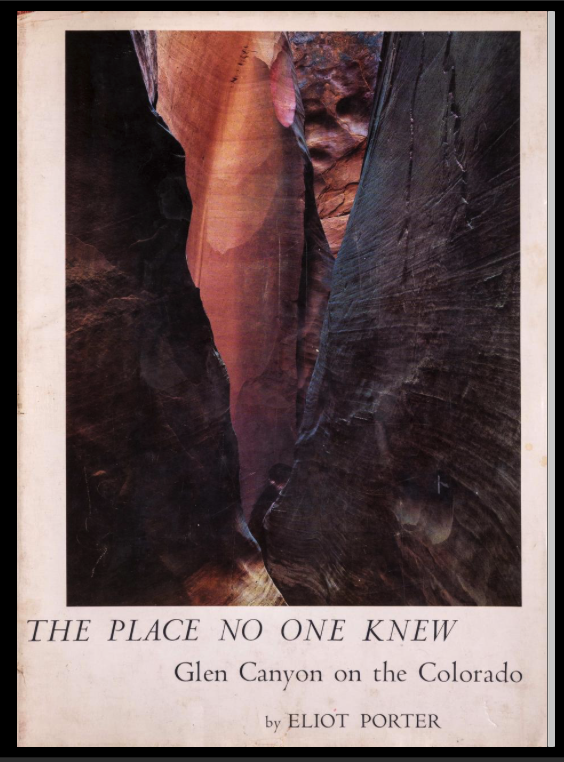
Eliot Porter :
Particularly : “In wildness is the Preservation of the World” and “In the Realm of Nature” - great bird images too!
His 1963 work on “The Place No-one Knew” Glen Canyon (Colorado River) before it disappeared because of a dam build is immense and started a Preservation Furore . Free PDF of his book “The Place No-one Knew”
The book dedication: To my children
But where will the chance to know wildness be a generation from now? How much of the magic of this, the American earth, will have been dozed and paved into oblivion by the great feats of engineering that seem to come so much more readily to hand than the knack of saving something for what it is?.. Again and again the challenge to explore has been met, handled, and relished by one generation—and precluded to any other.
I’ve started this discussion so that I hope others can contribute - both to help me learn some “seeing tricks” for composing good intimate landscapes, and to learn of other photographers I can investigate and learn from.
I don’t really like the definition of intimate landscape. What is usually referred to as an intimate landscape should probably termed as an extraction. Although that’s not accurate either because all photography is an extraction.
An intimate landscape means different things to different people now. It was coined originally for Eliot Porters images. What made his work intimate was not the scale of the subject but his relationship to the subject matter. It was a personal relationship. To me it’s like personal relationships between people you know well. You know their mannerisms. You know what they will say before they say it. You know how they will tuck their hand under their chin when they say it. There is a familiarity that comes with knowing someone for a long time. Eliot Porters images show that kind of personal familiarity with nature. You can tell by what he shoots that it’s these personal revelations about the woods that he treasures so much. He never trades this for the sake of art. Design always plays a secondary role in his work. The arrangement of shapes within a frame is never the point with him.
I have seen many ‘intimate’ landscapes that aren’t intimate at all in the Porter sense of it. In fact I make some intimates that are more artsy than being truly intimate. Close up images of driftwood are usually about design and have little to do with intimacy. Making intimate portraits is hard. It usually takes a lot of time spent with the subject matter. Even Porter’s images are not all the same in that sense. His publication ‘In Wilderness is the preservation of the world’ is in my opinion his best and most intimate work. It’s all shot in New England where he spent a decade observing its natural world. How could he possibly achieve the same awareness with a few rafting trips through Glen Canyon before it was dammed?
Thanks Igor - thanks for your additions and thoughts on “intimate” - agree wholeheartedly.
In this camera club and international salon world we live in its refreshing to be able to trust to the authenticity of his camera images in this photoshop and AI world. Compositionally his images are wonderful, and lighting gorgeous so those aspects of art and design are very prevalent, or at least keep revisiting the scene until light and composition come together to truly represent the feelings imparted whilst enjoying a small part of nature.
Yep, I’ve always called them slices in my head and you’re right that the relationship(s) of the subject(s) to each other and the photographer isn’t as important or emphasized in today’s catch-all of the term. It seems to have become just a smaller “slice” of the whole and to be opposite what we think of as a grand landscape; all encompassing, massive in relation to the viewer and designed to awe.
I just watched a video where the author stated that he didn’t want to make grandiose images. It made me think of these 2 opposites - grandiose and intimate. In both cases we define them incorrectly. An image with sky can be intimate, as is Robert Adams work. And similarly many intimate landscape are grandiose. By that I mean loud, attention getting, and impersonal. Problem is that these are extreme definitions. Many images have elements of both?
Yes, I think a grandiose image has little to do with how much expanse is being displayed.
That’s true, Igor. Personally, I believe the labels “Grand Landscape” and “Intimate Landscape” should be replaced with the simple “Landscape” label. Doing so allows the viewer to experience the image through their own lens (pun intended).
Just a technical note regarding Porter’s color work. They were shot using a Linhof 4x5 on Kodak color negative film. Not only were his landscapes photographed this way, but also his avian images. I find that remarkable.
-P
This is an interesting discussion, and I’m glad we’re having it. The “problem” with grand and intimate (one suggesting largeness and the other closeness) isn’t just that they represent different qualities (one = size and the other = proximity), but that they have a positive value judgment associated with them. If my landscape isn’t grand, does that make it lesser? Of course not. If my small scene doesn’t feel intimate, does that make it objective? Not necessarily.
This is one reason I like to keep the adjectives out of landscape, and I like to use the phrase “small scene” for things that don’t really fit our categories. For example, a close-up photograph of driftwood on sand doesn’t feel like a landscape, but it does feel small scene-ish. It may or may not be intimate, but that might not be my call (or might only be my call).
And, thanks for giving me some good reading material. I’m off to explore the work of Porter.
ML