The photographer is looking for thoughtful feedback on the image as a whole, especially around the areas noted below.
Feedback Focus: Artistic / Expressive
About This Image
I was wandering around Olmstead Point on Tioga Road. I was looking for a vantage point along the road east of Olmstead Point where I could photograph both the road as it curved and Half dome together. I don’t think it can be done from the road, but perhaps further away possibly while standing on the slope of Tenaya Peak with a very long lens.
Anyway, as I was wandering on the hillside I came across this Erratic. just balancing there. I found it interesting. So the idea of the title is two-fold. One, I found this boulder just balancing, ergo, Finding Balance. Two, its hard finding a way to balance all things in life, as we are always pulled in so many directions that sometimes finding balance is hard, so that when it finds you, you should just stay there as long as you can. I think this Erratic has been there in balance for a long time.
Feedback Requested
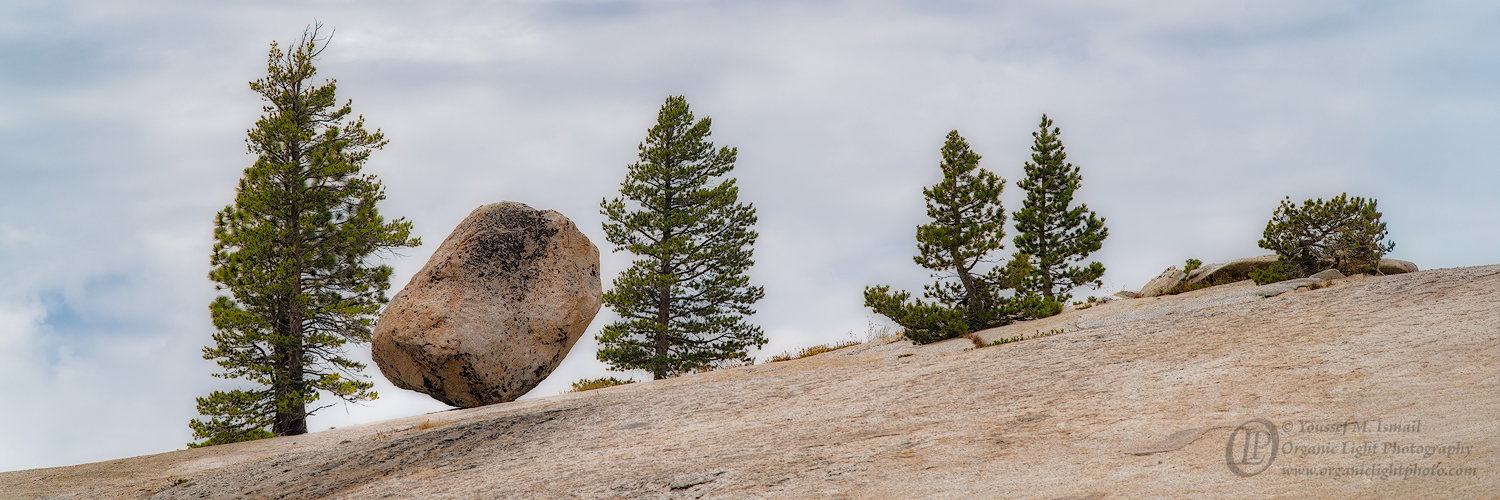
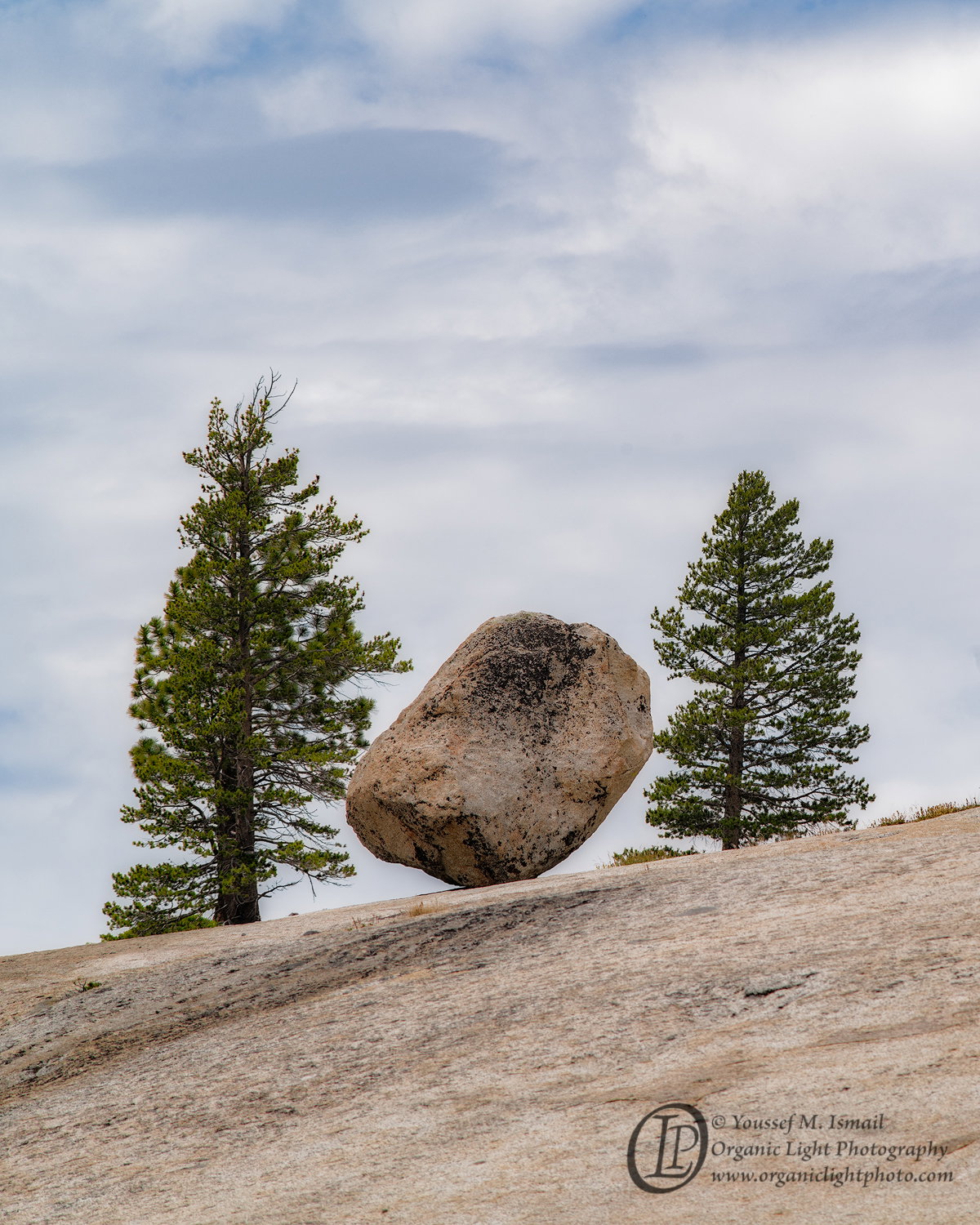
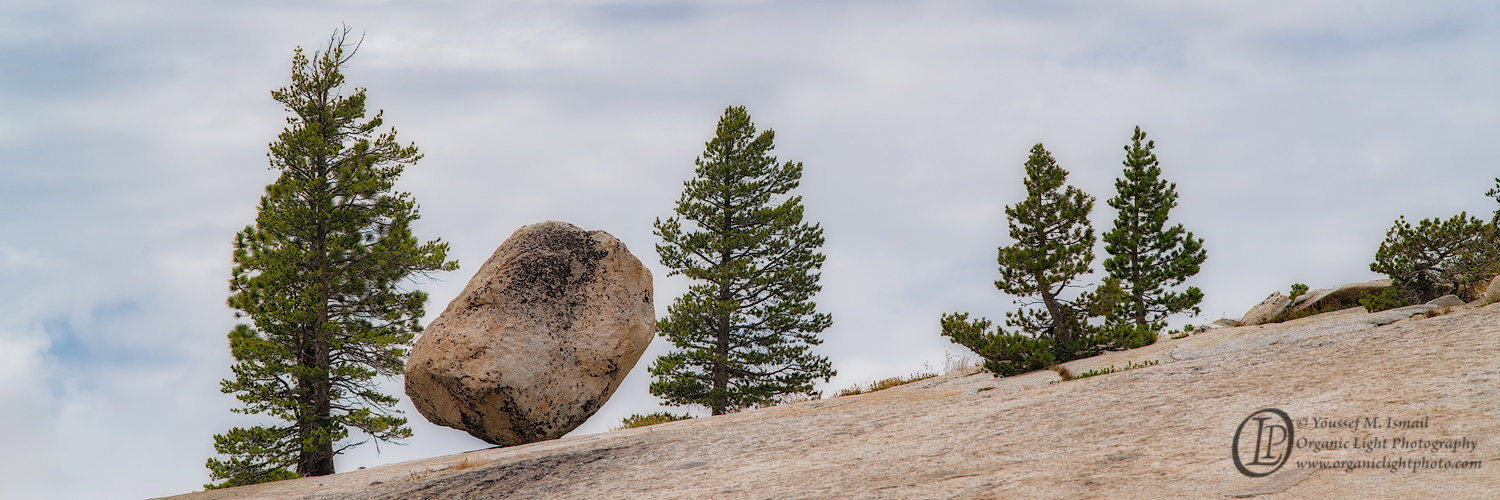
So my question is which version best portrays finding balance?
Any other feedback or comments are welcomed as well. Thank You.
Youssef, while both are quite dramatic, I’ll vote for the vertical, especially as you’ve position that boulder so well between the two trees. Both feel like that boulder can come tumbling down at any minute…Yikes! The long slope in the horiztonal is a good touch.
I like both, Youseff. It’s a striking scene. It feels like the kind of rock that would be featured in many pictures, but I don’t think I’ve ever seen it. Great job working the area to find something special and under-appreciated. It almost looks photoshopped in, like someone found a rock that’s small enough to pick up, photographed it, and put it in a larger scene to make it look huge!
Regarding your question and intention, I think the vertical works best for the title and concept you are engaging with.
What I like about the horizontal composition is that it feels more like a story that is still unfolding. Perhaps it’s the horizontal nature of a story-board (literally) giving us a sense of time or past, present, future, etc. Reading the story board though, the image is less about finding balance and more about anticipating its loss. It’s clear the rock would have rolled downhill, so we read the timeline from right to left (that’s unusual), but it also feels like the rock could tip to the right, which gives us a different direction of viewing and thinking about time unfolding.
I guess the short version of my rambling is that the horizontal image is much more uncomfortable, but not just because it has less visual balance. It’s the potential for the scene to change before our very eyes that gives it a different feeling altogether.
I prefer the vertical, I think it really emphasizes the “balance” aspect. And, maybe it’s just me, but this image made me laugh. Th vertical in particular. Just the sight of the giant boulder sitting there between the trees is so incongruous
Both are wonderful, in different ways! I prefer the horizontal because it feels more unbalanced which fits the story of the rock – which must be quite amazing.
I can also see another composition – the first with the frame horizontal and including a little less sky and FG and more to the left, which would show more of the darker area that suggests the path which the rock will take.
The sky also has some interest – I wonder about a B/W for the first with the sky becoming dramatic and foreboding.
Well seen in any event! I’ve also roamed around this area several times and never saw this amazing rock.
Wow, what a find! this is quite something. This is actually quite deceiving and mind-bending. To me, the boulder looks like it’s actually floating in air - helped by the lightness of the granite slab beneath it.
The balancing act of the boulder, or the balance of the composition? Ok, so it’s both and a play on the word .
I think no matter how you slice or crop this, the balancing boulder is the story (and a mysterious and compelling one! How did it get there??? (Glacier erratic, yeah, I know.) The vertical crop is compositionally balanced and really showcases the erratic well.
The pano crop also showcases the boulder. In this case it looks like it’s rolling downhill. Actually, the weighted balance makes it look like it’s rolling uphill actually.
Feedback on the pano, I would ask why crop so close to the boulder at the bottom? You mention all from the same original, so I’m guessing there’s more room at the bottom on the pano? Personally, I’d give it more room at the bottom, but still keep a pano format.
Like I was eluding, just fascinating no matter how you slice it. Well seen and captured Youssef
Well, Youssef, I like both images. I agree with @Lon_Overacker that at first glance it looks like the erratic is floating.
I also agree that the pano could use a little more of the slab, and you might consider cropping the pine on the far right.
Additionally, I think the mid tones need a bit of a boost in both images.
Having been at Olmstead many times, I do not recall ever seeing this rock. You have a unique image here, I think.
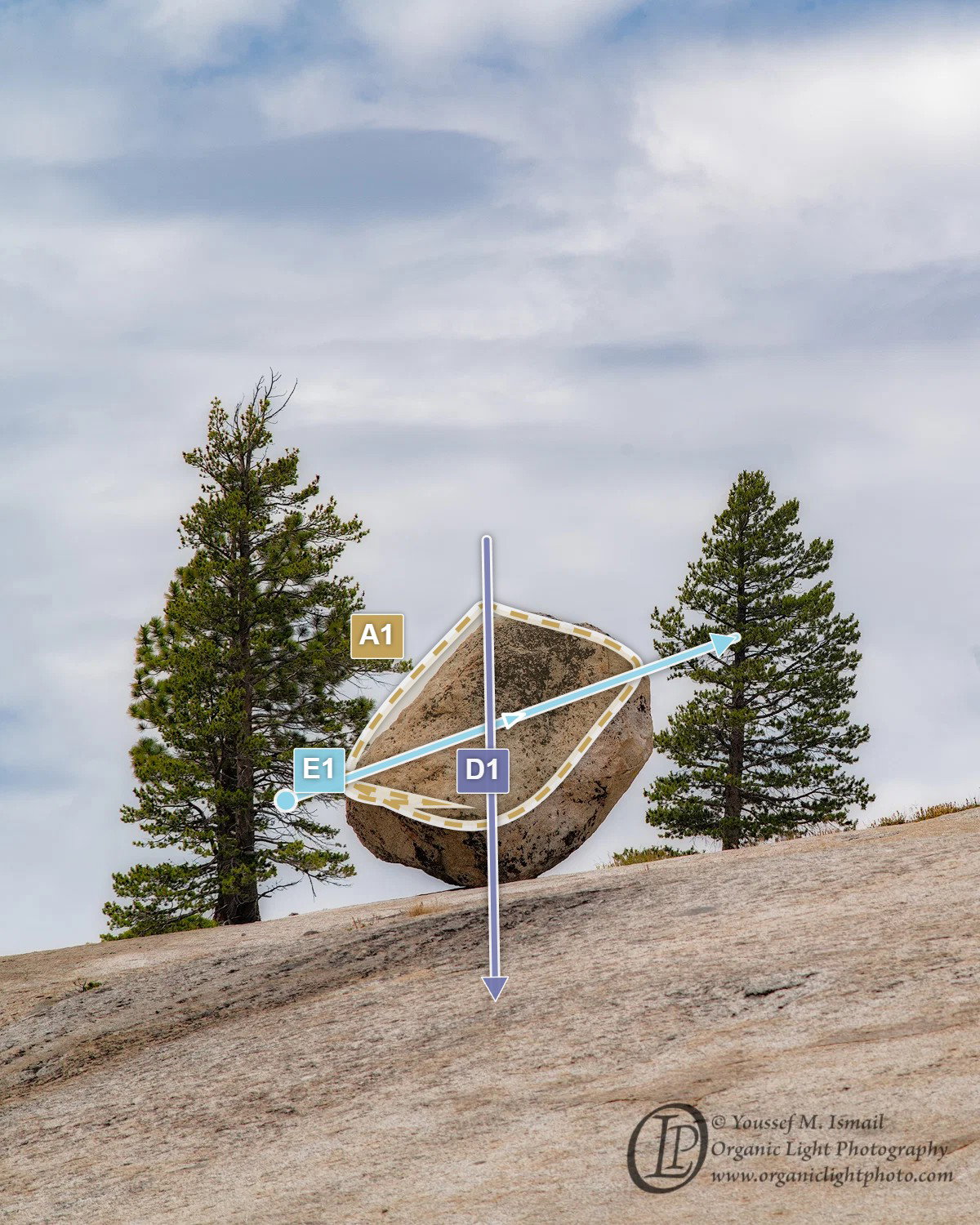
OK, so you and I both have studied physics, as have others here, I’m sure. It is apparent that the center of mass of the boulder is low and left, since that is the only way it can balance as it is. I can see a bulge in the rock there which mean greater mass there. Granite, being rather homogenous generally, this boulder may have slightly greater density in the lower portion, but there is no way to verify that. In any event, it’s very mysterious, and causes one to pause in thought.
To think that this huge rock was carried by a glacier and then left balanced after the ice melted, on a previously glaciated slab of granite is quite remarkable.
Thanks for sharing such a thought provoking and nice image!
-P
@Preston_Birdwell, I have studied physics and you are on target. The shape of the erratic is nearly rectangular in shape. Where E1 and D1 cross gives approximately the center of mass of this granite Erratic which is most likely homogeneous and the center of mass is essentially over the contact point where the erratic meets the hill and gravity is pulling the center of mass right through the contact point.
It looks elusively unbalanced, I think because of the slope it is sitting on.
@Lon_Overacker and @Preston_Birdwell I will go back and look at the original file before cropping if I can get more of the slope on the left side I will try. But I recall cropping as I did the pano to keep the two trees from being chopped off at the top.
Visual Notes
[A1] Rectangular Shape - corner to corner from opposing corners will generally give the center of mass
Might be a case where employing the “tranform” tool could help. It’s not everyone’s cup of tea, but if one can alter an angle by just a couple degrees to retain some other element in the frame, it might be worth looking in to.
I love the optical illusion; at least to me; of this boulder seemingly floating in mid air. Usually I tend to favor horizontals, but in this instance I am all in with the vertical as it seems to have great balance with the two trees flanking the glacial erratic. I also quite like those clouds in the sky as well. Very nicely done; no suggestions from me.
I first viewed this image on my phone, and was amazed by the illusion that the boulder floats in the air. It looks like an action shot, where you caught the boulder as it came bounding over the edge. Often that effect is lost for me once I can study an image, but not this one. As I would flick the photo up and down on my phone it still looked like it was in the air even though I knew it wasn’t. (The effect is much less on my computer monitor.)
I like the vertical because it shows that illusion the best, but agree the horizontal is a more intriguing composition. For that one, I’d be tempted to add more space at the bottom as @Lon_Overacker suggests, and to crop off the right just past those two smaller trees.