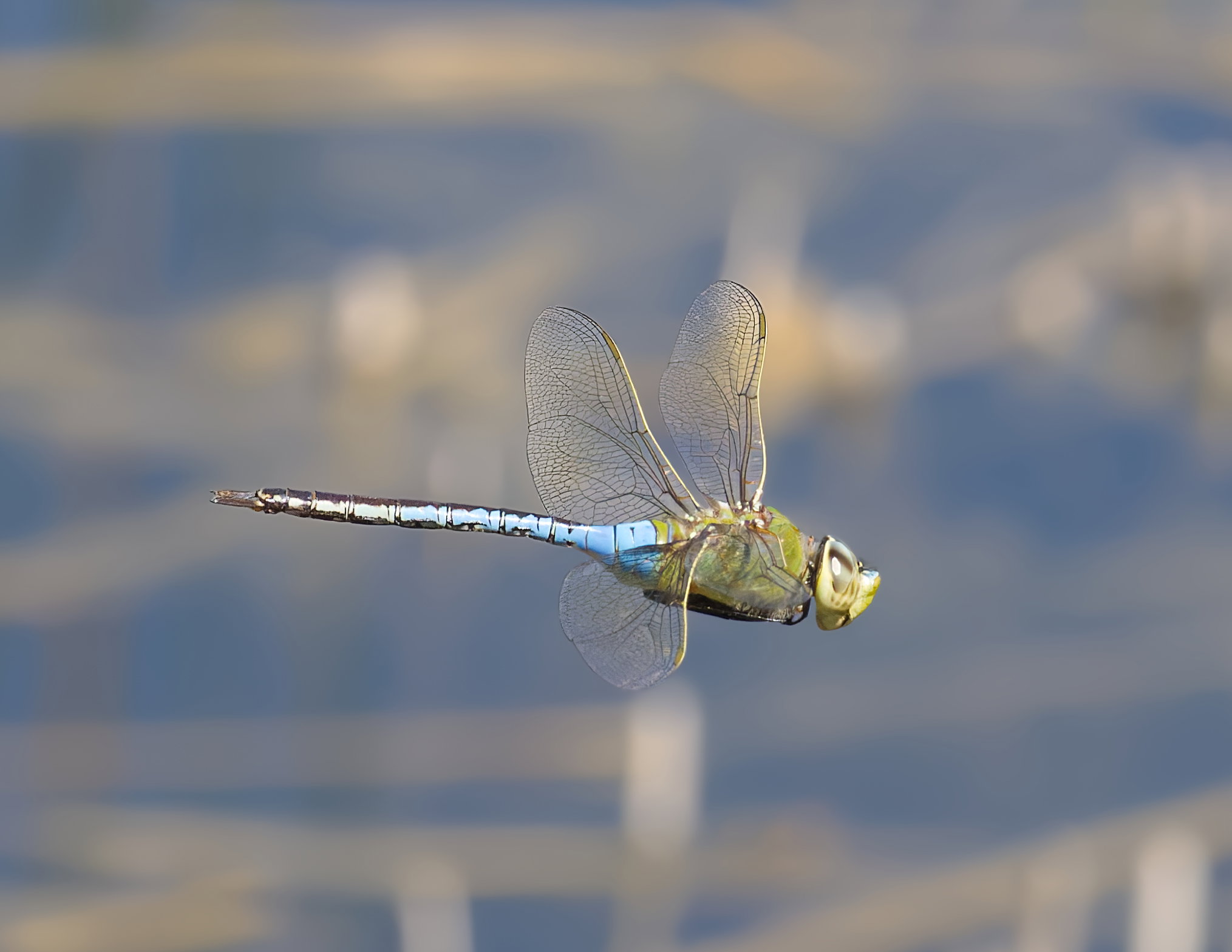
The photographer is looking for thoughtful feedback on the image as a whole, especially around the areas noted below.
Feedback Focus: Artistic / Expressive
About This Image
I give you our old friend, the Common Green Darner. This animal might be the ideal starter dragonfly. Big, colorful, abundant, and often flying in a straight line. Does it get better than that?
All dragonflies have fascinating natural histories. In the case of CGD, migration is the main thing. We have multigenerational migration, rather than a single individual completing a round trip. A southern generation moves north in spring, breeds and dies. Then a new northern generation develops during summer. Many of those adults migrate south in late summer and autumn. A southern resident generation bridges the winter and produces the next spring migrants.
Feedback Requested
My goal in nature photography is to steadily improve my photographic skills and tell meaningful stories about natural history.
Russ, the catch of the Darner in flight looks great. The detailed veins in the far wings are a fine addition. I do think the entire Darner could be burned-in slightly, with more burning-in of the bright verticals in the background so they don’t get as much attention.
Russ: You are the dragonfly flight shot master and this one is no exception. I might be tempted to remove some of the brighter OOF elements in the BG, especially the vertical ones directly below the darner and the one in the RLC. >=))>
A beautiful job on the dragonfly, Russ. I agree with others that the background could stand to be subdued a touch, but the dragonfly itself is awesome. As usual, you’ve included some very interesting natural history that is very much appreciated.
I took the liberty of downloading your image and working on the background in LR, mainly selecting it and moving a bunch of sliders (highlights, contrast, clarity, texture, dehaze) to the left quite a bit. That left me with a rather bright patch through the top of the far wing, so I selected the dragonfly and intersected that part of the wing with a radial gradient and brought down the highlights and whites a bit.