The photographer is looking for generalized feedback about the aesthetic and technical qualities of their image.
Description
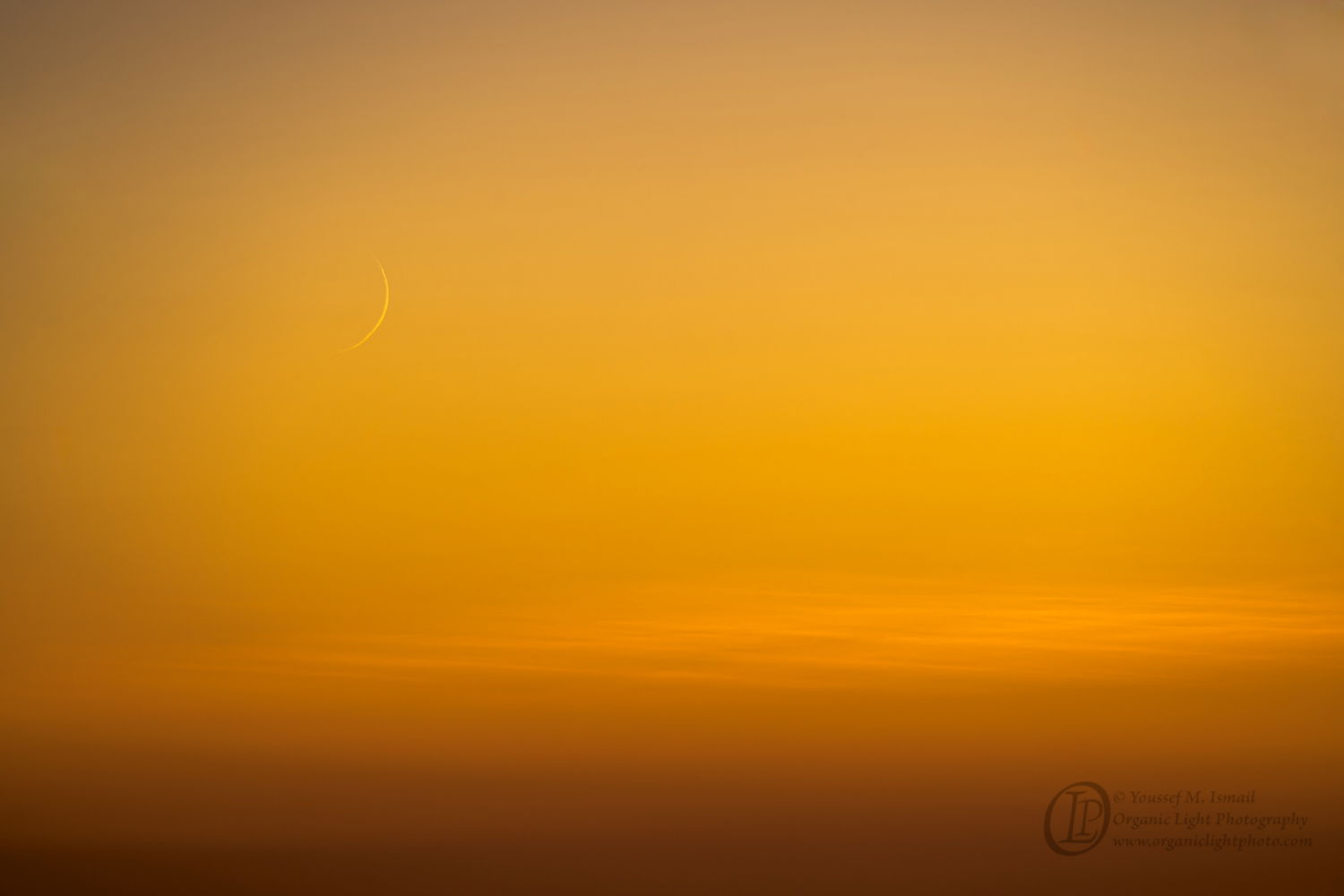
Another month has passed and time to go out and catch the moon Once Again. Something about this frame of the several I made earlier this evening stood out to me. Perhaps it was the wisp of cloud in the lower part of the frame. Maybe it was the lone sliver of light in the thin crescent on 2.8% illuminated at the time of exposure.
Specific Feedback
Any thoughts on this would be much appreciated.
Technical Details
Nikon D850, Nikon 400mm f/4 MF at f8, 1/20 sec, ISO 100
Processed in ACR and PS, with minimal adjustments.
Critique Template
Use of the template is optional, but it can help spark ideas.
Vision and Purpose:
Conceptual:
Emotional Impact and Mood:
Composition:
Balance and Visual Weight:
Depth and Dimension:
Color:
Lighting:
Processing:
Technical:
When I clicked on the thumbnail, I didn’t even see the sliver of moon. Imagine my delight when the photo opened and there it was.
So beautiful, and so subtle. The most delicate moon ever.
You did it again!! Wonderful – I love the colors you got this time! The subtle hints of clouds you so often find are marvelous – a link between the atmosphere that envelops us and the universe out there.
I got busy and neglected to even check for clear skies, which we probably had.
What a stunning photo! Absolutely fabulous. Like Julie, I also didn’t notice the moon until I opened the larger version. Could you tell us what time of day it was. And like Glenys, I am gobsmacked by this photo…
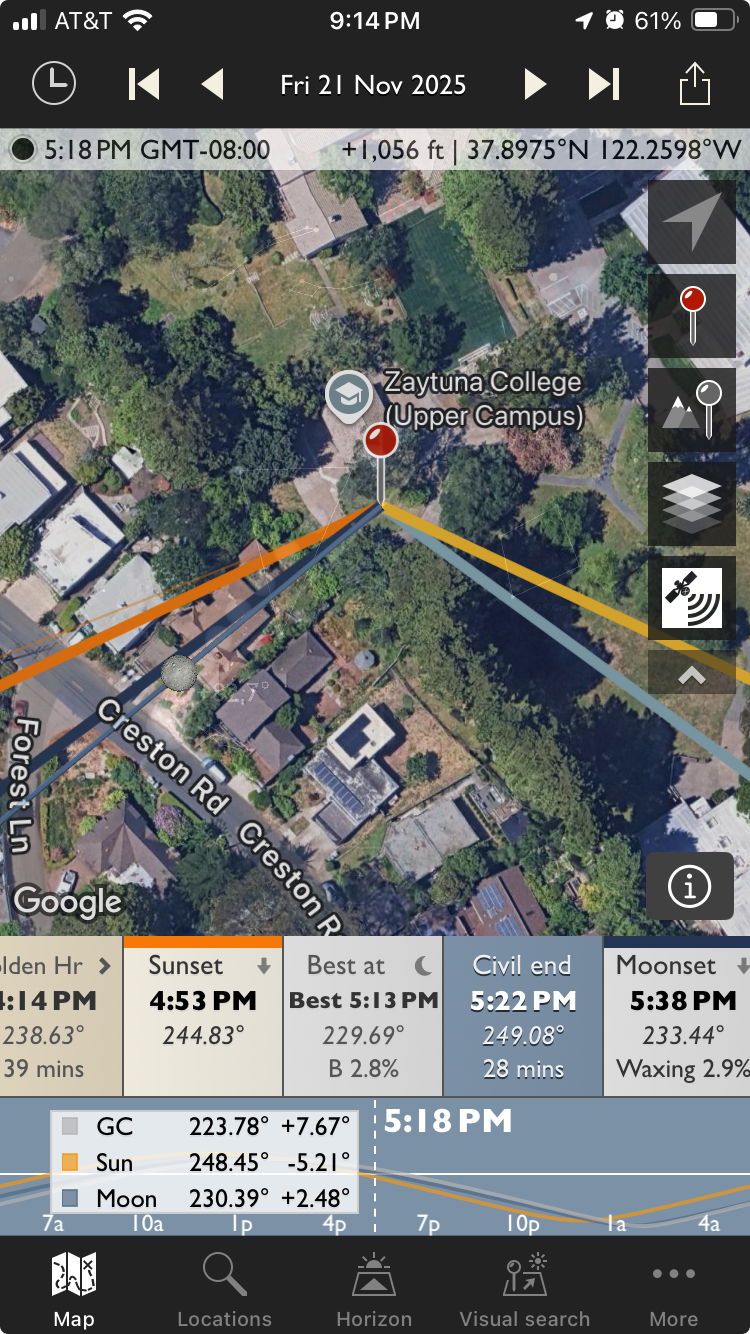
@Tony_Siciliano , it was taken on Friday November 21 that particular frame was at 5:18 pm. I was in the Berkeley Hills just off of Grizzly Peak Rd. December 20th will be the next day a new crescent will be back in the post sunset sky.
Check out The Photographers Ephemeris, https://app.photoephemeris.com. You can get everything you need for crescent moons – except the weather. The waxing crescent will be shortly after sunset a day or two after the new moon, and the waning crescent shortly before sunrise a day or two before the new moon.
This is the very tool that I use. In fact when TPE first came out, it did not have crescent moon visibility information. I had previous correspondence with Stephan Trainor, the creator of TPE, and I gave him the information needed on the the science behind how to predict crescent moon visibility. He gracisouly added into the application.
Wow – I am very impressed! Thank you for stepping up with the idea! And now I’m curious what is the information on the science behind the visibility prediction? I’m not phrasing that well – I mean, I know there is orbital data that predicts everything about the phases of the moon and planets, but — well – I don’t even know enough to ask the question…
Astronomers have been trying to predict when new crescent moons become visible for thousands of years, from the Babylonians, and Hebrews to the Indians to those in Muslim Age. No one was ever very successful at predicting it. Then in 1997 B.D. Yallop, an astronomer at the HM Nautical Almanac Office introduced a paper and method to predict the probability of sighting a new crescent moon any where on earth on the day of conjunction, day after conjunction and second day after conjunction. It changed everything. You can read the paper for free HERE. It breaks down the surface of the earth into 5 zones: A - easily visible to the naked eye, B - Visible to the naked eye under perfect atmospheric conditions, C - visible to the naked eye after finding it with an optical aid, D - only visible with an optical aid, E - Not visible. Its all based on the the astronomical calculations of the moons parameters on any given day. It has been a very good model for predicting its visibility. If the sky is clear, or at least having a good enough window between clouds, I have found the predictions to be solid. TPE uses that model to give visibility predictions. For this photograph, the SF Bay Area was in the B zone and we did have great conditions and it was visible. This is where I was on Friday and TPE was predicting I was in Zone B.