The photographer is looking for generalized feedback about the aesthetic and technical qualities of their image.
Description
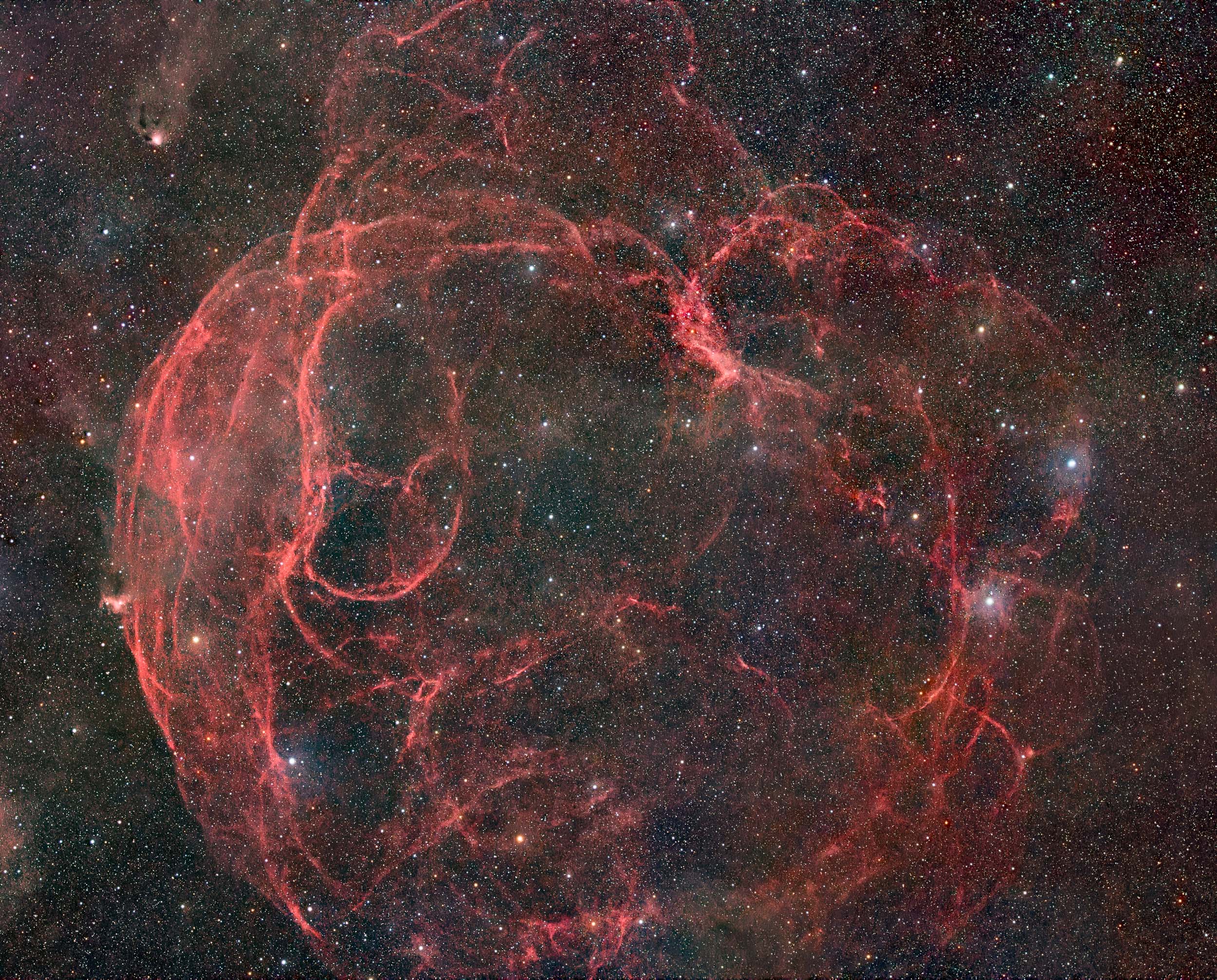
Another one from the recent stretch of clear dark nights. But clouds came in halfway through the shoot and I only got 158 1-minute frames, or 2.6 hrs of acquisition – about a third of what I had hoped for. This is a busy region on the edge of the Milky Way and a very dim structure so I could probably get a cleaner result with more acquisition time. This is with the reducer, giving a 280mm field of view, and trimmed a little from each side. I’ll try to repeat it with a 2-frame mosaic.
Specific Feedback
All comments welcome!
Technical Details
I’ll spare you – but everything has gotten so much easier with PixInsight in the last few years. After the integration (stacking) of the source files, it took about an hour of fiddling with about 11 processes in PixInsight.
Critique Template
Use of the template is optional, but it can help spark ideas.
Vision and Purpose:
Conceptual:
Emotional Impact and Mood:
Composition:
Balance and Visual Weight:
Depth and Dimension:
Color:
Lighting:
Processing:
Technical:
And the hits keep coming! Neat deep space image, Diane. One thing I find interesting about these images are the number of stars present-space is not empty!
Thanks, @Gill_Vanderlip and @Allen_Brooks! This is the remnant of a supernova. All these nebula objects are relatively close to us – in our own galaxy – as are all the stars we can make out with backyard equipment. Occasionally there will be a tiny distant galaxy that is large enough to be recognizable. Several other nearby galaxies that we can get a good view of without a lot of magnification are Andromeda and the Large and Small Magellanic Clouds in the southern hemisphere. There are more distant ones that tax the most serious amateur equipment but can be resolved to a reasonable extent with clear dry air.
The whole universe is an unbelievably huge interconnection of galaxies and groups of galaxies that are on the surfaces of immense bubbles. Lately (from recent telescope observations) there has been a lot of speculation that things we have taken for granted about the universe might need revision. The smallest objects we can begin to resolve with the new space telescopes are very far away. The light from the most distant to date has been traveling about 13 billion years, and is a window into the early universe – about 300 million years after the Big Bang. It’s a good time to be a cosmologist.
Thanks @Ryan_H! @Allen_Brooks, there are an estimated 100-400 billion stars in our humble galaxy. And an estimated 2 trillion galaxies in the observable universe.
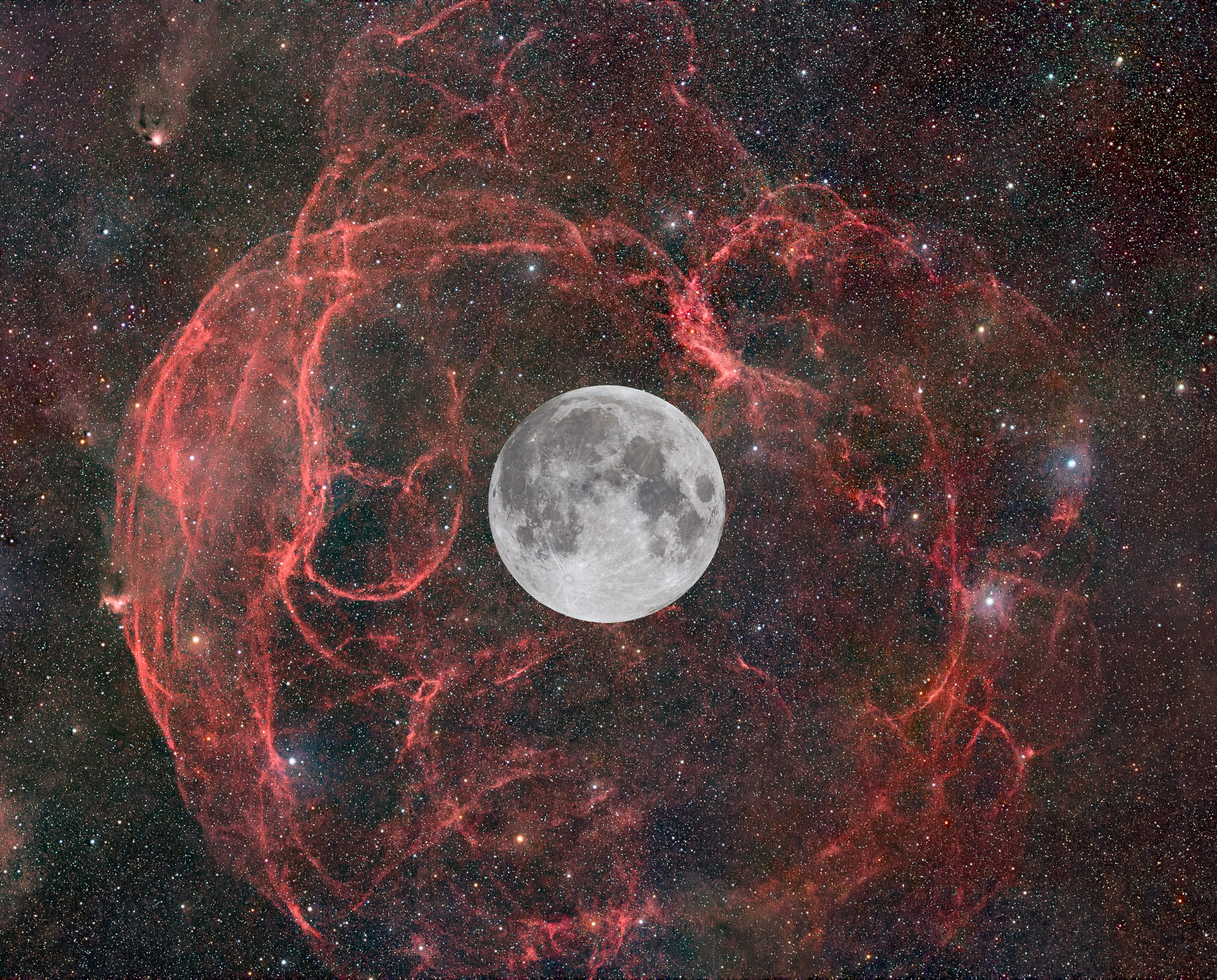
This is one of the larger structures we can observe. I’ve added another image to show its size relative to the moon.
Gorgeous, Diane! Your efforts to capture these stunning astro images laudable.
Here’s little more on the nebula from Wikipedia…
The nebulous area has an almost spherical shell and a filamentary structure.[2] The remnant has an apparent diameter of approximately 3 degrees, an estimated distance of approximately 3000 (±350) light-years, and an age of approximately 40,000 years.[3] At that distance, it spans roughly 160 lightyears.
It is believed that the stellar explosion left behind a rapidly spinning neutron star known as pulsarPSR J0538+2817 in the nebula core, emitting a strong radio signal.
Thanks, @Preston_Birdwell and @Glenys_Passier! Fascinating additional information, Preston – I love what we can get with a quick web search these days.
Diane: This is the kind of photography I’ll never do but I so much enjoy the images you’re able to produce. John Calvin once said that the finite cannot comprehend the infinite but you’re making it a little easier. >=))>
Wonderful capture. I feel like the stars could be a bit brighter to match the brightness of the nebula, or perhaps fewer small stars so that the background does not look so bright, if that makes any sense. It is amazing what we can capture with the equipment available today from here on Earth.
Thanks, @Bill_Fach and @Youssef_Ismail! I agree that the stars could be a bit larger here. It’s frustrating that they usually need to be reduced but it’s hard to guess by how much until it’s too late. It’s not difficult to go back and redo, but then you have to guess how much you reduced them the first time.