SOOC Caribou (+revised)

Revised Version

Revision 1 (latest)
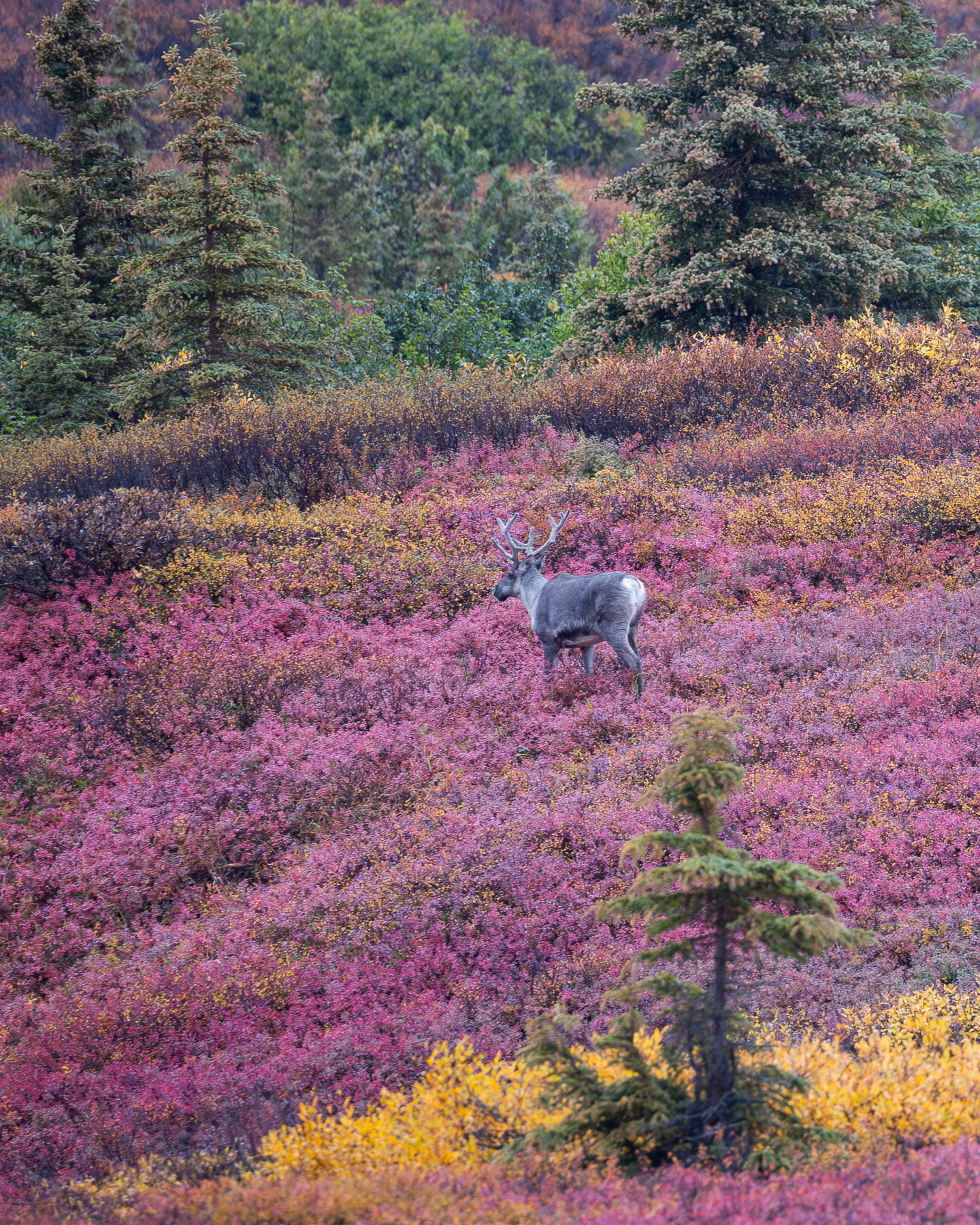
What changed: This is actually a different frame, but I thought the posture of the caribou was better, more still, maybe a tish more of a head tilt in my direction. Significant crop (1/3 of original scene), and with this one, I did some contrast adjustment, etc. Still no saturation, but a tish of dehaze, which impacts saturation. I figured as a wildlife image, the breadth of scene was not ideal.

Added after receiving feedback from the community.


Original Version

Critique Style: Standard

The photographer is looking for thoughtful feedback on the image as a whole, especially around the areas noted below.

Feedback Focus: Technical Help

About This Image

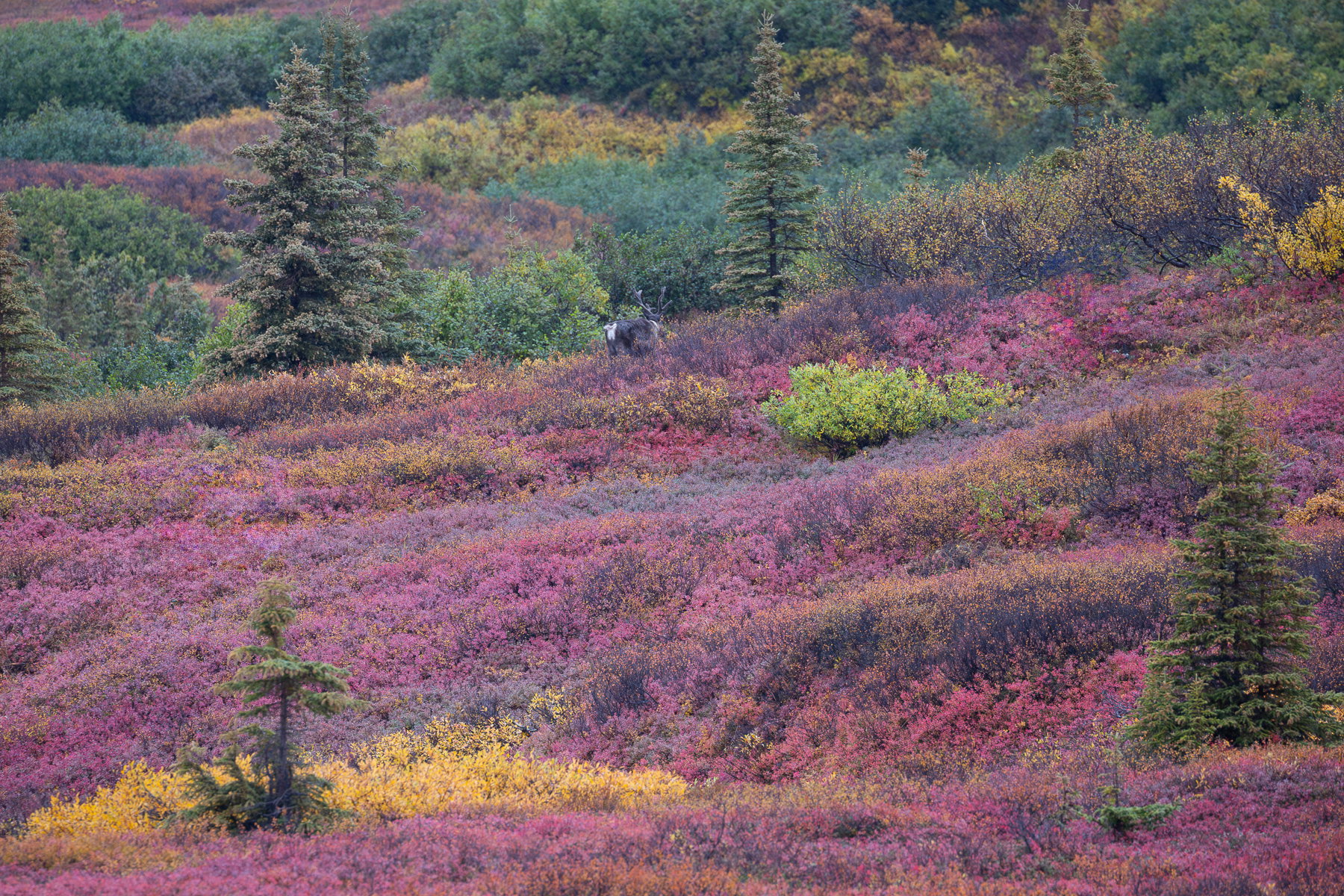
This is not a very good wildlife image. The caribou are all running away, showing us what they think of our presence. Nonetheless, I wanted to share it partly to show how amazing the background and environment are for photographing wildlife in September in Denali National Park. This is almost straight out of camera. Part of me is like, dang, those caribou messed up a perfectly good intimate landscape!

This is a raw conversion to jpeg with just NR and slight exposure lift in LRC

Feedback Requested

As noted, I’m mostly sharing for info purposes, but in case I ever go back (or go to Botswana or something) I would love thoughts on the following:

  1. What strategies do you have for getting in position with wildlife without disturbing them or endangering yourself?
  2. What’s you default choice of ISO, shutter speed, and aperture when shooting wildlife at a distance of 50-100 yards?

Technical Details

Canon 5D3 with 100-400mm at 400mm
ISO 1250 (which is high for that camera), f/5.6 (I know!), 1/60s (shocked it’s a clear as it is with bean bag on a bus window)
All I did was noise reduction and a slight increase in exposure

Marylynne, first of all what absolutely stunning colors. Amazing! I share your pain with the caribou turning away at just the wrong time. I think I have an entire portfolio of animals hindquarters, partial animals, animals that have disappeared, etc. In regards to your question regarding the camera setup for wildlife I will tell you what I do. My caveat is that by no means am I an expert but I love wildlife photography. I shoot on manual with auto ISO. I don’t actually limit the ISO beyond the camera limit but I do keep an eye on it and try to keep it below 5000-6000 if possible. Fortunately there are lot of ways to clean up noise if absolutely necessary. The key for me is to have a fast default shutter speed, usually 1/1600 or faster. When I miss shots it’s because I’m too slow. You can always decrease your shutter speed if an animal is just sitting there. My default aperture is as wide open as the lens lets me go. Again you can change the aperture if there’s not quick action. I also shoot wide because there is so much flexibility with cropping with the new cameras. So overall,my default us for something that is just going to flash across my view and be gone. Always be ready to shoot quick (with the camera) and fast (with your shutter speed) If you’re ready for that you can adjust your settings for other things at your leisure.
I am always trying to improve my wildlife photo preparation skills and am looking forward to what the real experts say.

1 Like

I wish I could help you regarding approaching wildlife and settings to use, but I’ve taken about 3 animal images in my entire life. So you don’t want any advice from me.:rofl:

Shame those animals had to intrude upon a perfectly fine landscape. The colors are quite amazing, but I have to ask. Are they accurate? Not that they have to be. That’s all part of the creative process. I assume it’s blueberry, but almost looks heatherish. Guess I just made up a word. That said, a beautiful photo.

Marylynne: I shoot wildlife if the opportunity presents but rarely seek it out. Part of my frustration is getting good light on the subject in an interesting pose. If these guys were facing you it would really be killer but with all of them worst side forward so to speak they almost spoil the scene. One thing you might consider is to put a little more attention on just the middle bull -which seems to be ignoring you the least- by cloning the others away completely. It’s still a butt shot but less egregious than the others. The colors are spectacular and don’t look out of line to me considering my memory of them on our trip. >=))>

Thanks for replying, @timothy3, and @Michael_Lowe, and Bill.

Timothy: I think NR has improved a lot in the last decade or so. I used to the ISO on my Canon 7 D at 800. I think I’ll try the auto ISO approach. I had two bodies on the trip: 5d3 with the 100-400 and the 5D4 with 24-105mm.

Question: you mention shooting wide open and shooting wide, so what lens do you typically use? I considered using my 24-10mm and cropping because the body and lens are just so crisp most of the time.

Michael: The colors are pretty accurate. Shot raw, increased exposure a tish, did NR and exported to JPEG. I wanted to share it with no color enhancements to show just how colorful the tundra is: blueberry, maybe some kind of heather or perhaps lowbush cranberry which can be purplish, Bear berry (more red) and I think dwarf birch (the gold vegetation). So many berries there: crow berry, lingonberry. Bears need to get fat somehow without huge salmon runs. Caribou and moose are harder to catch!

Bill: I’m an opportunist with wildlife. It’s too hit or miss for me, and it’s a different kind if creative experience too, at least in my case. I got a few really good bear shots I’ll share next week.

ML

Marylynne,

First of all, I LOVE the colors - the scenery you’ve captured is beautiful and quintessential AK Autumn on the tundra. Beautiful image.

But now I want to challenge your wildlife paradigm… Were you in Denali on a “Wildlife” workshop, or on a general “Alaska, let’s go to Denali” workshop (sorry, I’m not judging any workshop… just trying to determine what your intent on this trip was.)

I say that because, unless you’re on a wildlife, and animal specific workshop - like bears at Brooks Falls, or Kodiak, OR Bald Eagles at Chilkat, then for most purposes you’re photography is going to be mostly scenic and wildlife will be a bonus. IMHO, if that’s the case, then I think you should default to landscape settings and then be prepared to pivot to wildlife settings.

My only time at Denali was 1993… and we rode the yellow “campers bus” out to Wonder Lake. The campers bus was great because half the seats were taken out for backpacks… Me and my buddy Kyle set up our tripods in the bus! One brown bear, a moose and a couple caribou from a distance… Not what you call a wildlife adventure… but we had the gear and waited for the opportunities!

I guess what I’m trying to say is that you need to be set up for whatever your goal of the trip is. I’m guessing “wildlife” was more like bonus material and not the main agenda. If that’s so, then I would have foregone the “wide open” high shutter speed and shallow dof field settings, and focus on sharpness, depth of field - on a tripod… And for this image specifically, those caribou aren’t trotting at breakneck speed… a shot at f/16, 1/60th of a second would have recorded the scene just as beautifully, but more sharp front to back. IMHO, this is not a wildlife image, this is a landscape image of an environment that happens to contain some wildlife.

I’m no expert… but shooting wildlife in AK is much easier with an 800mm f/4 and a 1.4 and 2x converter…

Sorry for the novel. I love this image as a landscape. Unfortunately the wildlife settings don’t work as well for the landscape image.

1 Like

The colors are wonderful, Marylynne.

When seeing wildlife is a possibility, I put on my longest lens and set the camera much the way that Timothy does. I’ve missed some good shots because I had a wide-angle lens on the camera when wildlife made an appearance. The landscape isn’t going anywhere. If I see a landscape shot I want, there’s almost always time to change lenses and settings.

Although I use auto ISO when wildlife may be around, it tends to blow out the highlights. If there’s time, I’ll shift to manual.

Marylynne, lots of great suggestions. I definitely agree with Lon that you set up your camera for what you’re planning to shoot and pivot from there. I also agree with Don about using a long lens. I like to shoot mostly wildlife and use the canon RF 70-200 f2.8 and the RF 100-500 f4.5-7.1 almost exclusively. I realize that for me stating shooting wide open and wide means something very different then shooting landscapes or macro. For me wide is as close to 70 or 100 on the two lenses respectively and as wide open as those lenses will allow me to go. I tend to hike around a lot and shoot handheld. For where I have gone the wildlife for me is too unpredictable for me so I do not use prime lenses. (They’re also too heavy and unwieldy for me if I’m in and out of a vehicle a lot and shooting handheld). For a trip like you mentioned to Botswana I have used the 100-500, or equivalent. Almost always in the space of 15-20 minutes I’ll be going from 100 to 500 multiple times, The wildlife (and birds although that is not my emphasis) are far away and then something very close. It definitely keeps you on your toes. The unpredictability and uncertainty are both the delight and the great challenge of wildlife photography.

1 Like

An awesome color palette, Marylynne. Too bad the caribou had to mess up the scene. There’s been some great discussion above and I can’t really add anything to it except to say you should hold onto this image and throw it in a folder labeled (get creative with processing) or something similar. This has huge potential for being turned into something impressionistic.

1 Like

Thanks, everyone, for the tips and feedback.

The trip was a photography workshop in which most of the attendees (just 7 of us), were into wildlife. I was kind of the lone landscape, small scene, abstract gal. We had the Camp Denali Bus all to ourselves, so we each had our own row (4 seats) and could shoot out of either side of the bus. One day, I took the back row and had a “caboose” area for my tripod. My best wildlife shot (will share later this week) was from that position.

@Don_Peters: I was shooting with two bodies, so I had the 100-400mm on one body for wildlife, but I hadn’t really set it up with auto ISO or a high shutter speed. And we didn’t see anything but beavers the first day or two. The wildlife body was still set for Aperture priority from when it was my primary camera, so I just jacked up ISO to get the shutter speed up “in the moment.” It’s a Canon, so it’s got Custom 1, 2, 3, and I have each of those set up for different things, but since it’s now my back-up body, I couldn’t remember what they were. The first two days were just a mess for me on the wildlife front, but I did get better stuff later. My plan though is to set up that body as dedicated " oooh, look, wildlife" body.

@timothy3: Thanks for clarifying what you meant by wide angle. Funny how relative these things are. In landscape terms, wide is 15-24mm. 100 is my starting point on what I’m going to dedicate as my wildlife camera/lens combo. I think on my next trip where wildlife is part of the appeal (say Yellowstone or something), I’ll be more careful to dial in a default on the body mounted with that lens.

@Lon_Overacker: It was a Denali fall color and wildlife workshop, so a dual focus, but certainly not Bears at Kodiak kind of focus. We were beyond the closure and had the park almost to ourselves for the last season of the road closure and last week of the park being open. I was mostly into foliage. Others wildlife. And I did have two bodies. I just hadn’t shot wildlife in so long that I hadn’t dialed in the settings for the body that had the long lens. My priority was not wildlife, and it shows. I did come away with stuff I like a lot, so this is “more of a reacquainting myself for next time” kind of post. My last time in Denali, I witnessed a mating grizzly threesome from 50 feet, so after that, caribou and moose 50 yards away were kind of an afterthought.

Thanks again all. I’m grabbing my back-up body now and setting up for sudden wildlife opportunities. Also setting the C1, 2, 3 options on my main body. I used to do that all the time: C1 was macro with mirror lockup and fully manual exposure, C2 was wildlife with a higher ISO, shutter priority, C3 was bracketing exposure for hdr, which tells you when I was doing all of that! I specialized over the years and stopped using all of those custom presets.

EDIT: C1 on both cameras set up for “action”

ML

The original poster added a revised version of their image.