Revised Version
Revision 1 (latest)
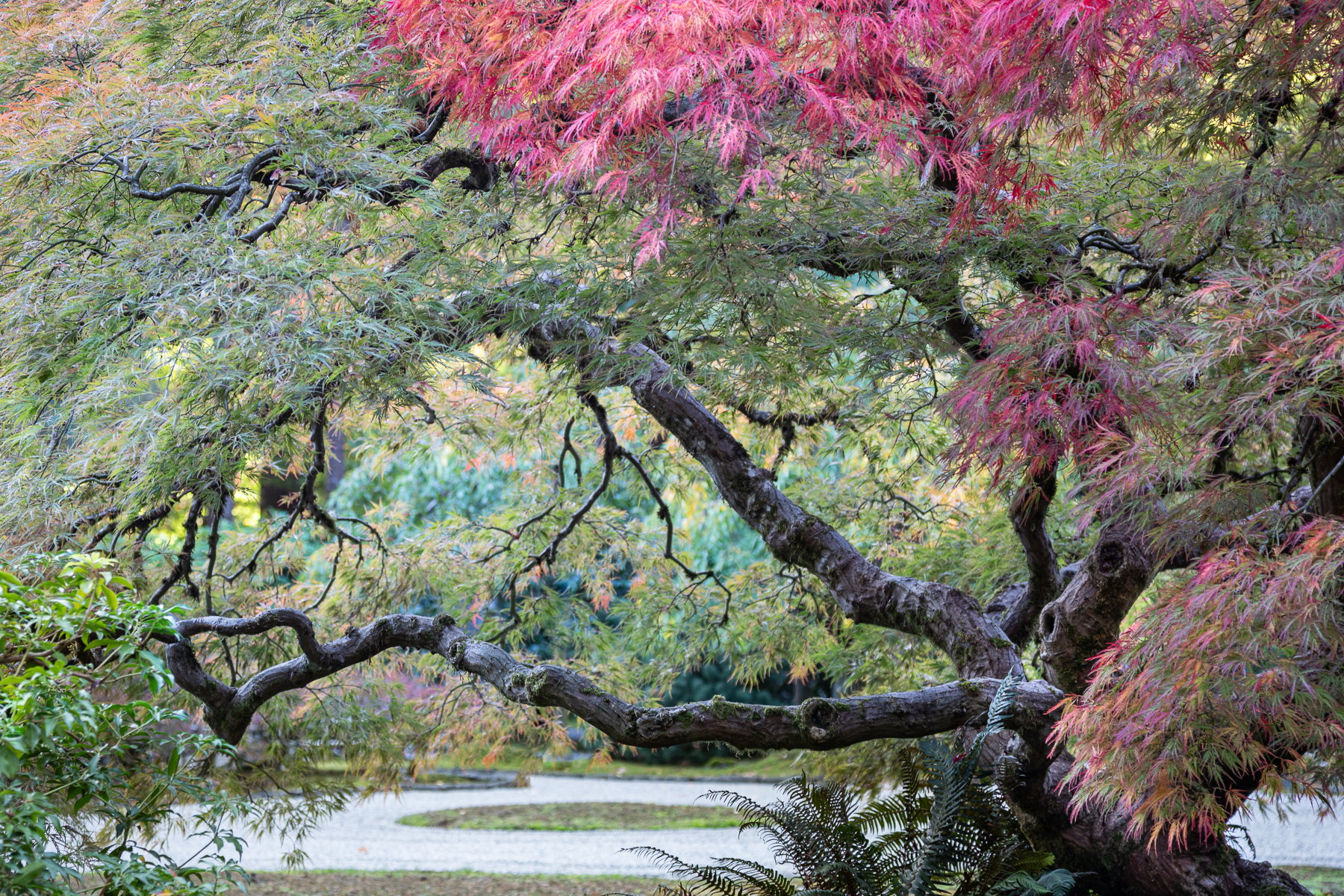
What changed: Healed over some distracting light bits and burned upper left corner.
Added after receiving feedback from the community.
Original Version
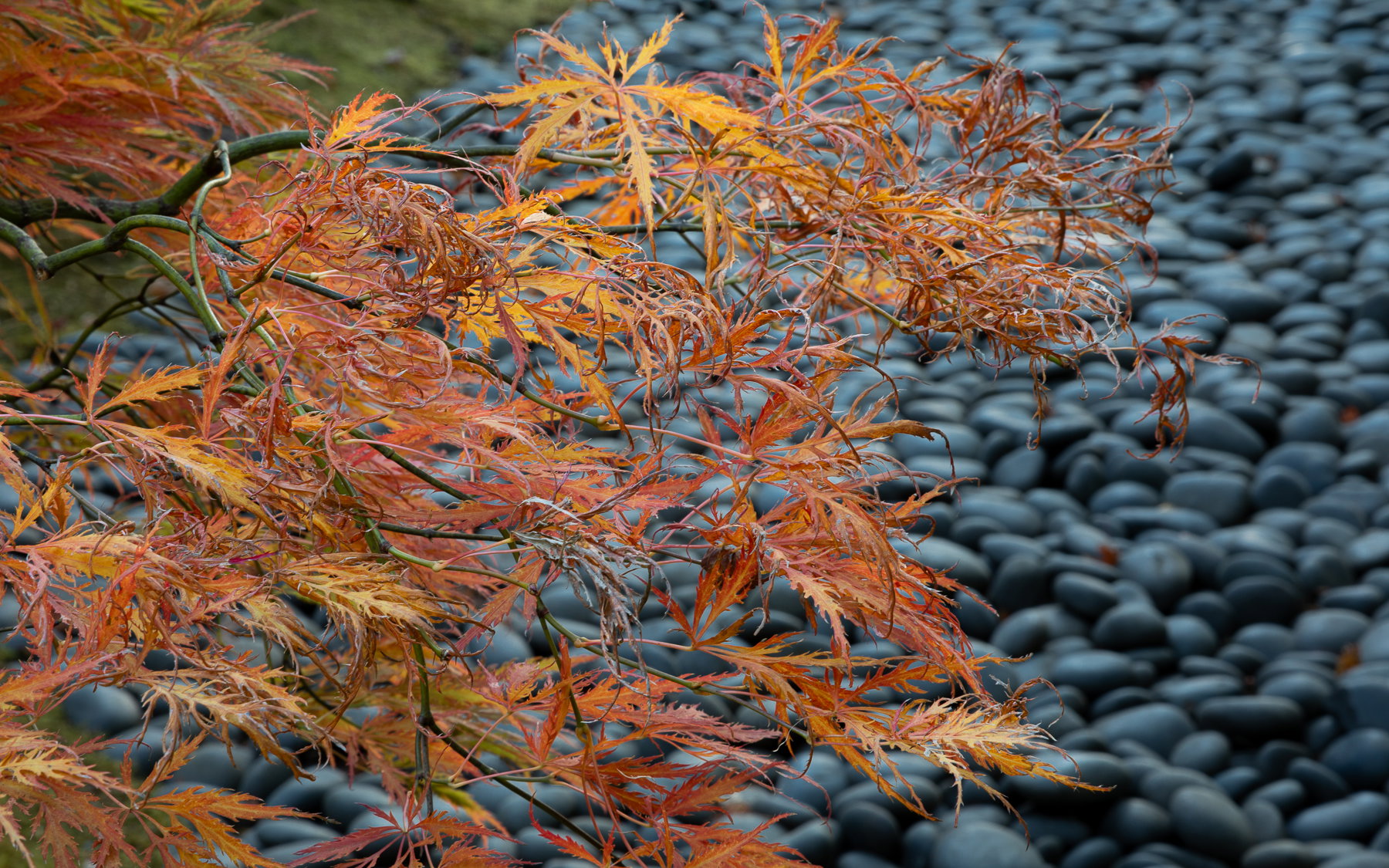
Maple with Rock

Maple Framing Flat Garden
The photographer is looking for deeper feedback connected to their intent, creative direction, and specific questions.
What I’m Trying to Express or Explore
I have been enamored with the Portland Japanese Garden for decades, and this year, at Igor Doncov’s suggestion, I’m exploring how to apply Japanese Aesthetics to my photography there. I shared a set of images using the muted color palette of traditional Japanese painting a few days ago. You can see those here: Traditional Japanese Muted Color Schemes
Now I’m sharing a couple of images with some of the other principles of Japanese Aesthetics: wabi-sabi, asymmetry, and framing a scene.
These two images were made with the intention of exploring how asymmetry and imperfection in the leaves/trunks can still create a sense of balance or harmony between different elements. The hard/soft, rock/plant, near/far elements, impermanence, along with asymmetry and organic imperfections are connected to what both destabilizes and balances us. It’s the wabi-sabi of real life.
Where Feedback Would Help Most
As always, I’m open to any and all feedback. In particular, with these two, I’m wondering the following:
- Aside from the subject matter itself (clearly Japanese maples), do these photographs have a more Japanese aesthetic than some of my other work?
- Of the two images, does one seem more successful considering my vision? In other words, does one have a more uniquely oriental art feeling than the other?
- Is there anything about my approach here that feels like a traditional Western Landscape approach that undermines my efforts to apply Japanese aesthetic principles?
As always, I appreciate the time it takes to offer critique. Please know I value it greatly.
ML
Technical Details
Canon 5D4 with 24-105 at 105mm and 93mm respectively
ISO 200, f/20 for the first, f/5 for the second (might have been better to do the opposite?), 1 sec and 1/15sec