
Critique Style Requested: In-depth
The photographer has shared comprehensive information about their intent and creative vision for this image. Please examine the details and offer feedback on how they can most effectively realize their vision.
Self Critique
Which of the two versions speaks to you more, if either ?
Creative direction
I stumbled into this technique through the kind of accident that only photographic incompetence can deliver.I stumbled into this technique through the kind of accident that only photographic incompetence can deliver. I had set out one morning with grand plans of capturing birds in flight, except the light had other ideas and was being thoroughly uncooperative. Faster shutter speeds were off the table unless I was willing to push the ISO into territory my mother would not have approved of, and since she did raise me with at least some standards, I kept the ISO modest and gracefully resigned myself to the photographic equivalent of giving up: hunting for the proverbial bird on a stick.
Then, true to form, I forgot my settings entirely. A few birds chose that exact moment to fly past, I reacted on pure instinct, and the camera produced something I could not quite explain. Streaks, ghosts, suggestions of wings. I should have been embarrassed. I was instead intrigued. The frames were odd enough to make me want to try it again, this time with the dignity of pretending it had been intentional all along.
Naturally, I soon discovered that I had not invented anything. Generations of far more competent photographers had been doing exactly this for years, probably while I was still trying to figure out which end of the lens went where. Mildly humbled but undeterred, I kept at it, and have since been quietly hooked. I have been experimenting with various species, wind conditions and camera settings in an attempt to make the results a touch more predictable, with limited success.
Honesty compels me to admit that luck still does an enormous amount of the work, and that my keeper rate is not the sort of statistic one shares in polite company. But every so often the camera, the wind, and the bird agree on something, and a frame slips through that almost looks intentional. That is usually enough to send me back out the next morning, ISO low, expectations lower, hoping for another happy accident.
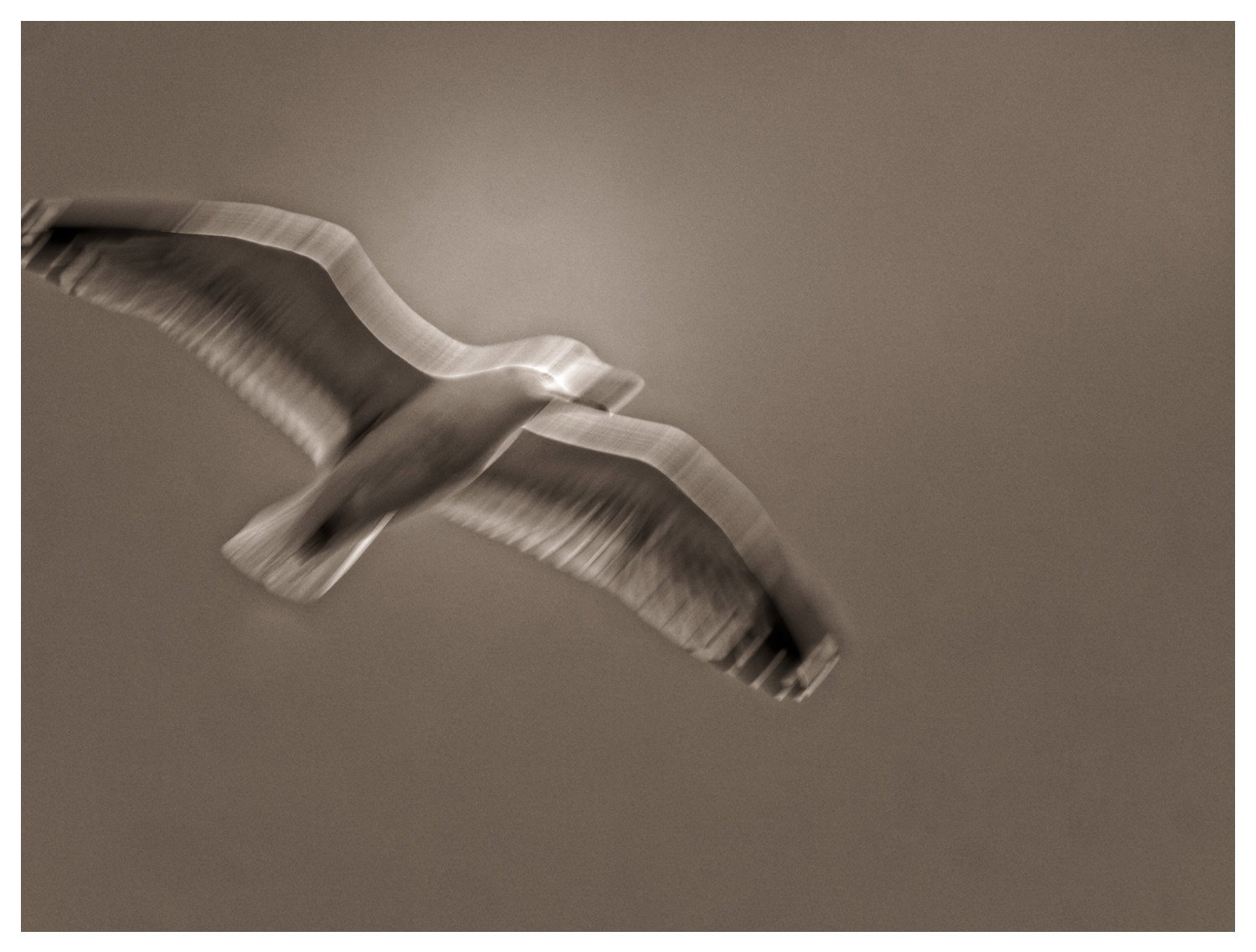
What I find compelling about this kind of image is that it does not really depict a bird at all. It tries instead to convey a sense of what it might feel like to be one, gliding freely through the air with the wind shaping every movement. The intent was to move beyond description and into sensation, beyond the noun and toward the verb.
To push the image even further away from the documentary, I processed it as a sepia toned black and white. Stripping away the colors removes one more layer of distraction and invites the viewer to focus on what really matters here, which is shape, light, and the gesture of motion itself. The sepia adds a touch of timelessness, a faint echo of old illustrations and forgotten field notebooks, which felt right for a subject that is already half memory by the time the shutter closes.
Specific Feedback
Does the sepia processing work for you ?
Technical Details
OM-1 Panasonic 200mm f2.8 + TC14
280mm @ f22 - 1/30s - iso 80
Description
These images were taken last week in a small coastal town in Normandy, where the seagulls have long since given up on the dignified work of fishing and devoted themselves full time to a more profitable career: organized seaside crime. They patrol the streets like feathered little gangsters, scanning rooftops, pavements, and especially picnic blankets, all with the calm professionalism of birds who know exactly what they are doing.
Somewhere along the line, generations ago, the local gull elders clearly held a meeting and concluded that chasing actual fish was a young bird’s game, full of cold dives, scaled prey and questionable returns. French fries, on the other hand, do not swim away. Chicken legs do not require diving. Ice cream cones practically deliver themselves into the open beak of any gull with reasonable timing and a flexible attitude toward consent. Why work, when you can specialize in lunch redistribution.
This particular gentleman was gliding directly over my head, fully focused on a sandwich heist somewhere in his immediate future, when I happened to point the camera up. He did not even acknowledge me, which I took as professional courtesy among working colleagues. He had a job to do and so did I, and neither of us wanted to slow the other down.
I am still debating whether I should turn the photograph in to the local authorities as evidence. The composition would make a passable mug shot, all wingspan and intent, and the sepia treatment lends it a certain noir quality that suits the subject’s career path. The only thing missing is a tiny placard with a date and a list of priors. On the other hand, snitching on a fellow opportunist feels uncomfortably close to a betrayal of the artistic spirit. We were both, in our way, trying to make off with something we had not strictly earned.
For now, the gull remains at large. The fries of Normandy remain in peril. And I have a portrait of one of the prime suspects, hanging quietly on my hard drive, awaiting the next development in the case.