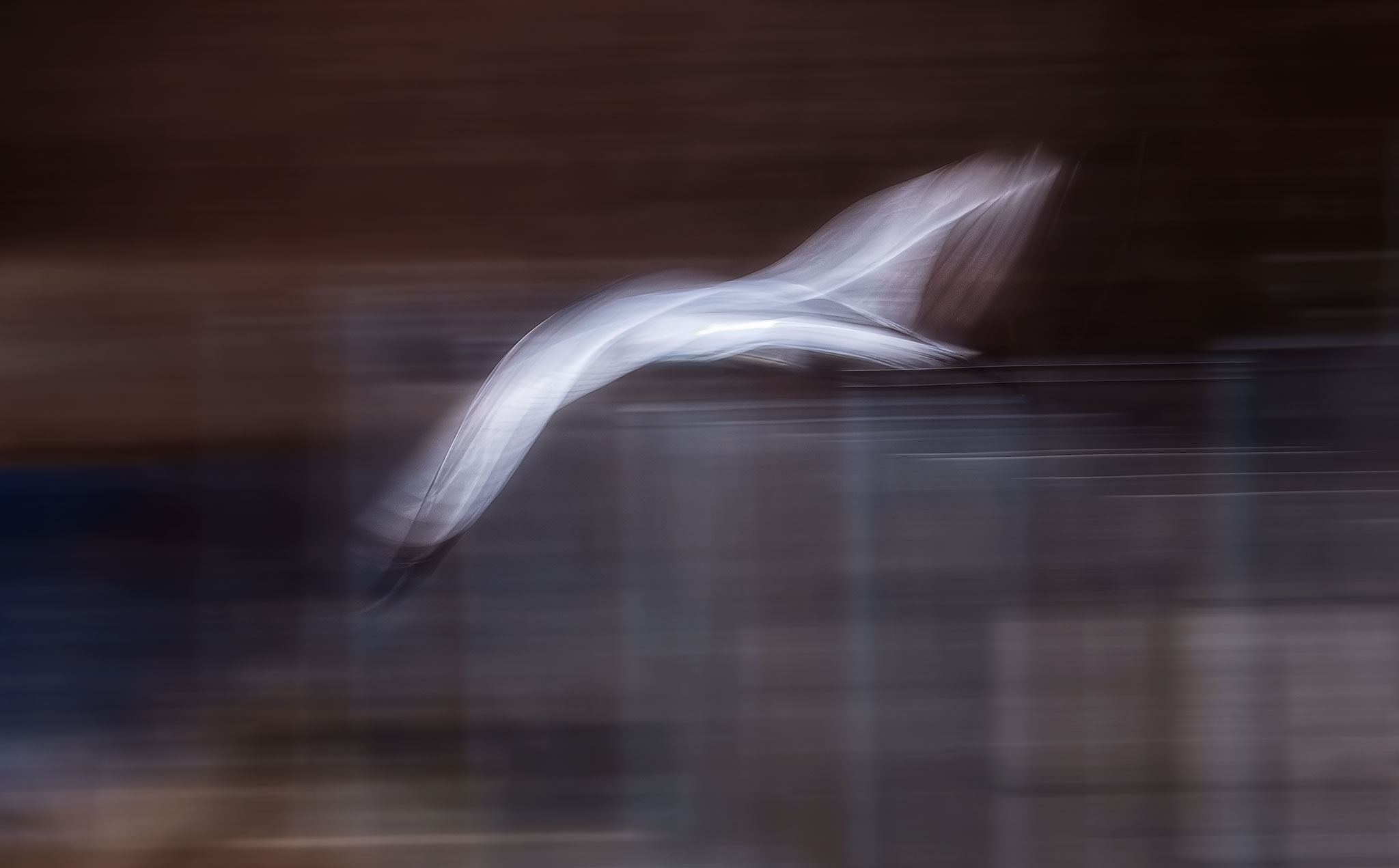
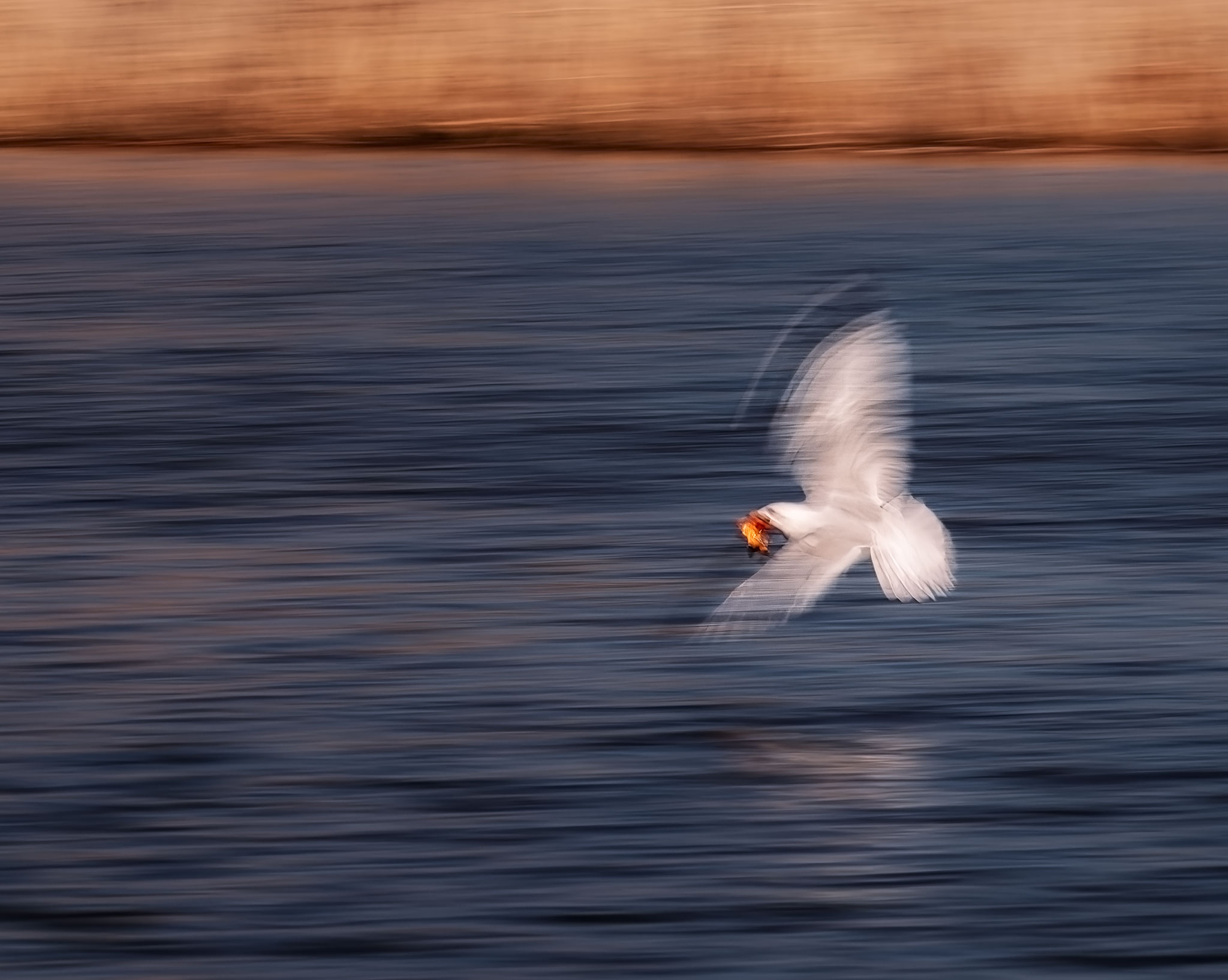
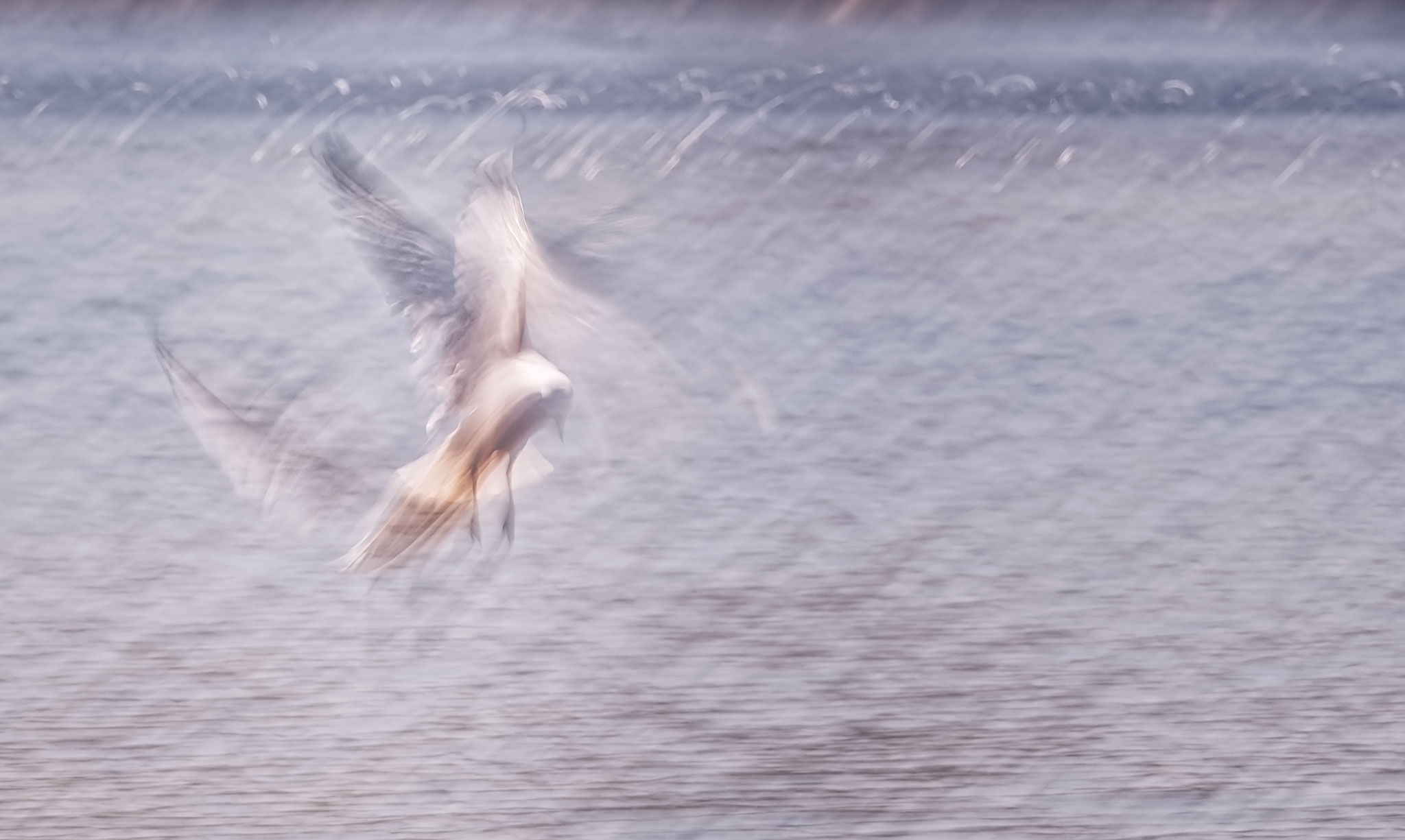
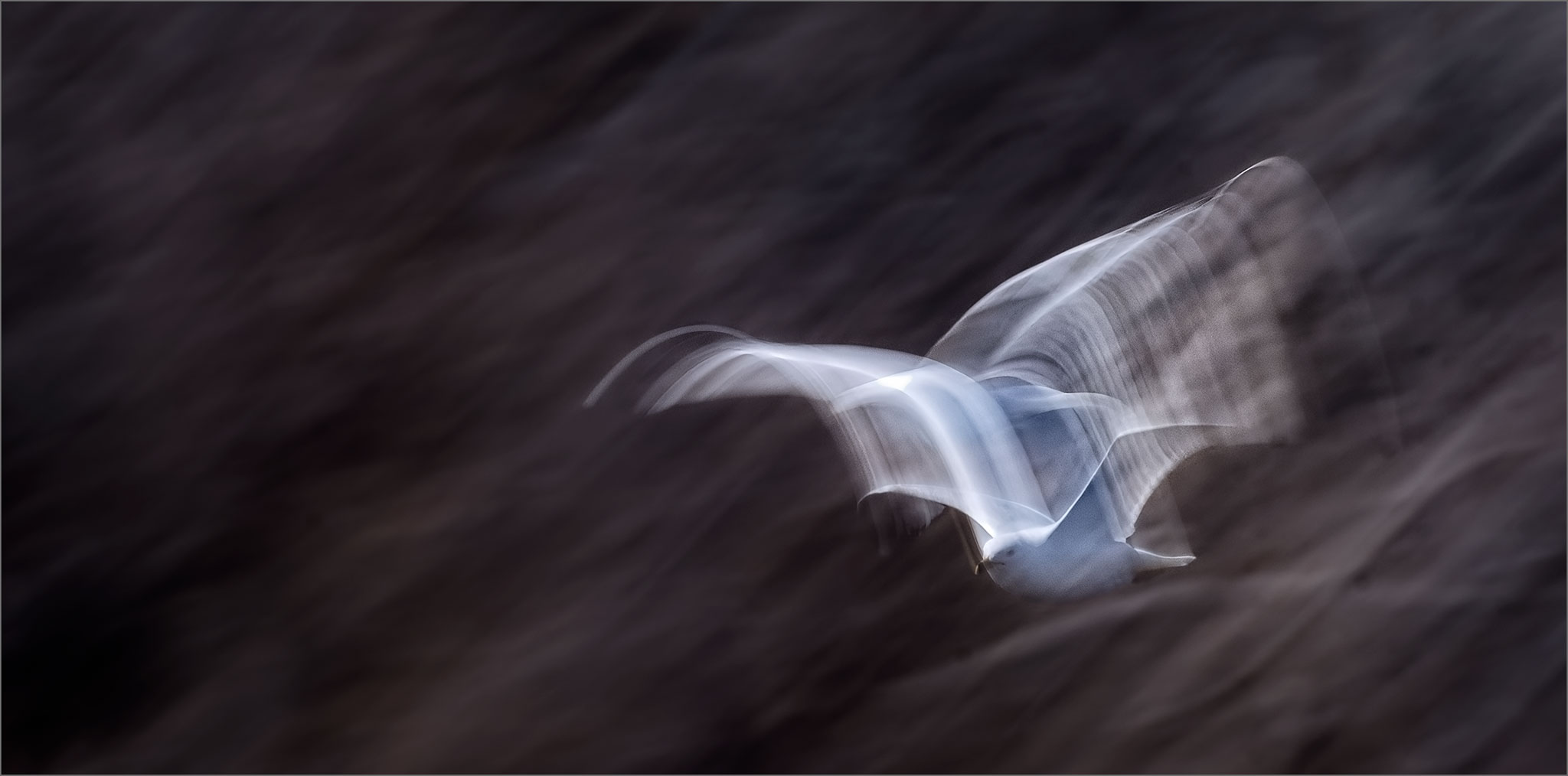
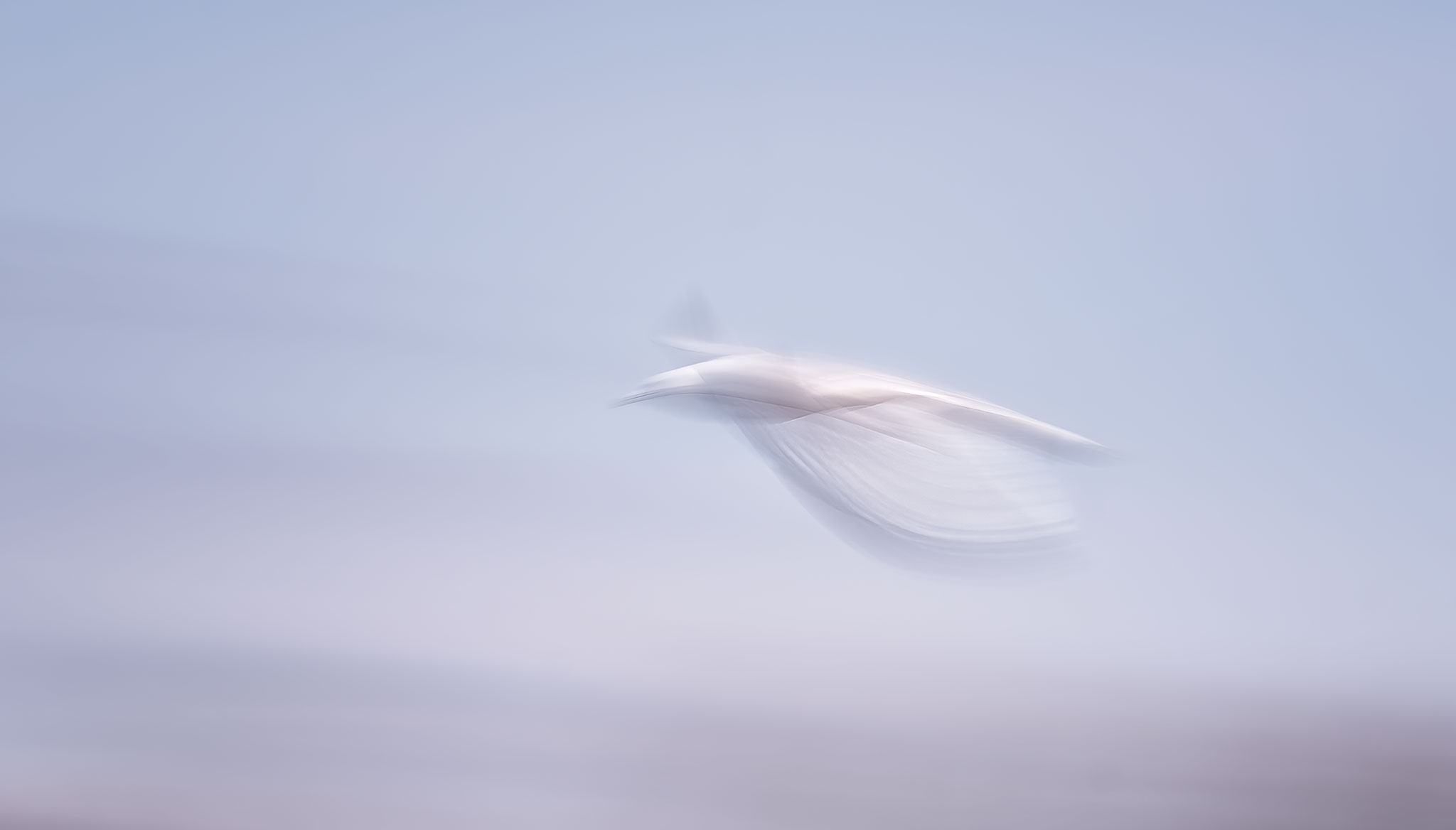
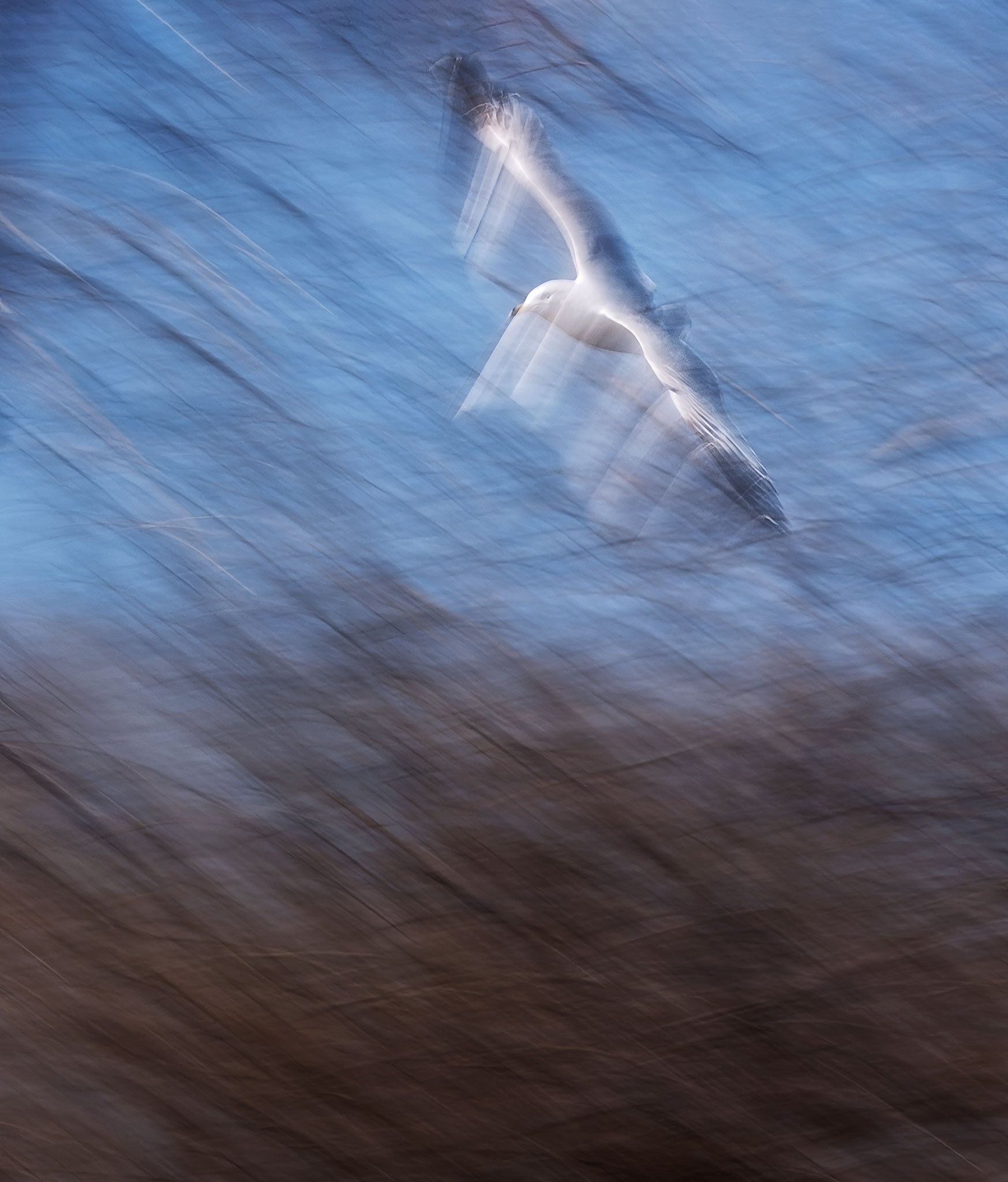
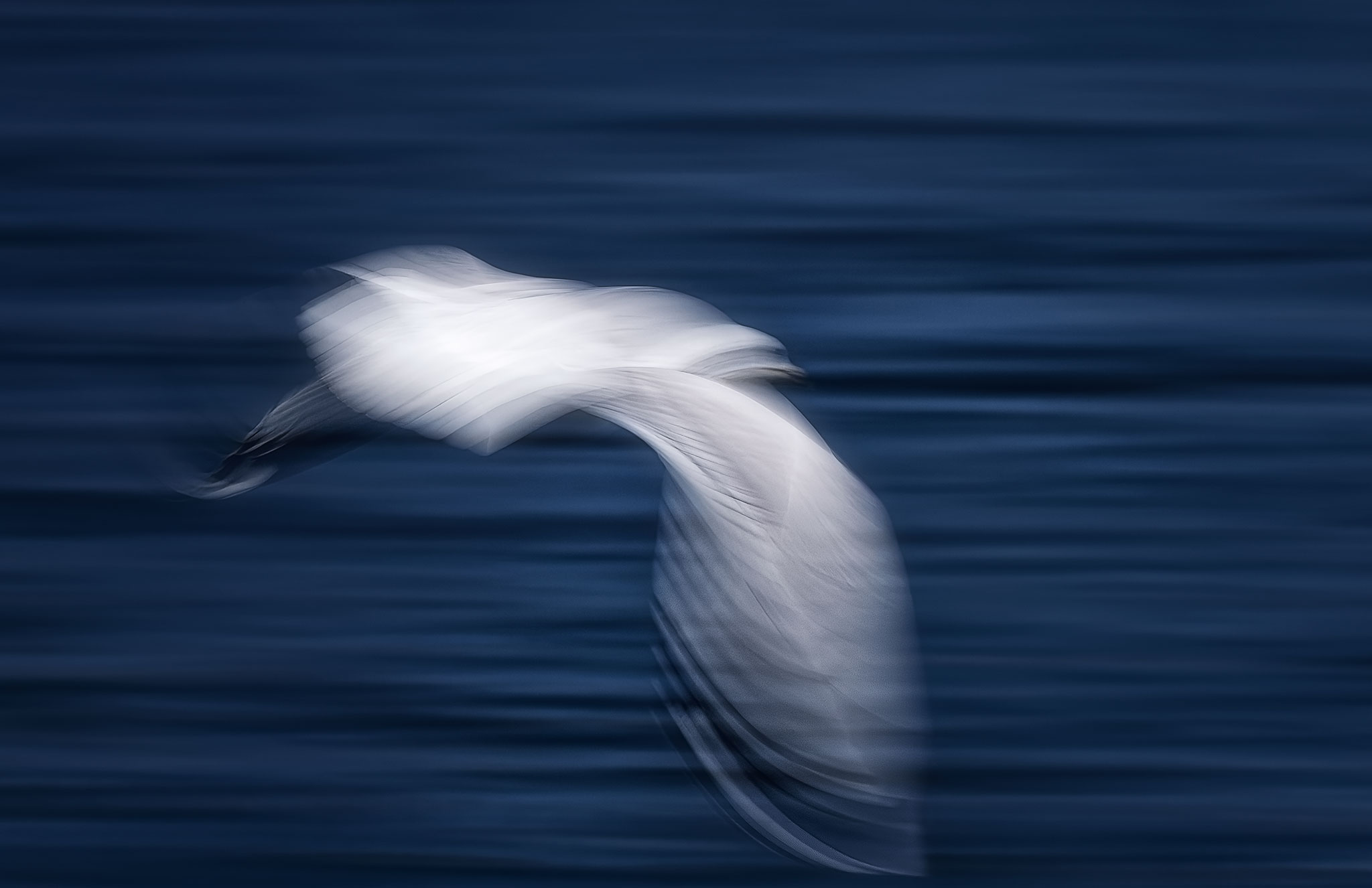
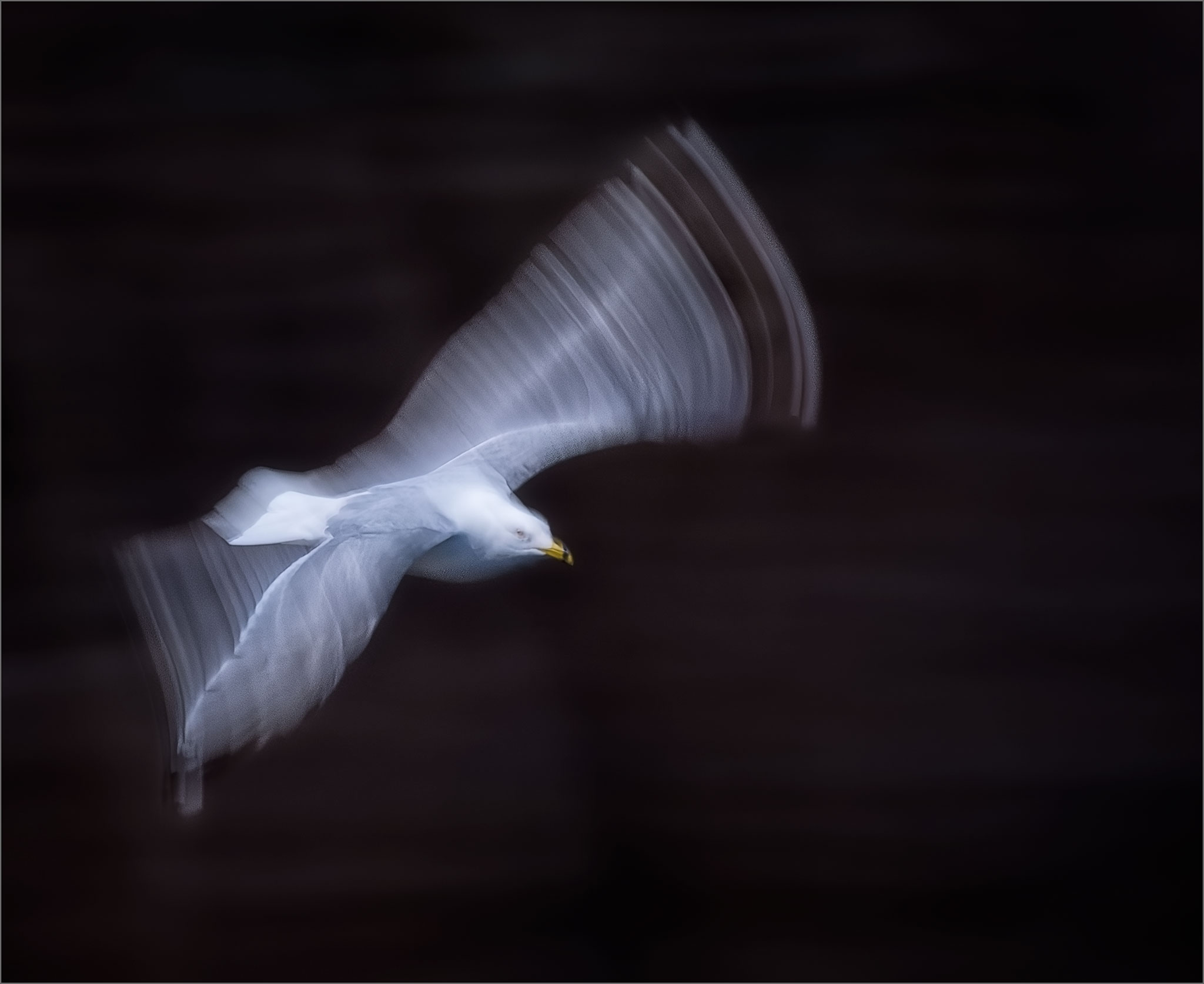
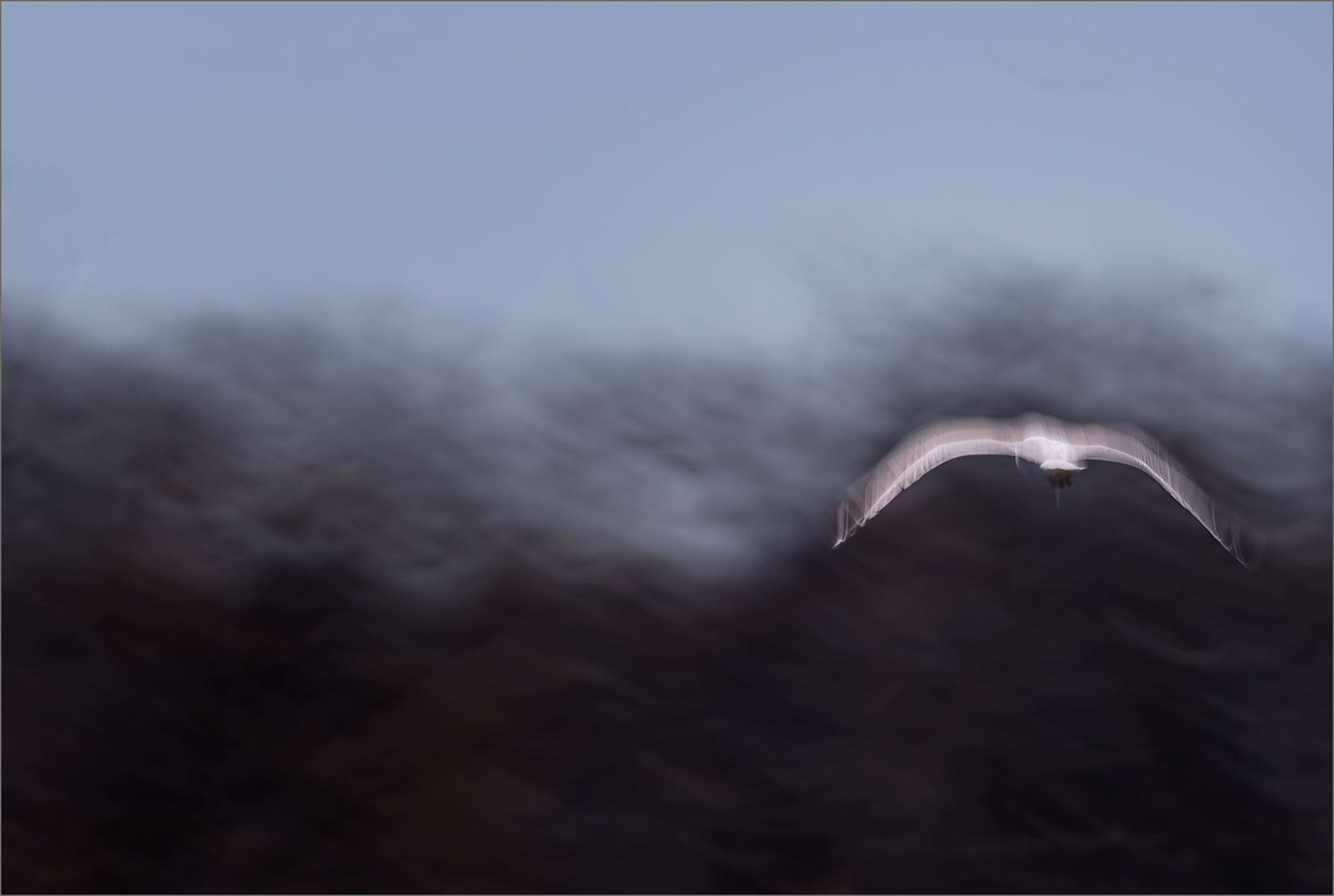
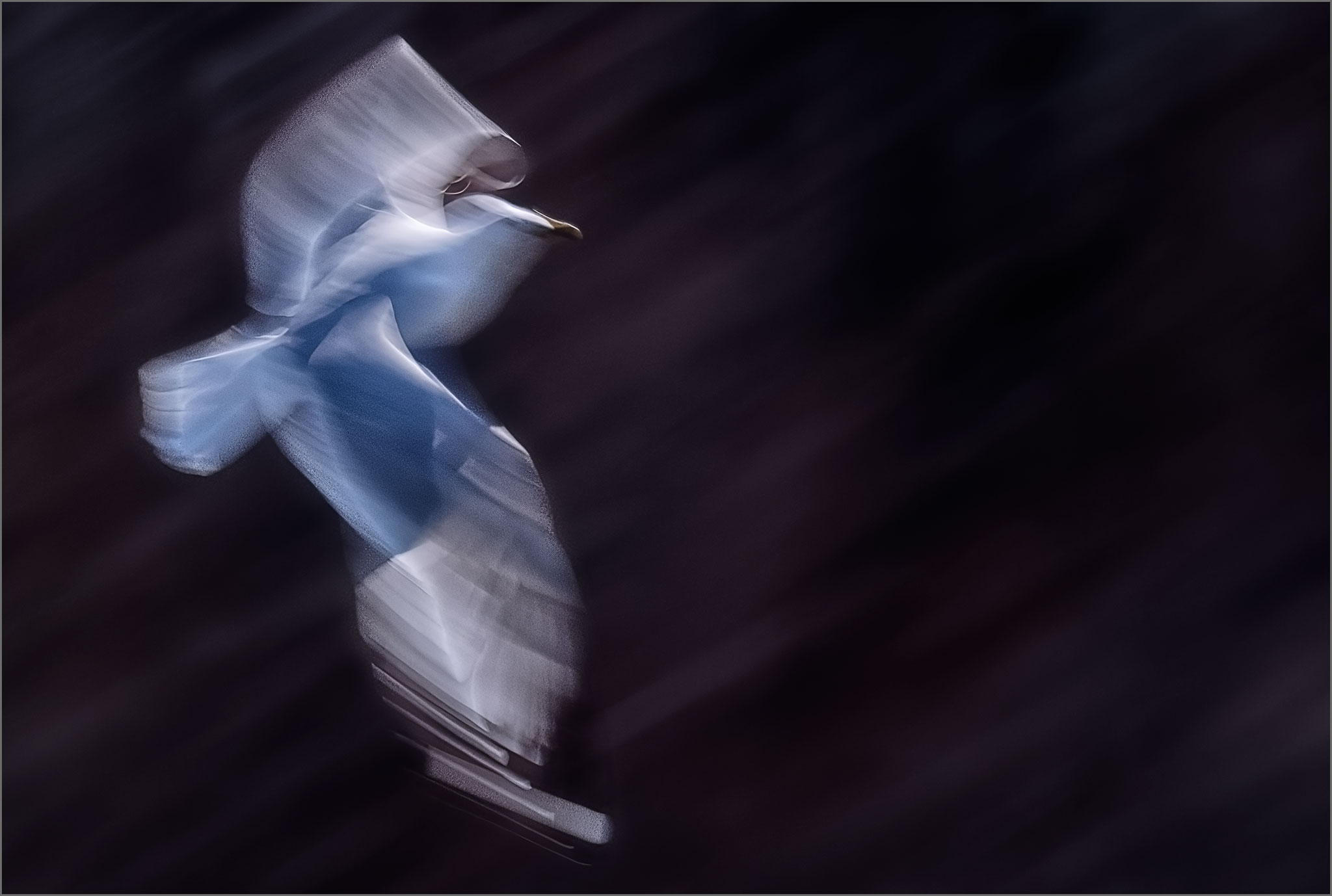
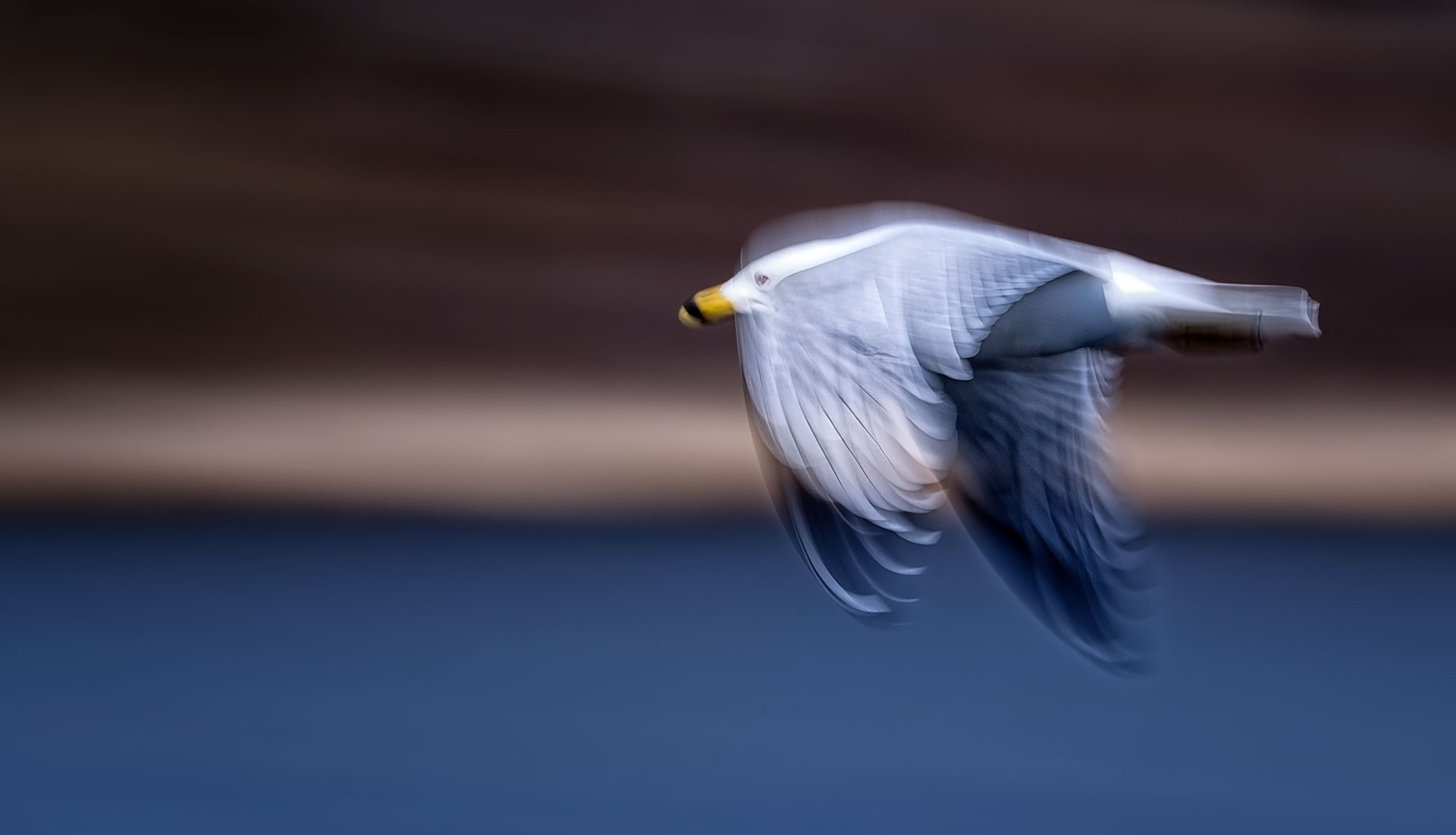
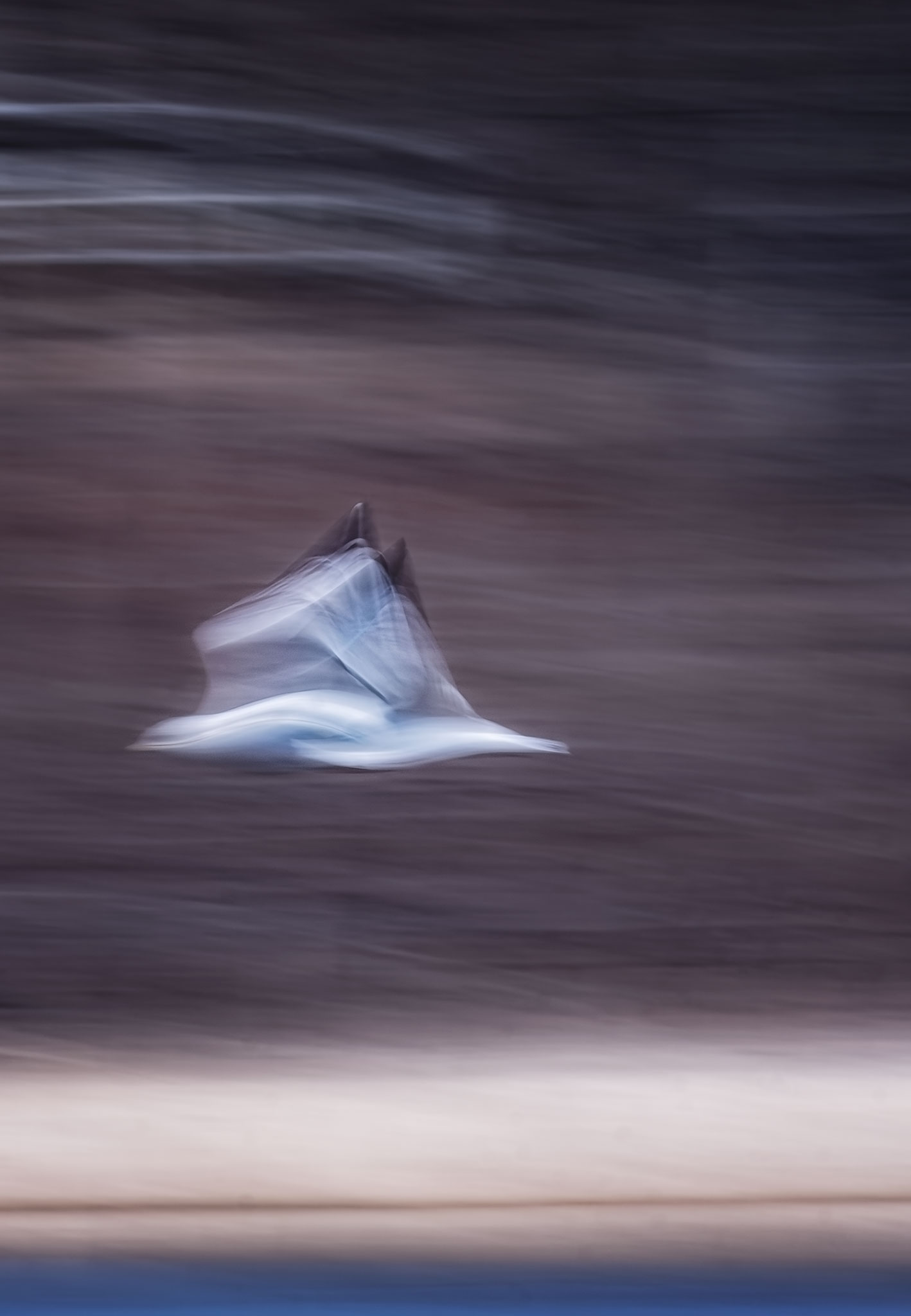
I watched a webinar by Jiri Hrebicek on this site a few weeks ago and was really inspired to try out his techniques and dream-like images. I tried several of his techniques but had the most success so far with slow-shutter-speed panning. I got a super telephoto lens two years ago, and learned how to track birds then with fast shutter speeds, but I don’t think I would have dared to pan birds, let alone pan them with slow shutter speeds, if I hadn’t watched his video.
I already posted two individual images from this project, and I will post another multi-image post like this tomorrow. All these images are from two sessions (around an hour each) with gulls. The main problem has been finding the gulls. The first day I went to the nature reserve, there were a bunch, and I went to town with them. The next two days I went, there were none. On my fourth attempt, there were only a couple. The big birds (herons, egrets) don’t fly much, and the small birds are too fast for my reflexes. Gulls are perfect for this kind of panning because they fly longer and in more predictable trajectories, and I’ll keep playing with them as I come across more of them.
Self Critique
I love the abstract feeling of the images, the sense of capturing the essence of motion, the beauty caught “by chance,” and the textural quality that the backgrounds take on when panned.
What could be improved? There’s a fine line between badly out-of-focus shots and ethereal images, and I’m not always sure which side of the line I’m falling on.
Creative Direction
I love the techniques used by Hrebicek in general (e.g., slow-shutter-speed panning, multiple movements within one shot, letting the camera keep still while motion is happening in the scene, ICM, multiple exposure). There is something about abandoning myself to chance and being pleasantly surprised by what comes out that is deeply satisfying. As someone who likes order and predictability in life, maybe I feel reassured by the idea of how things can sometimes go right even when they cannot be predicted and planned in advance. And maybe these images kind of reflect how I experience the world–not in super sharp and detailed memories of scenes but in subjective impressions of fleeting moments.
I don’t have a clear vision of where I want to go, and I like other kinds of photography as well. I just know I really like these kinds of techniques a lot and want to do more. If you have insights into how I can refine and develop these half-baked ideas, I’d really appreciate it!
I love seeing this project take shape. This is a wonderfully cohesive set, all color and not high key. I’m guessing the next set will be the black and white high key images?
Regarding your question: None of these look like accidentally blurry images. They all read to me as intentional and well chosen. The only one I wish were different in any way is #7, which I wish had more space at the bottom edge of the wing.
I know what you mean about not knowing what you will get when doing this kind of technique. It’s one of the things I like about ICM as well. And I think the idea that we should know in advance what the image will look like is kind of a myth, or at least an ideal we don’t all share or don’t adhere to all the time. Who was it, Gary Winograd I think, who said “I take photographs to see what the world looks like photographed.”
You also said a mouthful when you said this:
I think the joy and wonder in your abandonment of expectation and order is palpable here, and it’s so important in any art form to find a way to break free of patterns. Like you, but perhaps “worse,” I am big on routine, predictability, lists, order, knowing everything in advance to avoid anxiety and unexpected negative experiences.
There is a freedom that comes through in these images, and the idea that even when we let go and can’t predict, beauty happens. I also see the “subjective expression of fleeting moments” concept. The freedom, the soaring emotion, the energy comes through, and the color palette works well to emphasize the gulls and their shapes/movements while still providing some context. Letting go and fleeting moments: these two ideas fulfill the “what else is it about” aspect of a project.
Marylynne, thank you so much for your encouraging and insightful comments :-). I agree about #7, and yes, the next set will be all black & white. Also, that quote by Winograd is right on! It’s often good to pre-visualize and compose and all that, but an element of surprise now and then injects some excitement and joy to photography. Late last year, I also tried out doing street photography by shooting from the hip (i.e., without looking at the camera), and I was again taken by the candid moments I was able to capture that I wouldn’t have been able to if I composed and made myself more conspicuous (and thank heavens for digital film and being able to delete tons of pictures without any cost!). It’s the same type of free-wheeling shooting. And you summarized the “what else is it about” part better than me. Thank you very much
Obviously this is extremely subjective, Canan, but I found that as I scrolled through the images, the more abstract they appeared, the more I like what you created, with #1 being my favorite.
Marylynne, thank you so much for your encouraging and insightful comments :-). I agree about #7, and yes, the next set will be all black & white. Also, that quote by Winograd is right on! It’s often good to pre-visualize and compose and all that, but an element of surprise now and then injects some excitement and joy to photography. Late last year, I also tried out doing street photography by shooting from the hip (i.e., without looking at the camera), and I was again taken by the candid moments I was able to capture that I wouldn’t have been able to if I composed and made myself more conspicuous (and thank heavens for digital film and being able to delete tons of pictures without any cost!). It’s the same type of free-wheeling shooting. And you summarized the “what else is it about” part better than me. Thank you very much
What a nice series, Canan. I watched the same webinar and was very much impressed. You are threading a fine line between abstraction and portraits with movement in them. At first I was looking for the latter, but the abstraction works so well in picture 1 and 12, that I changed my mind. Image 4 combines the 2 features very nicely. Keep going.