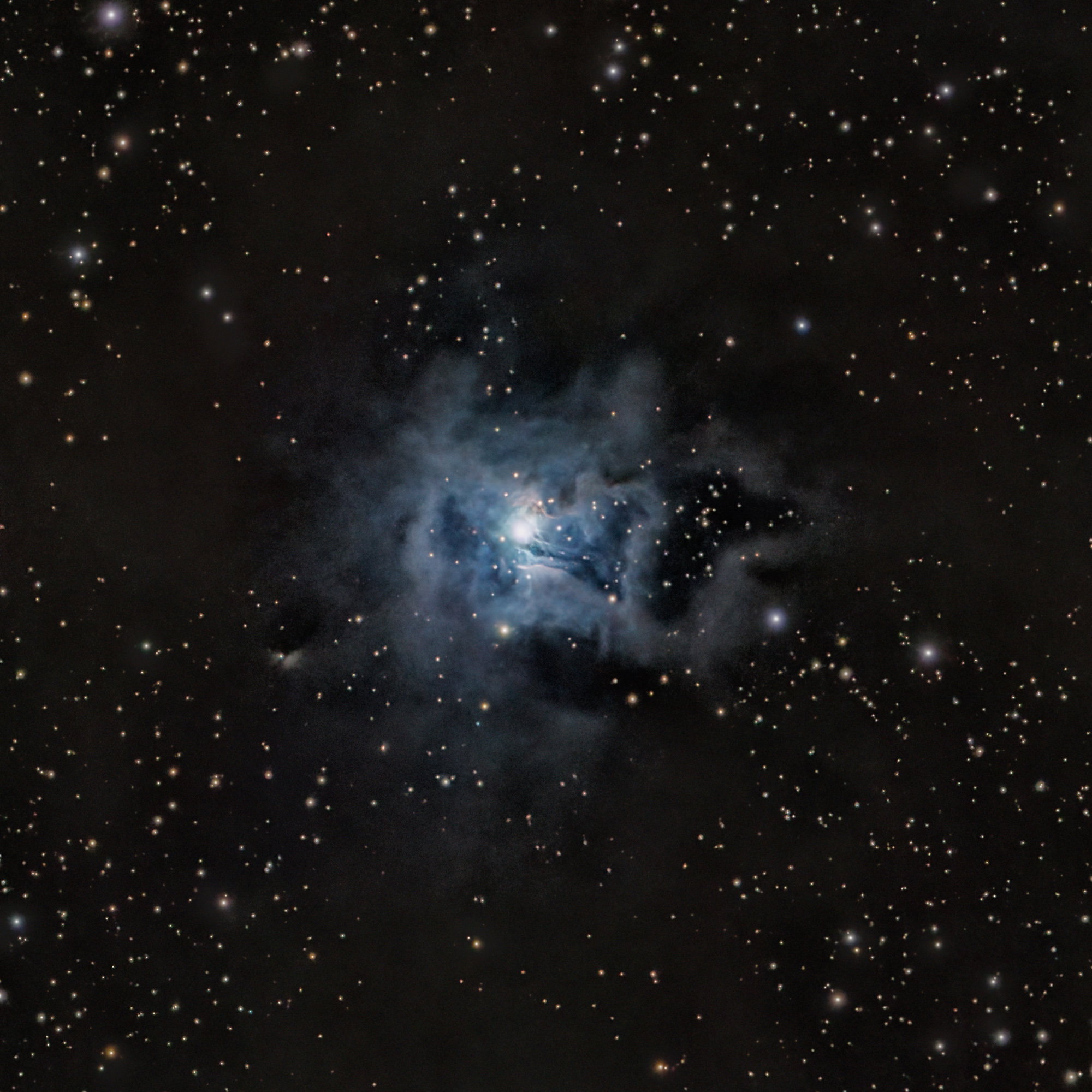
What changed: I don’t care for the extensive dust clouds around this nebula and decided to try to bring out the interesting and very small center area. Last night was more clear so I re-shot it and chose the last 29 files where the stars were smaller, indicating the clearest and stillest air. Then processed to minimize the midtones of the dust, then cropped – to 4% (sic) of the full frame.
Added after receiving feedback from the community.
The photographer is looking for generalized feedback about the aesthetic and technical qualities of their image.
Description
I was excited to see a forecast of several clear nights around the dark of the moon, but this month is still “galaxy season” – when most of the relatively large and colorful nebulae are not yet in the night sky. The Iris is a target I’ve not tried before, and it is very small and surrounded by dust clouds that I don’t find lovely. It is in the north where our skies are a little darker – away from the overpopulated San Francisco Bay Area – but low enough to have a lot of intervening atmosphere, and that atmosphere the last few nights has had poor transparency and a lot of thermal turbulence, limiting resolution of small objects. But I decided to try it last night instead of wasting the time sleeping. I got a better result than expected, and there may be a better night Monday or Tuesday, so I may post a redo.
Specific Feedback
All comments welcome!
Technical Details
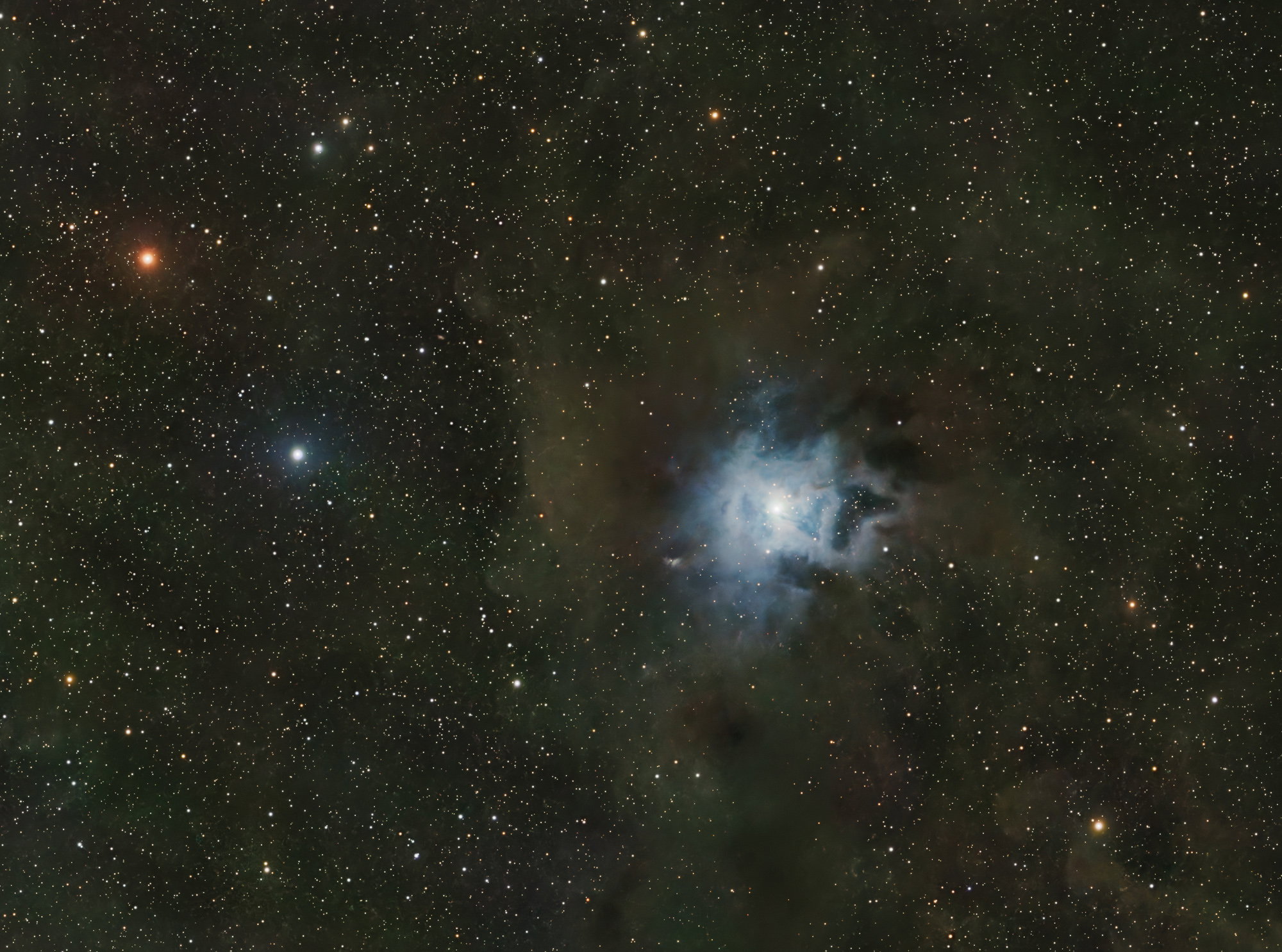
Only 60 3-minute exposures, after deleting 80 due to high thin clouds passing through. Shot with my astro rig (telescope, tracker and on-board computer). Processed in Pixinsight (I’ll spare you the details). Cropped to about 50% of the full frame and a minor contrast tweak in PS. The cropped file is roughly equivalent to the view of a 1400 mm lens.
This image is pretty amazing! The white squiggly clouds surrounding the Iris really set it off nicely.
Susanna
| Diane Miller Nightscape & Astro Moderator May 16 |
| - |
Critique Style Requested:Standard
The photographer is looking for generalized feedback about the aesthetic and technical qualities of their image.
Description
I was excited to see a forecast of several clear nights around the dark of the moon, but this month is still “galaxy season” – when most of the relatively large and colorful nebulae are not yet in the night sky. The Iris is a target I’ve not tried before, and it is very small and surrounded by dust clouds that I don’t find lovely. It is in the north where our skies are a little darker – away from the overpopulated San Francisco Bay Area – but low enough to have a lot of intervening atmosphere, and that atmosphere the last few nights has had poor transparency and a lot of thermal turbulence, limiting resolution of small objects. But I decided to try it last night instead of wasting the time sleeping. I got a better result than expected, and there may be a better night Monday or Tuesday, so I may post a redo.
Specific Feedback
All comments welcome!
Technical Details
Only 60 3-minute exposures, after deleting 80 due to high thin clouds passing through. Shot with my astro rig (telescope, tracker and on-board computer). Processed in Pixinsight (I’ll spare you the details). Cropped to about 50% of the full frame and a minor contrast tweak in PS. The cropped file is roughly equivalent to the view of a 1400 mm lens.
Hi Diane! This is beautiful, as are all of your astro images. I don’t usually comment as this is WAY outside my wheelhouse, but I do enjoy them. Please keep them coming!
I’m with Steve! Certainly not my expertise - although I’ve done more night time photography in the last 2 years than I did all years combined prior…
Your capture is beautiful and kudos to you for all the technial accomplishments to achieve such results. The end result is stunning!
ps and note to @npn - the new category format and organization has gently allowed me to see all the categories that I historically have not spent much time viewing… So just a quick note to acknowledge the new format is providing visibility to images that might not otherwise get attention. I like it!
Terrific capture Diane, and great work with the processing - inspiring! I love the balance between the nebula and the two stars on the left. According to Sky Safari the nebula is 6 light years across - amaze, amaze
Wow! Absolutely beautiful. Like many of the previous posters I don’t do much, if any, astro photography but your images are stunning. It makes me want to expand my skill set.
Both photos are awesome. I like both. I like the original as it shows more of the surrounding sky, especially the addition of the blue and orange stars. I like the revised photo for the depth of detail in the nebula core.
Would it be possible to blend the two photos together?
Thanks, @Lon_Overacker , @Jerry_Austin , @timothy3 and @Youssef_Ismail ! Youssef, I could easily combine the two in PS – don’t know about in PI but there is probably a way. There is leeway in PI processing to go partway in between, and maybe enough to get the same result as combining them. Masks can be used in some processes.
I could have brought out even more of the dust clouds in the original – there is a surprising amount of leeway in astro processing, especially in stretching the linear acquisition files – similar to going from our raw files to PS.
Thanks, @Don_Peters and @santhru ! What amazes me is that I can do things like this mostly from the yard, or, when conditions are better, by carrying the setup to a remote location. It’s easily portable. The hard part is getting clear dark skies, but even quite a bit of moonlight can be OK for some objects – no filters needed these days.
With this rig I can’t see the object – the light from the telescope goes to a special astro camera (although regular cameras can be used but without the major benefit of a cooled sensor). I can see a faint image of each acquisition frame on the iPad screen – enough to check composition or obstructions but nothing like the final processed image. But the run is automated after initial hands-on polar alignment, managed by a small onboard computer and a smart phone or tablet.
Visual astronomy has its proponents, but even with a big telescope our eyes aren’t sensitive to color at the dim brightness of deep sky objects. We might see some dim color but nothing like a properly shot and processed image. An astrophotography rig can combine many shorter exposures to give the equivalent of 6 hours or more of photon gathering. When desired for dim objects, they can be shot over multiple nights to multiply the acquisition time.
 |
| 

