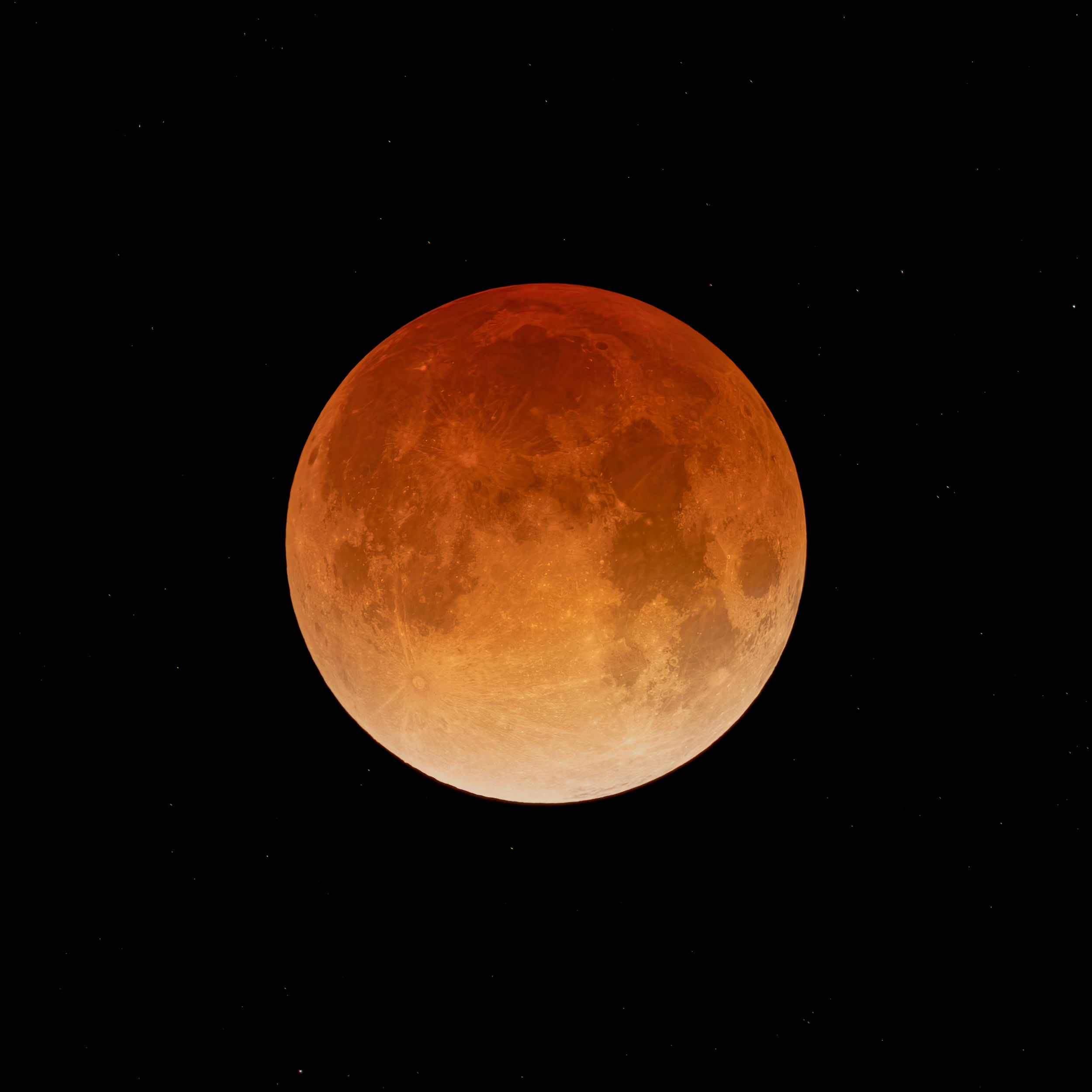
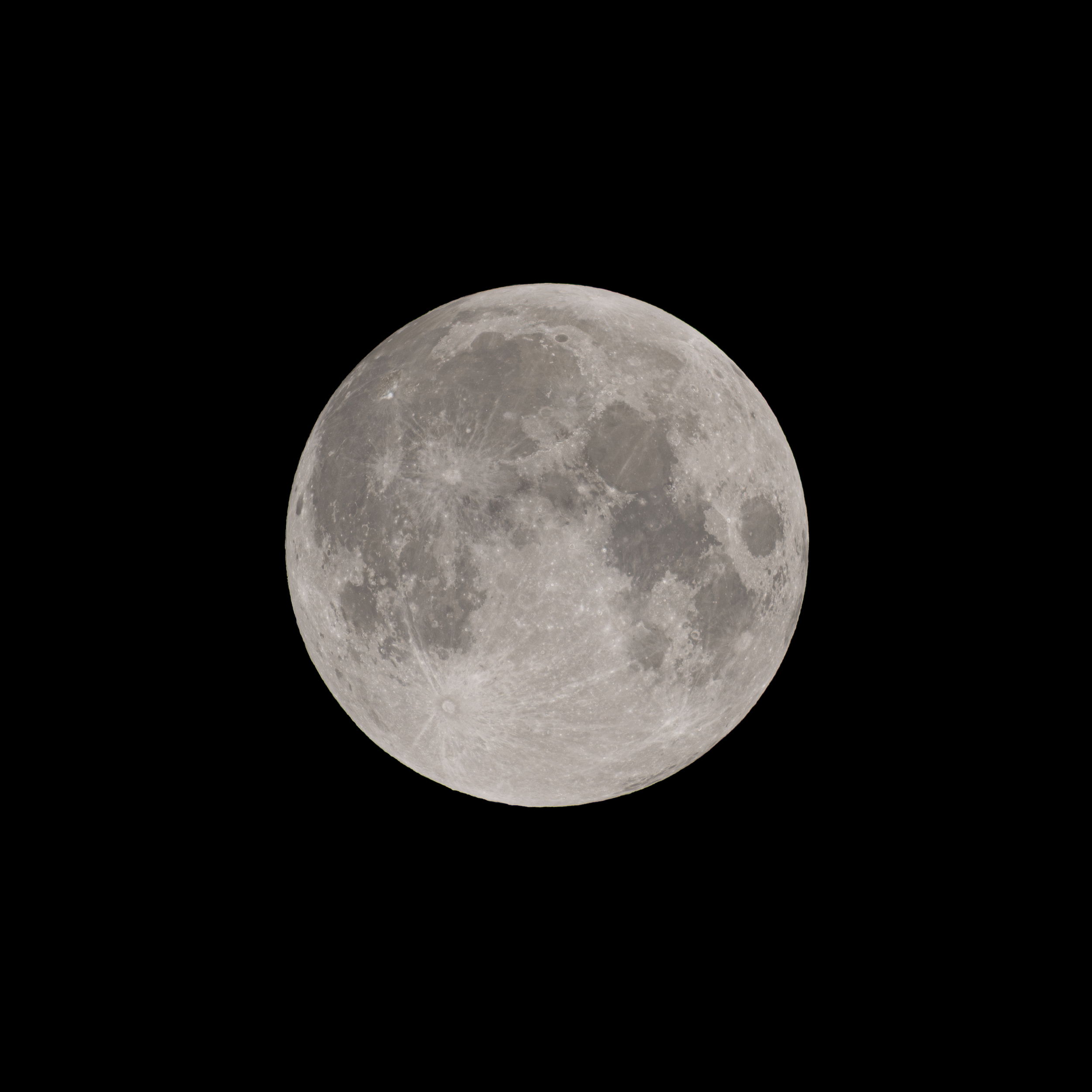
For comparison of detail, this is the moon before the eclipse started – the only adjustment to the raw file was a small amount of Texture. My goal was to dig out as much detail as I could at full eclipse, when it is very dim.
Critique Style Requested: Standard
The photographer is looking for generalized feedback about the aesthetic and technical qualities of their image.
Description
After a lot of weather-watching, we flew to Shoshone, CA – a tiny landing strip S of Death Valley. Skies were beautifully clear and light pollution very low, but there was more wind than forecast. Not horrible but a stiff breeze that did affect longer exposures on the tracker. I’d tried tracking lunar eclipses a couple of times before but with very inadequate equipment, so was eager to see what I could pull out with a longer exposure than with a tripod. With my 100-500 + 2X at 1000mm (f/13) I would be limited to about 1/10 sec. at ISO 6400 or more without tracking. I was pleased with the improvement I was able to get over my previous attempts. (This is the 10th one I have shot, with one more attempt wiped out by last-minute clouds.)
Specific Feedback
All comments welcome!
Technical Details
Canon R5, RF 100-500 + 2X, 15 sec, ISO 200. In LR, Shadows up full, Highlights down just a little and Exposure up a little, Texture up a little. Crop to about 50%. Into PS for a touch of Topaz Sharpen and Nik Pro Contrast, then Curves with a gradient mask to darken the light part just a bit. (Eclipses are usually not centered in the earth’s shadow so one edge of the moon is significantly brighter.) I did some shorter exposures for an HDR but Curves did the trick nicely.
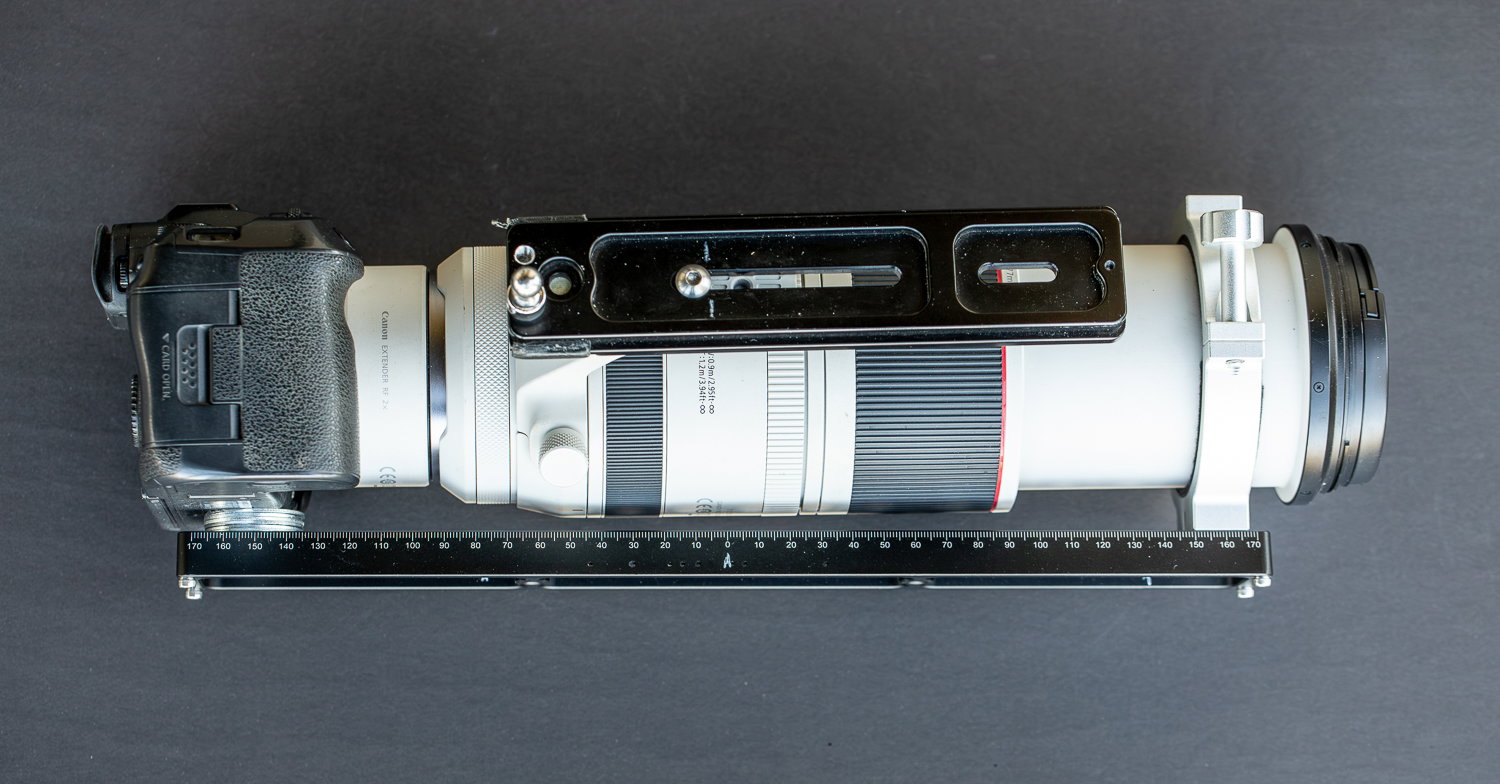
Here’s how the camera is mounted to a dovetail bar that fits on the tracker head. Mounting by the lens foot would not be remotely rigid enough. The mounting ring on the front is a standard telescope ring. They come in many sizes and fortunately one was perfect for the lens. A stack of washers (glued together) made a nice spacer to screw the camera body to the bar with good aim, but next time I”ll add one more washer. The picture reveals that eyeballing wasn’t good, but it worked fine.
Wow ! Thanks for this post, Diane. Details of the moon are…well… are out of this world tight.
Diane,
Nicely done. I thought about tracking it also but that would have meant I needed to go somewhere to get away from the trees that surround my house, but could not since I had to teach the next afternoon.
Your equipment worked for you this time. The detail in the moon is wonderful and your exposure is perfect, look just as I recall. I am still waiting for a really deep eclipse where the moon is fully immersed in the red light. The moon would have to be directly on the Ecliptic at totality, this moon was off by about 1 degree. Earth’s Umbral shadow is 1.3 degrees wide so the closer the moon gets to the center of the umbral shadow the deeper the eclipse and the darker the moon becomes. June 2029 is supposed to have a super deep eclipse. Looking forward to that one.
Very cool, Diane. I was in Joshua Tree, not terribly far from you. Wonderful shooting conditions, except for that wind. You got a wonderful shot of the moon at totality and I appreciate seeing your rig!
ML
Excellent image, Diane. Your rig worked very well. If I may suggest on your rig, replace the stack of washers with two washers with a layer of moderately rigid foam between them and then screw it down to just the right distance. It will also give you just a bit of vibration absorption.
Thanks, @Stephen_Stanton, @Youssef_Ismail , @Marylynne_Diggs and @Dennis_Plank ! The next one will be spectacular, as Youssef mentions, being so well centered in the earth’s shadow that there will be very even illumination across the moon – and also the darkest illumination. Definitely worth tracking. Unfortunately at mid-totality it will be just rising, right on the eastern horizon, here on the west coast. Good for a foreground, though. (We’re already plotting for getting somewhere east of the middle of the country.) For info on that one, go to the website for timeanddate.com and put in 2029. You can enter a location and see the visibility there.
Dennis, sounds like a good idea, but do I want to have any freedom of motion at that point? Astro rigs would use a solid metal riser at a point like that. I should have removed the lens hood but there were some lights just west at a road maintenance yard and I was worried about reflections getting into the lens. But I managed to locate the tracker so they were just behind the vertical tail of the plane so should have taken the hood off. But even a solid tracker isn’t immune to wind. At home, if I set up behind the garage there is a fairly small area where I can see Polaris over the roof to polar align, but I need to prop up a wheelbarrow in front of a heat pump that is about 25 ft away, because when its fan runs I get shaking stars. And that’s with the real astro rig, which is as solid as it can be and uses a separate guide camera and software that smooths out issues with meshing gear teeth, but it won’t help with wind shake at my typical 1-minute exposures.
Your MacGuyvered solution worked very well. The eclipse has excellent detail and prefer the color version over the BW one. Unfortunately for me, I woke up, saw clouds, and went back to bed. No eclipse for me  . You processing is quite good and I cannot think of any nits to pull from the earth’s shadow. Well done…Jim
Thanks, @Jim_Zablotny ! I think most of the country was under clouds. We were lucky to find a good spot.
Now I’ve shot the star field with the astro rig to composite, but need to also get some with the moon in the frame so I can scale the two. Sensors are different sizes and resolutions.