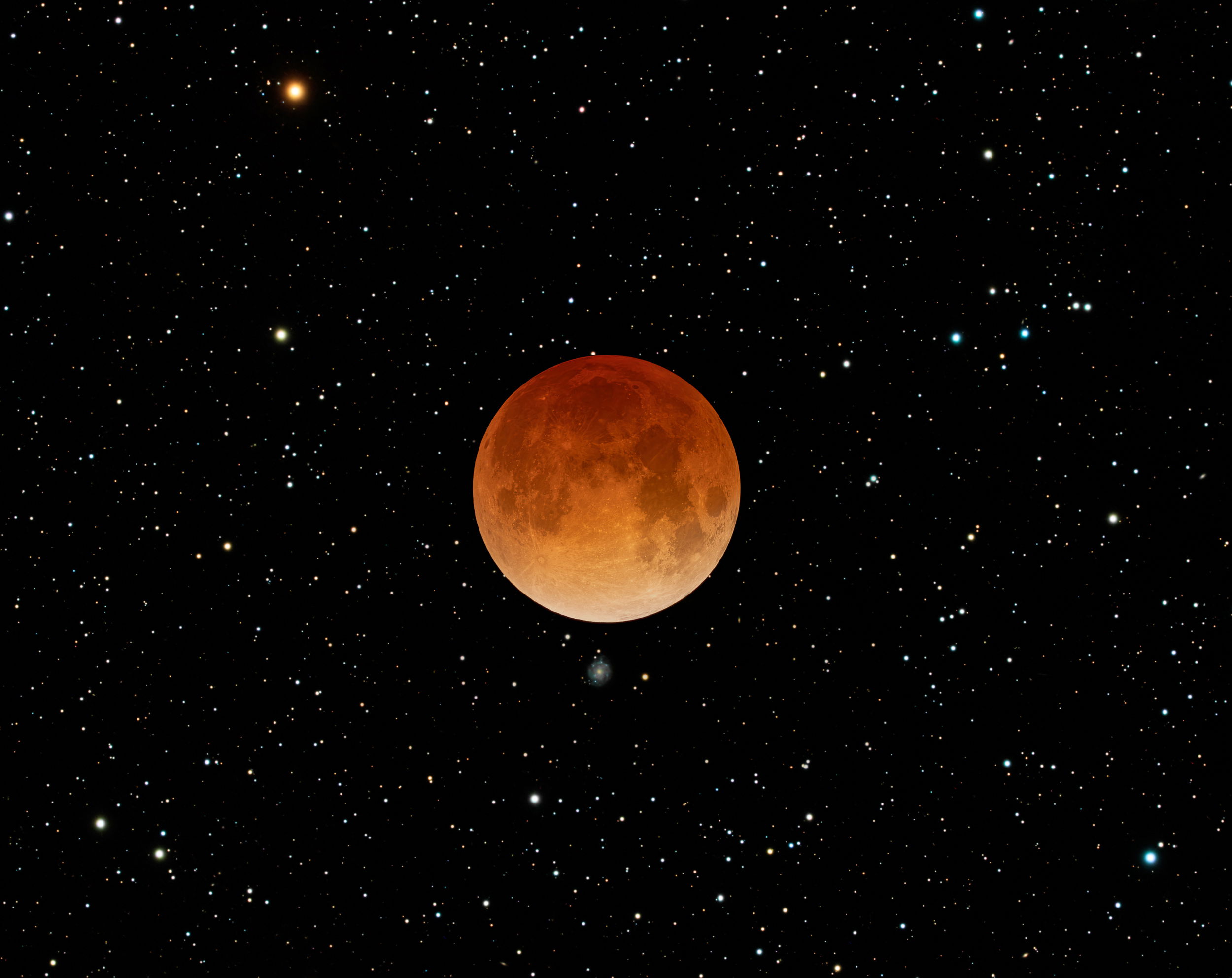
I reprocessed the star image with a different stretch that gave less contrast – I think it is more realistic and the galaxy processed much better. The moon was aligned more accurately, too.
The photographer is looking for generalized feedback about the aesthetic and technical qualities of their image.
Description
After going to ludicrous trouble to get a decent shot of the very dim eclipse, I wanted to composite an accurate star field. My “daytime” camera and lens was better for the moon, with 1000 mm and on the tracker, but the astro camera and telescope were necessary to get good stars. With Stellarium I was able to find the exact position of the moon in the sky at the time of that shot, and night before last the moon had moved far enough away that I got several hours of frames and processed them in PixInsight to get the stars at that spot. Then I had to scale the stars to match the moon frame, as the astro rig has about a 640mm FOV. That took getting another shot with the astro rig of just the moon – at 5 am this morning. After scaling I relied on Stellarium to let me rotate the field correctly. A plate solve on Astrobin ID’d the galaxy just below the moon as NGC 3423 and the reddish star in the UL is OCC 585, 7th magnitude, just barely visible with excellent eyesight and very good conditions. So the astro rig picks up an amazing number of very dim stars.
Specific Feedback
All comments welcome! (But spare me an assessment of my sanity – I already know.)
Technical Details
Basically described above and in the post of just the eclipse: The lunar eclipse
Thanks, @Dennis_Plank ! It’s interesting that the telescope (a refractor, which is a specialized telephoto lens) cost less than half my Canon 100-500, the astro camera less than half my R5 and the tracker/tripod about the same as my larger RRS tripod. But it is a world (no, a universe!) of difference.
Diane, a truly stellar image here. Your Astro work is on another level to say the lest. Nothing I would or could ever attempt with my gear. Amazing to see the amount of the clean and intense stars surrounding the moon overall.
Thanks for sharing this one…
Pretty spectacular Diane. I have to echo the other comments about just how clear and bright the stars are! What a rabbit hole astro photography is…maybe someday I get the courage up to dabble in it.
Thanks, @Paul_Breitkreuz , @Keith_Flood , @Stephen_Stanton and @Paul_Holdorf ! It IS a rabbit hole – or a black hole. Best avoided! But it is SO much easier now than even 7-8 years ago. The tracker was still set up and we may have a few clear dark nights so I’m shooting a new object tonight. Just needed to go out and uncover it and turn it on and pair it with the iPad, then did the rest inside. Not that common to get a few clear nights near the dark of the moon.
Outstanding photograph. You planned and executed it with such exacting detail and clarity. The redo of the star field with less contrast is perfect, looks completely natural. Someday I’ have the funds to fall into that black hole as well, and I’ve got some ideas brewing. Again great work.
Thanks, @Glenys_Passier, @WillR and @Youssef_Ismail . That’s not exactly a well-known galaxy – all the pictures I can find of it are very fuzzy, except one from the Hubble. It’s claimed to be about 45 million light years away. Who knows what it looks like right now…
Thanks, @Gill_Vanderlip – I’m going to! But it will have to go in the hall where there is room next to the solar eclipse of 2017. The corona that year was more interesting than this last one, as it varies with how the sun’s magnetic field is feeling. And I got a decent star field for it, but I may even redo it. I think I still have the data, just need to re-process with some new tricks.
I really like this and the star details are amazing. I have seen these blue colored stars and other colors too in my own night images. Always wondered why. Now I know it is the way they are supposed to be. I thought there was some issue but was overthinking it. Thanks for sharing.
Thanks, @Andrew_Sentipal! Stars vary in their temperature, giving colors from deep orange to blue, with many white. Our regular “daytime” cameras and lenses can barely capture a hint of star color, and rarely accurately. Some of the recommended filters for night sky photography distort star colors to blue/cyan and blue also comes from chromatic aberration in the lens. And an accurate “daytime” color temp/WB is vital. Good refractor or reflector telescopes are highly corrected for flat fields and optical aberrations to capture stars with nice shapes and accurate colors.
Hi Dianne,
This sounds like a lot of work on your part, but the end result is so worth it. To say this is amazing would be an understatement. I just love the crispness of the moon and stars. I hope you have some wall space for this!
This is just spectacular. Normally, moon shots can be a bit boring, mine included. This one is on another level The stars add a whole new dimension. Well done.