Evening Symphony

Critique Style Requested: Standard

The photographer is looking for generalized feedback about the aesthetic and technical qualities of their image.

Description

Every time I go out and photograph the Milky Way I make mistakes that I learn from, and little by little I’ve tried to narrow the number of them. I really wanted to get out and try doing a couple of things differently, but the season has been obnoxiously busy. Fortunately I was able to get out and photograph for two nights on a trip in July.

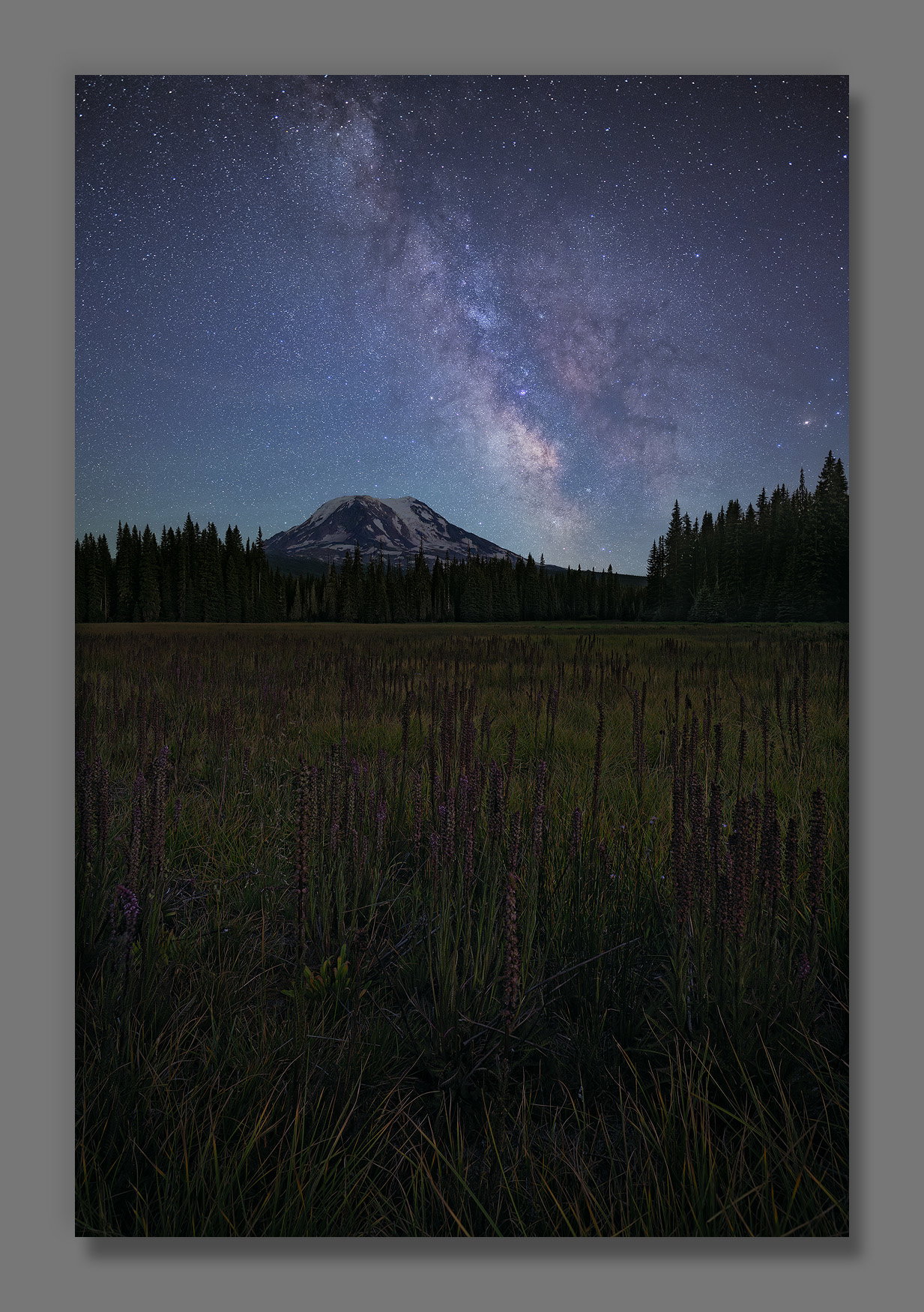
This image of Mt. Adams was from the first night. I photographed a wonderful patch of lupine below the Milky Way in this meadow back in 2020, but I made several mistakes, the camera was an APS-C sensor, the lens had comatic aberration, etc. I’ve really wanted to go back and see if I could take something similar for the scene, but with a lot better quality.

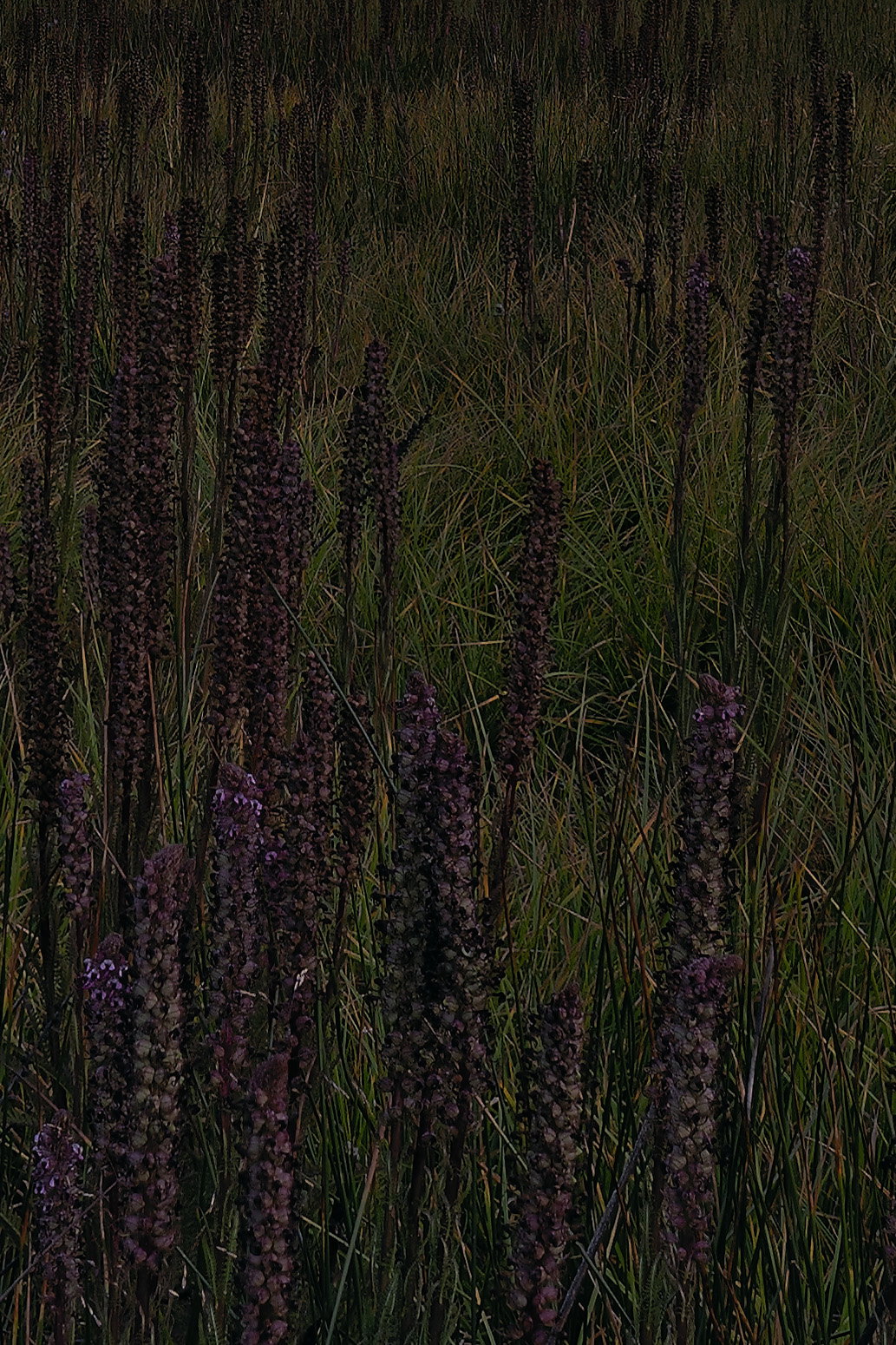
Sadly, although I went at the same time of year as 2020, the flowers in the meadow were done. There were these past-prime flower stalks from a different plant (Elephant’s Head??) that I thought might be interesting, so I went ahead and photographed anyway.

Specific Feedback

The land is a blend of four images (for depth-of-field) taken after the sun had set. The sky is a stack of nine photos taken about an hour and a half later. I blended the land using Helicon Focus, with a bit of touch up by hand, and stacked the sky with Sequator. Any thoughts on how to improve those appreciated.

I had planned on shooting more images to stack, but decided to adjust the focus after the first nine to be sure I had it sharp. That was a big goof, because everything after that was slightly less sharp. (Lesson learned. Next time I’ll take an image, then look at it at 100% zoom, then adjust and recheck until I have it dialed in.) I forgot to take a dark image.

I tried shooting some long exposures to get the land without having to use the blue-hour photos, but the cameras light shows in the foreground of those. Next time I’ll have to see if I can turn that off in the menu, or just physically block it.

I find getting a realistic level of light on the foreground, yet keeping detail, to be really challenging. In addition, I typically struggle to get sky color that doesn’t look crazy. Your thoughts on both of those points would be very much appreciated.

Technical Details

NIKON Z 7II
NIKKOR Z 20mm f/1.8 S
1/10 sec. at f/2.2 and ISO 2000 (sky)
1.3 sec. at f/4.5 and ISO 64 (land)


Critique Template

Use of the template is optional, but it can help spark ideas.

Vision and Purpose:
Conceptual:
Emotional Impact and Mood:
Composition:
Balance and Visual Weight:
Depth and Dimension:
Color:
Lighting:
Processing:
Technical:

1 Like

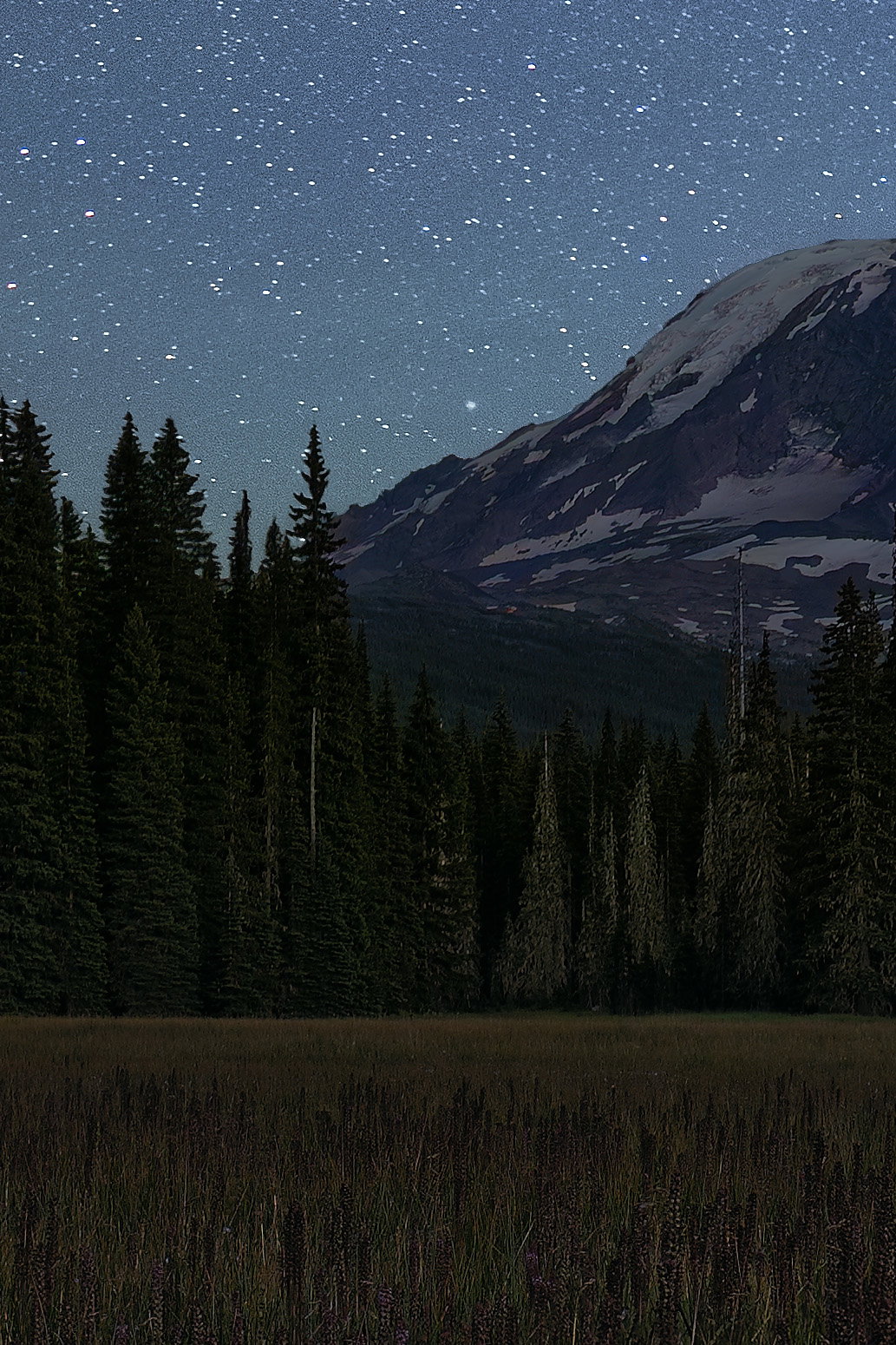
I find downsizing can hide a lot of ills, so here’s some 100% crops if that helps with critiquing.


John,

I can feel your frustration with this type of photography. I too have struggled with trying to get the land without having to use blue-hour photos, but in the end, there needs to be some light in order to expose to. I think the sky color in this photo is very nice and believable and overall the photo looks quite natural and how I would envision it looked like that night. I know it would have been darker overall, but something that the mind’s eye would have assumed. I have also found that using the denoise feature in ACR does a great job of cleaning up any noise in the photos.

1 Like

I’m a bit rushed just now, but to start: Frustration? It’s the game with this stuff. But this looks quite nice! My take would have been to have less FG and more sky, but the FG is the classic wide-angle view, leading the viewer to the sky, and I can’t fault that. You have achieved wonderful depth in the FG, leading back to the mountain. And the MW is in the perfect position. The blend of exposures looks fine to me – a bit of moonlight would explain the blue in the sky as well as its relative brightness. The FG and sky look very natural together here. I love the subtle gradient toward the top – very realistic. And the sky detail is excellent. The dust lanes in the MW are very nicely brought out. The star quality looks as good as you can expect from a standard lens..

I’m in the Mac world and have never used Sequator but I understand it’s basically the same as StarryLandscapeStacker, to align a set of exposures and stack them to reduce noise. Nine should be enough to get good noise reduction, which you have here. There is more noise in the sky than in the FG, but that’s to be expected without a lot of exposures to average it out.

I rarely have a decent opportunity to shoot MW images, and when I do I come at them from the perspective of astro shooting with a tracker and astro camera and PixInsight software, so I do struggle with adapting to regular cameras. But one thing I have seen people mention before is “a dark image” – as in one. In astro photography we shoot a set of MANY “dark frames” (no light on the sensor, same exposure time, ISO and sensor temp as the light frames) and the software averages them to remove one type of noise – but not the same “shot noise” we have in normal exposures. But achieving the same sensor temp as the “light frames” is basically not possible with regular cameras. (The sensor of my astro camera is cooled to -10 deg C.) The type of noise these frames remove is hardly relevant with a MW shot – it is for deep sky objects like nebula that are very dim and will get stretched ridiculously by our “daytime” standards. So what is a single dark frame used for? Does Sequator want it? SLS can now use a set of dark frames, but I haven’t tested how much difference they make. If not done right (at the same sensor temp) they will do more harm than good. And I have tried every NR algorithm I can get my hands on for MW shots and none are remotely good at 100% magnification. Most manufacture some sort of strange-looking worms. Averaging a set of exposures in SLS or Sequator is the only decent NR to date. Nine should be good; 15 is getting to diminishing returns.

2 Likes

John, this view looks quite natural, with the minimal light on the land and a great collection of stars. In your added view with the mountain’s edge and stars the noise difference is very clear (but that’s not likely to be noticed even in a large print). Taking multipe sky images and patching them together is about reducing shot noise and that noise reduction scales as the square root of the number of images, so to get a significant improvement in noise you’d want to go to 16 images (noise improvement of 4 vs noise improvement of 3 for your 9 shots). Using Adobe’s (or someone else’s) AI noise reduction on your stacked sky view might be interesting. My one wish for the view as presented is a bit more contrast in the land, to better see the flower stalks. (The grass at the bottom shows decent contrast.) BTW, the views of those flowers has me thinking that they are a type of Liatris.

1 Like

Thank you @Youssef_Ismail , @Diane_Miller , and @Mark_Seaver for the thoughts and detailed replies!

That’s a great suggestion, and I actually compared Lightroom vs. stacking in Sequator. Lightroom did two things I didn’t like as well. First, the color was more “blotchy,” and second it took away a lot more stars. However, Sequator struggles with the area where the sky borders the horizon, and I used the Lightroom noise reduction of the reference image for that small area; I was really happy with that combo.

What I would love to play with is Lightoom noise reduction on the image Sequator produces, but to my knowledge Sequator outputs tiff and Lightroom needs a raw image. I’ll to research that more to see if there is something more there.

That’s a wonderful and long reply for someone in a rush; thanks!!

True! If I printed this I would add noise to the foreground to help even that out.

Sequator also uses this, but I forgot to take it. Next time… :stuck_out_tongue_winking_eye:

In that full-size image above Mt. Adams there are some slight squiggles. Are these the worms you refer to? At that area, those may have come from the Lightroom noise reduced version, but I’ll have to go back and double-check to be sure.

That’s great to know!!

Hi John!
Lovely image, I’m late to the game, and don’t have a lot of fresh insight to add except to confirm some things others have said.

I use Sequator to stack images as well. I’ve never used a dark frame and never thought it was a problem not to. I think @Diane_Miller gives a good explanation about why not to bother. @Mark_Seaver’s explanation about the square root is interesting, I’ll have to experiment with that. I’d been told to use an “odd number” of shots (though the person who told me that couldn’t remember why) so I’ve used 9, 11, or 21 generally. Honestly, I’ve not noticed a huge difference in the results.

I have tried LR DeNoise on astro landscapes and it’s not great, same with Topaz. I get the weird squiggly lines in the sky, it looks atrocious. If I have to, I’d rather just use LR old noise removal and look at the noise.

As far as your composition goes, it is great…the MW is in a perfect spot, and I like your foreground elements. I do think you have room to bring up the foreground a bit. I know that inner conflict between “I want to see the foreground” vs “But it’s night!!” very well. But I think you do have wiggle room to bring it up and still retain your nighttime feeling if you want to. Of course, I’m viewing on a tablet and it’s probably perfect on a monitor.
I think with the sky, too, you may have room to push the contrast a tiny bit more, but only if you want to.

And if it makes you feel better, I had one night this summer for astro landscape. Had my shot set up, foreground shot taken, did a series for star trails, decided that I was zoomed out too far and recomposed, in the dark, and by that point it was too dark for the landscape, thought I might be able to transform it in PS to match the foreground, but no. so yeah, I totally ate it. I got a nice star trails at least, but yes the frustration (and self-loathing!haha) can be real!

Seconding @JulieEdwardsViola!

Atrocious squiggly lines with “normal” NR tools – yes! You may have to go to 200% to see them, but once you do you want them gone! They look like smeared-out stars.

Stacking is (at least for now) the only solution. The square root thing is well established – with stacking, noise declines as the sq root of the number of frames. Even or odd numbers makes no difference. The square root curve levels off as it gets lower (if memory serves, it is a parabola) and around 15 is generally considered to be a point where the trouble of adding more frames doesn’t give a lot more advantage. But the curve goes on and on, flattening out and more gradually approaching zero but never getting there. As a matter of practicality, the amount of NR we need for MW shots is good with as few as 6-7 frames, with our cameras, even at high ISOs. It’s easy to test any clear night – just point the camera up and shoot a bunch and run Sequator or SLS with different numbers of frames, using your typical ISOs.

Dark frames are used in astro software for reducing a lower level of noise and that doesn’t become important with the amount of stretching we use. Forget about them. And I have no idea why anyone ever suggested using one. For astro shooting (dim nebula and the like), good software like PixInsight wants about the same number as the light frames, and both are typically hundreds. (But what counts isn’t the number of frames, it’s to total acquisition time. But depending on the quality of a tracker, the individual frames are typically 1-2 minutes.) That software also uses Bias frames. They are not relevant for MW shots, whose exposures are in between “deep sky” frames and our typical daytime frames, but much closer to daytime frames.

And, yeah, the frustration level would be comparable to me trying to learn to play the viola!

1 Like

@Diane_Miller Haha go for it! Viola is not frustrating AT ALL!!!
(laaauuuuggghhhhiiinnnngggg…)

1 Like

Thanks again all! Although it’s frustrating at times (I’ll have to remember the “I totally ate it” line @JulieEdwardsViola ), I love the journey of learning! @Diane_Miller your expertise in this area is more than appreciated!

1 Like