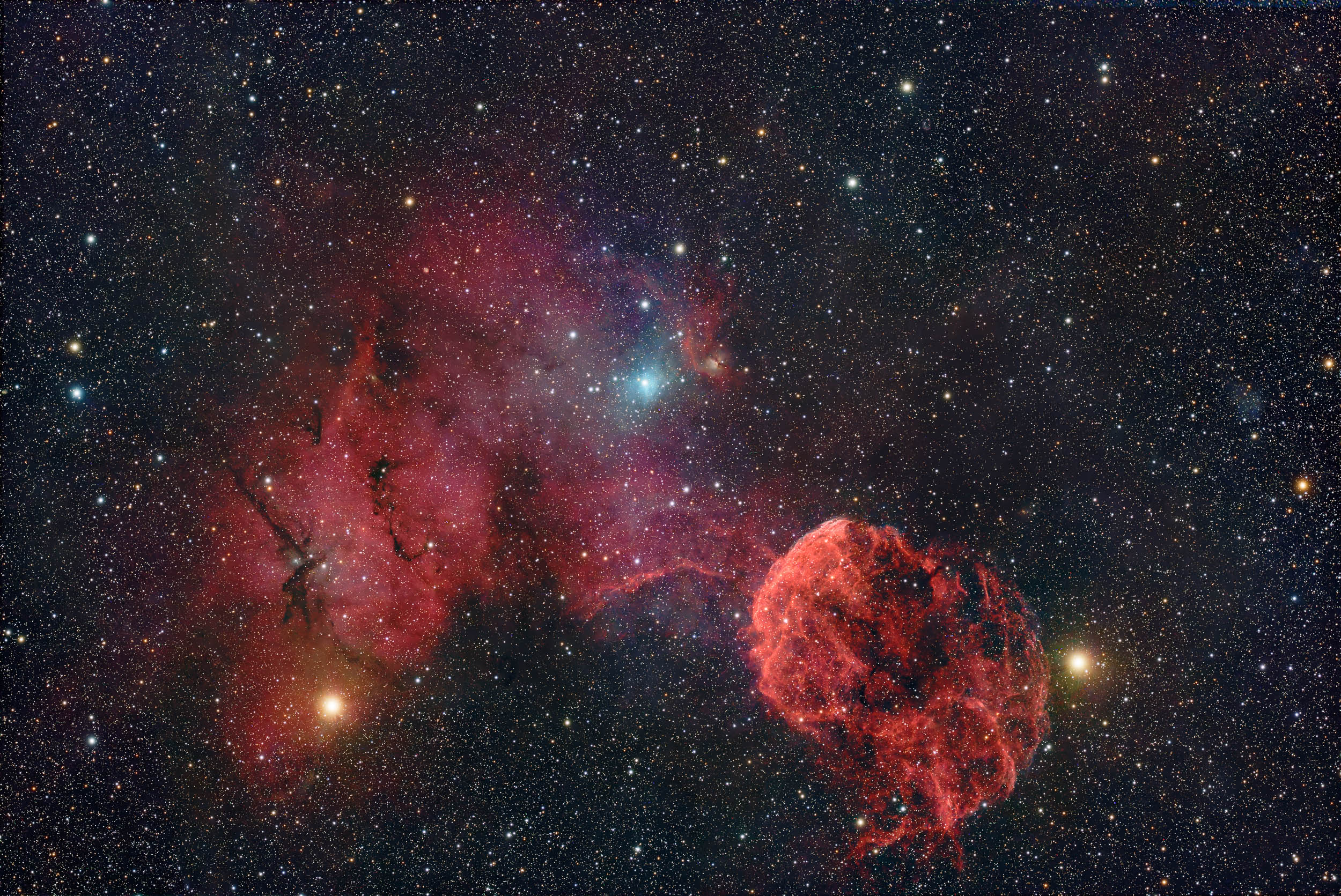
The photographer is looking for generalized feedback about the aesthetic and technical qualities of their image.
Description
We are in the middle of an awesome run of clear dark nights, 3 down and 2 to go, it looks like. I’ve had the rig set up behind the garage and thanks to the automation of the small onboard computer, each night after the programmed shoot it returns to its home position, aimed at the celestial north pole near Polaris. So the next night all I need to do is take the iPad out, turn things back on and re-establish communication with the house WiFi. I can then run things from indoors when it gets dark enough. I select the desired target and it goes to it. I start guiding and the autofocus routine runs, and repeats every 2 degrees C drop. When the target crosses the meridian the rig performs a meridian flip to avoid things crashing into the mount. When it has finished the number of images I programmed, it returns the aim to the CNP and shuts down.
Specific Feedback
All comments welcome!
Technical Details
You don’t want the details… trust me. An overview is 517 60-sec exposures, for 8.6 hrs of acquisition. This is the full frame – a 400mm refractor and an APS-C sensor – about 640 mm equivalent field of view. Processing in PixInsight has gotten much simpler with several new processes, so the initial combination of the source frames took maybe an hour and “developing” the integrated image took maybe half an hour.
Critique Template
Use of the template is optional, but it can help spark ideas.
Vision and Purpose:
Conceptual:
Emotional Impact and Mood:
Composition:
Balance and Visual Weight:
Depth and Dimension:
Color:
Lighting:
Processing:
Technical:
Thanks, @Paul_Breitkreuz and @Allen_Brooks! This object is one of the more photogenic ones for my modest magnification. I’ve never published anything except on a few astro forums. This stuff is like tennis – there is always someone just a little better. But sharing is fun. I’ve just started posting on Astrobin, but there are huge numbers of posts there every day and there is no dialog, just a Like and a Follow button.
What a remarkable introduction to astro photography you just offered. Dazzling photograph.
I thought about this as an abstract landscape … I wondered if some top and right could be cropped as it did not seem to be adding much … Then, since there is no natural up/down, I turned it and found that if is turned 180 the jellyfish seems to be bringing energy down into the scene.
Awesome photograph. The clarity is stunning as well as the detail and the perfect stars. I do wish there was a little more room on the bottom of the frame.
Thanks, @Dick_Knudson and @Youssef_Ismail! Dick, I can see a slightly tighter crop on this – or a shift down to satisfy @Youssef_Ismail – and me! The problem is, when the computer executes a “GoTo” to a target, it is to some coordinates that have nothing to do with pleasing composition. (And it would be hard to do that with the wide range of magnifications that can be used. In fact, I have no clue how it is decided. I’ll see what I can find!!
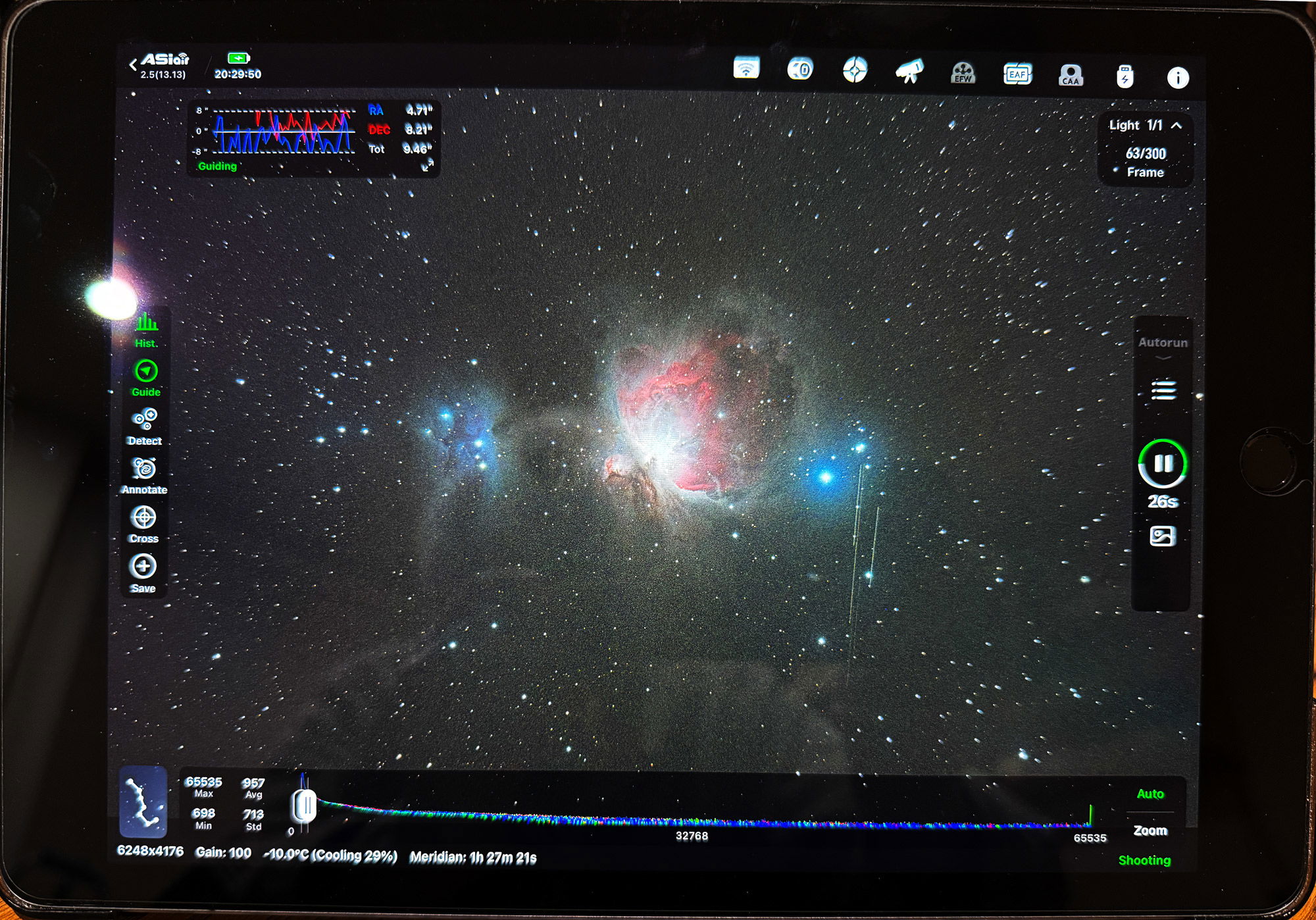
When I start shooting I’m relying on a low-res image that loads to the iPad, and it can be hard to make out the final stretched detail. So often a shoot winds up in my notes tagged for a re-shoot with slightly different framing. It there are some bright stars for a clue on the iPad, and I I noted what the camera rotation was, it’s not difficult to do better. You’ll see a revision of almost everything eventually. As the shoot begins, if I have enough clues on the image, I can move the centering of the frame by holding a finger on the iPad screen for a few seconds!
After sweating blood for years trying to learn to shoot things like this, and to process them, I’ve recently found myself writing a tutorial on the very simple path now offered in PixInsight with several new procedures that makes wonderful images from both modest astro gear and regular cameras. Processing that used to take a very full day now takes maybe an hour, with another hour or half an hour of computer number-crunching. That time has now been reduced hugely.
As I write this, the Orion nebula and the adjacent Running Man is displaying on the iPad beside my computer as my rig behind the garage found the target and is shooting 60-sec frames. There will be some high clouds but I might get enough in the breaks to be worthwhile. The last time I shot this object I didn’t have the autofocuser, which refocuses every 2 degrees C drop, as temperature changes affect the focus significantly. Here’s the screen! (And I need IS on my iPhone.) This one is far brighter than most objects – some only show a few stars until PixInsight works its magic.
This image is amazing for what it is. A distant nebula (whatever that is) - a bizarre outer space thing that doesn’t seem real, except that you have a photograph to show us that it is.
I agree with @dick1 that it’s also amazing as an abstract. It seems you could find dozens of abstract images within this frame.
Thanks for sharing a summary of your acquisition and editing process. I’d be interested in your tutorial if there’s a way to make beginner astro images with a regular camera.
Thanks, @Glenys_Passier, @John_Williams and @Cathy_Proenza! Definitely was a great week for the weather gods! Cathy, I’ll post the tutorial on my website in a couple of days – have some additions to make. It concerns processing. In the meantime, there are two tutorials with information for acquisition:
The new one will be on the Home page of my website, in the lower right.
Hi Diane,
This is certainly another beautifully conceived and executed nighttime sky image on your part. I love the color combination here and I can definitely see why this is called Jellyfish Nebula. I am sure I will not understand how you captured this, but I am going to check out the tutorial on your website as I find this very fascinating. Superb image!