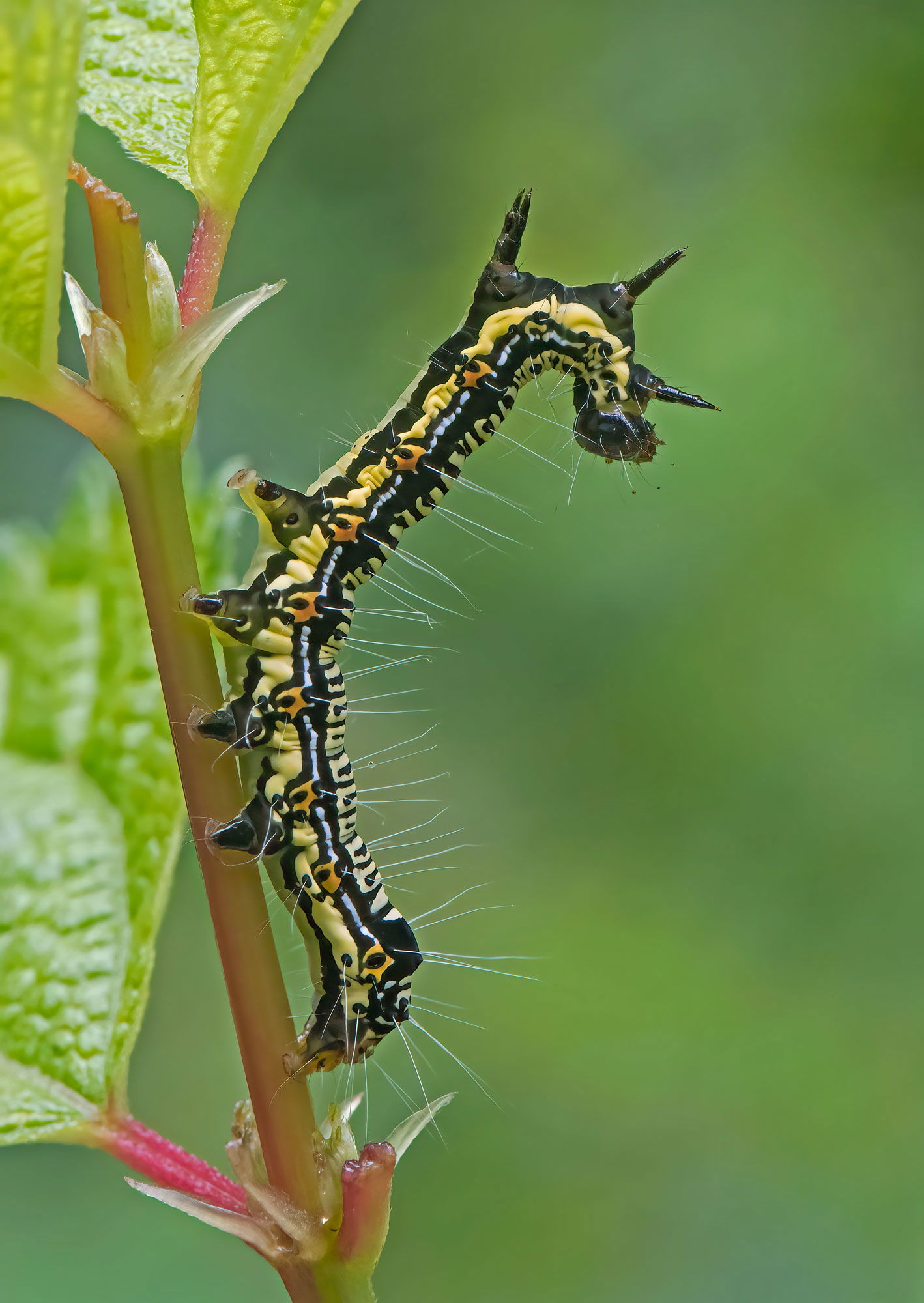
The very common larva of Arcte coerula rears up like a horse - as here -to discourage predators, and can spit out a green fluid for added effect. It may look pretty, but in some places - like Hawaii - it is an extremely unwelcome invader, as it is displacing some rare endemics. The Ramie plant you can see here has been used for 6000 years in E. Asia for making fibre. It is also used in Oriental medicine, as it contains some powerful chemicals. It is very common in Korea, and is also the host plant for the Red Admiral butterfly among others. It grows everywhere, and quickly. I used to avoid it as it looks like (and indeed is) a large nettle, but unlike the Irish nettle it has no sting. So - Ramie plant good, Ramie moth not so good.
Specific Feedback Requested
All comments welcome.
Technical Details
Is this a composite: No
D 500 + 105mm macro lens f14 1/160 ISO 1600
Topaz Denoise and PS Shadows slider. Cropped by 40%.
Agreed - the large view is excellent in its detail and smooth color transitions. The dynamic pose makes this a couple notches above your average caterpillar shot. That you got the sensor aligned with the whole plane of focus in the caterpillar shows great knowledge of the craft. And you didn’t crank the saturation slider which makes for a more natural image. Bravo.
Wow, Mike, what a shot, and what a story to go with it. That pose he gave you really makes the shot special, but how well you kept everything in focus is great too. Love the composition. The larger view is a must.
Fantastic detail, Mike. Gorgeous colors, composition and dof. Thanks so much for sharing all of the history and background about this moth. Great info. Nicely seen and captured.
You nailed this one perfectly. This type of behavior is also used by pine sawfly larvae in a group display. The soft lighting worked perfectly and the setae are nicely defined. Excellent job…Jim