Critique Style Requested: Standard
The photographer is looking for generalized feedback about the aesthetic and technical qualities of their image.
Description
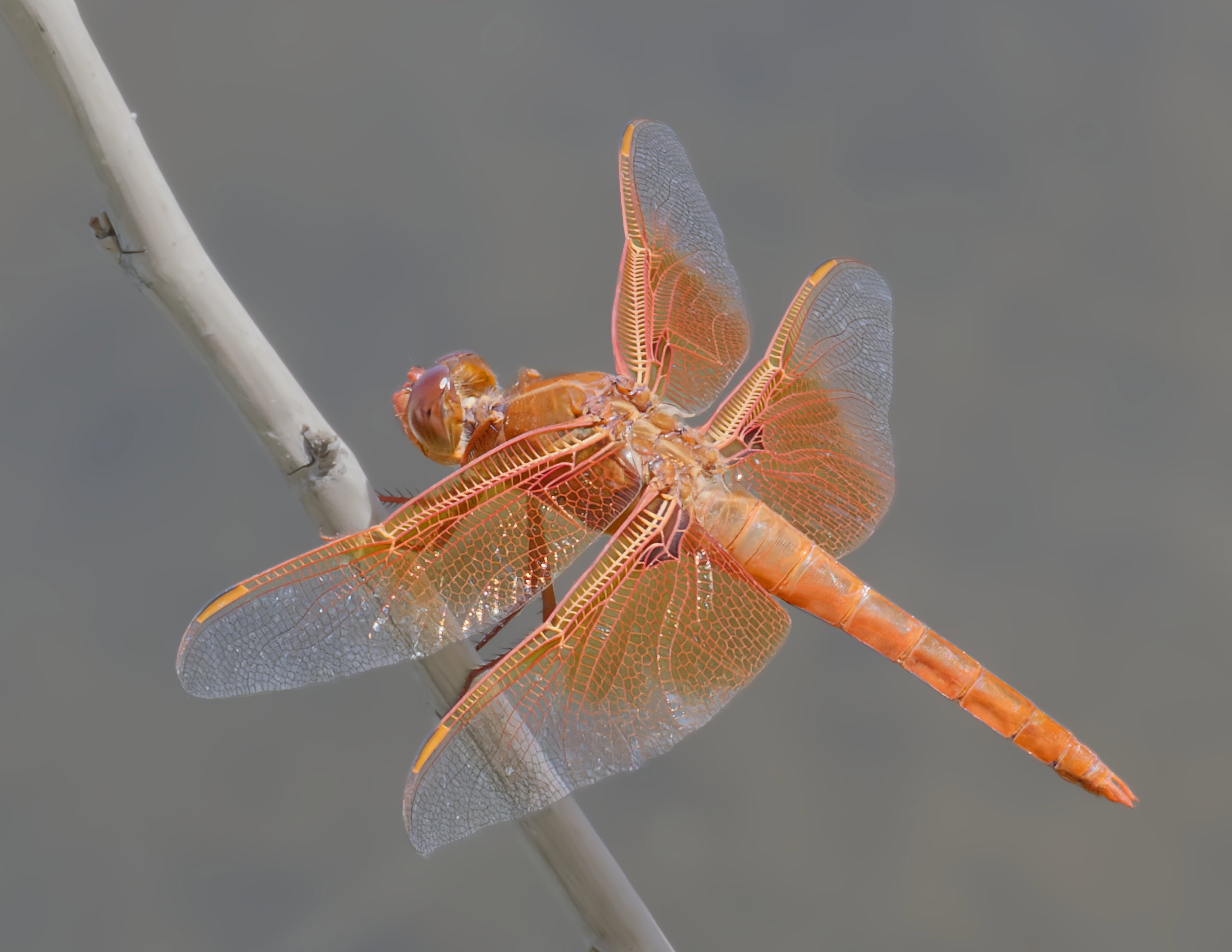
This photo is one of the best images I’ve captured of dragonfly wings. I’m fascinated by their natural history.
Your basic dragonfly wing is a thin, transparent membrane supported by a very complicated network of veins. The vein network divides the wing membrane into hundreds of small polygonal cells, which distribute stress more evenly than any regular geometric lattice. In this photograph of a Flame Skimmer, you can clearly see that the veins also have a corrugated accordion-like cross-section. This dramatically increases the wing’s stiffness, without adding mass.
Dragonflies have four wings, and all of them can be independently controlled. These animals can hover, fly backward, and fly sideways without twisting their bodies. They make banked turns so precisely that they capture their prey 95% of the time. Biometrics researchers are designing and studying dragonfly-like vehicles that could revolutionize aircraft wing designs in the future.
Specific Feedback
I am interested in all your comments. I’m especially interested in how excellence in photography and post-processing can contribute to our understanding of natural history.
Technical Details
OM Systems OM-1 Mark II, Post-processing in Affinity
1/500, F16, ISO 2000, 150mm, no flash
Wonderful capture with very nice DOF, and very interesting information! I think you could bring up saturation quite a bit as these guys are well-named for their vibrant color.
Russ: A great capture indeed with amazing detail. Such a pristine subject with terrific sharpness everywhere. Thanks for the natural history lesson as well. I whole heartedly agree that photography can do much to bolster our understanding. Most excellent. >=))>
Russell, an excellent dragonfly shot, and your description of the wings is fascinating. The whole field of biomimicry is very interesting to me, especially for the study of flight which you mention (butterflies and hummingbird hawkmoths too). I am not a scientist, and I don’t have the resources to use all the gear that scientists have available. So I’m often torn between going for as much accuracy as possible and seeking an attractive - even beautiful - shot.
I look at this shot and think: the colors and angle are very good, as is the overall composition. To gain an even better understanding of the wing structure, I’d take the photo from an angle more directly behind the insect, with as white a BG as possible. I think most of us in the macro part of NPN fall into the mixed category of “get a creative AND informative shot” for most of our efforts, and you’ve achieved this very well here. I also think we are somewhat “citizen scientists”; specialists can be helped by us uploading our most interesting shots to iNaturalist and eBird, to add to the world view of things in nature. End of my 2 cents!