The photographer is looking for generalized feedback about the aesthetic and technical qualities of their image.
Description
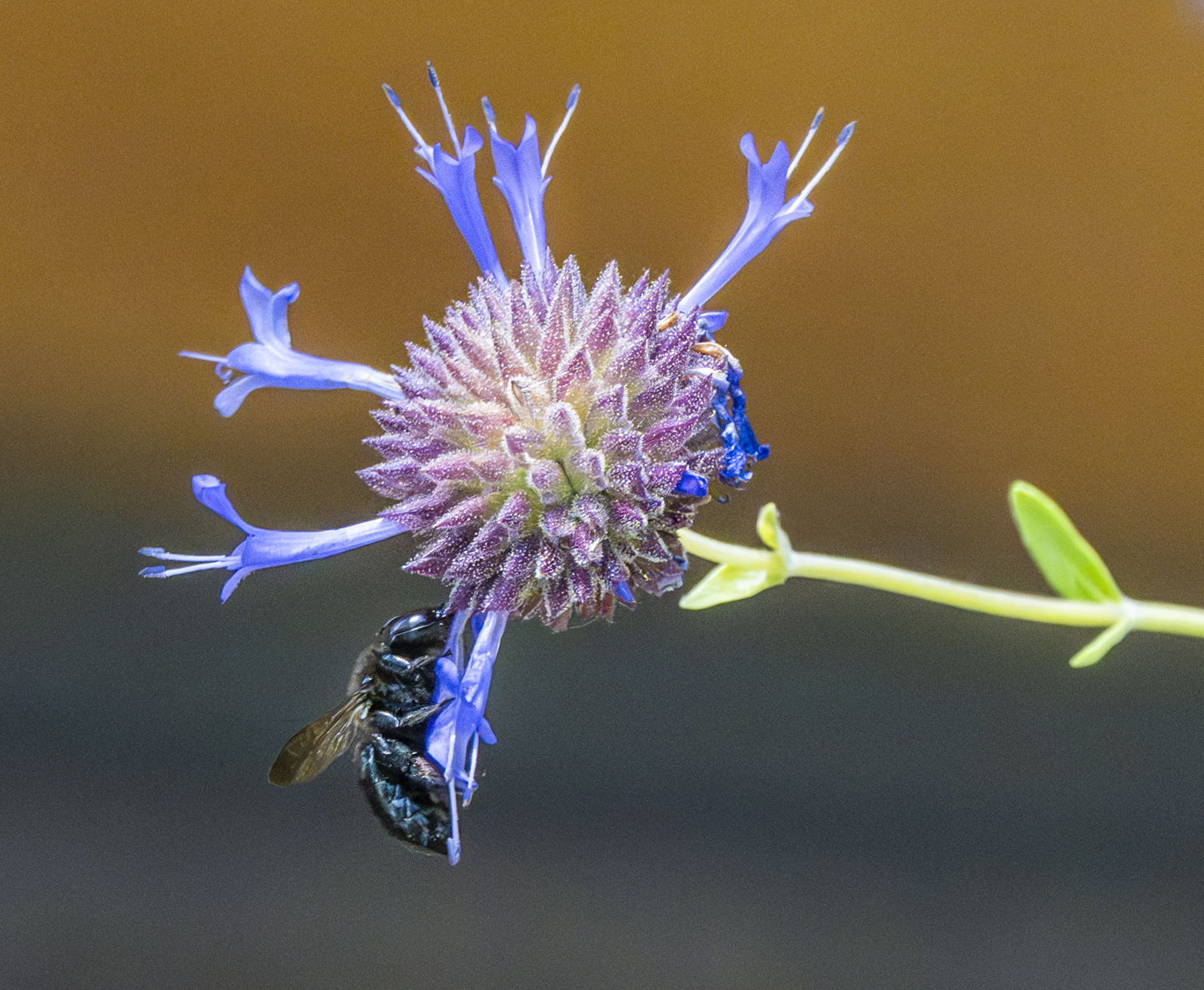
I have some cleveland sage that I’ve planted near the door for the look, and aroma. We like it and so do the bees and hummingbirds. I was out while ago hoping that a hummingbird would show up. I never did see a hummer but it was some bees showed up. I will shoot anything that moves. I liked this shot. I think its BG is interesting. It’s my house wall partially in the sun.
Specific Feedback
I am interested in hearing about any input on cropping, and what about the orange in the BG?
Technical Details
Z9, 180-600 lens, Nikon 1.4 TC, monopod, 1/1000th, f 9.0, 1260mm, ISO 22800, cropped to 1895 x 1980.
Critique Template
Use of the template is optional, but it can help spark ideas.
Dave, I suspect the softness is due to noise (still have some in the image) and large crop. I have found when I have noise I shouldn’t crop. As for the BG, I’m good with the orange and blueish gray. I like that flower. I have never heard of it. Nice to know that it attracts hummingbirds as well as bees.
A nice composition with a killer BG. This type of image benefits from shooting with a lower ISO. The subjects are fairly sharp but the hairs on the bees thorax are fuzzed out due to the overall resolution of the lens system and the hefty crop. As a suggestion, you may want to purchase a used 200mm f4 Micro which pairs nicely with the Z9. It is an older lens that can only be used in manual focus as its only limitation. I have been waiting for Nikon to make a Z mount version of this lens. Extension tubes will enable you to move in closer, but the amount of additional magnification is very small. Longer tubes also increase vignetting with an additional loss of light…Jim
Dave, that’s an amazing looking flower and bee, set off nicely by the background. The large crop and high iso show in the larger views but sadly no one is making a 200 mm true macro lens for mirrorless cameras, when that longer length is critical for best quality shots of smaller subjects like this. The modern tele zooms that focus to about 1/3 life size (like yours and my 100 - 500) work well for larger subjects like swallowtail butterflies and many of the dragonflies. With extension tubes, the magnification gain goes as the ratio of the extension length over the focal length, so adding 30mm of extension at 600 would only increase your magnification by 5%. For my R5 and 180 macro, adding 36 mm of extension (a 20% increase in magnification) causes significant vignetting in the corners.
Dave: Not much to add to @Jim_Zablotny and @Mark_Seaver regarding the technical issues but I really like the overall appeal of the image. I have sometimes taken shots like this and dolled them up with some PS filters to mask the flaws. I think this one would be worth the effort. >=))>