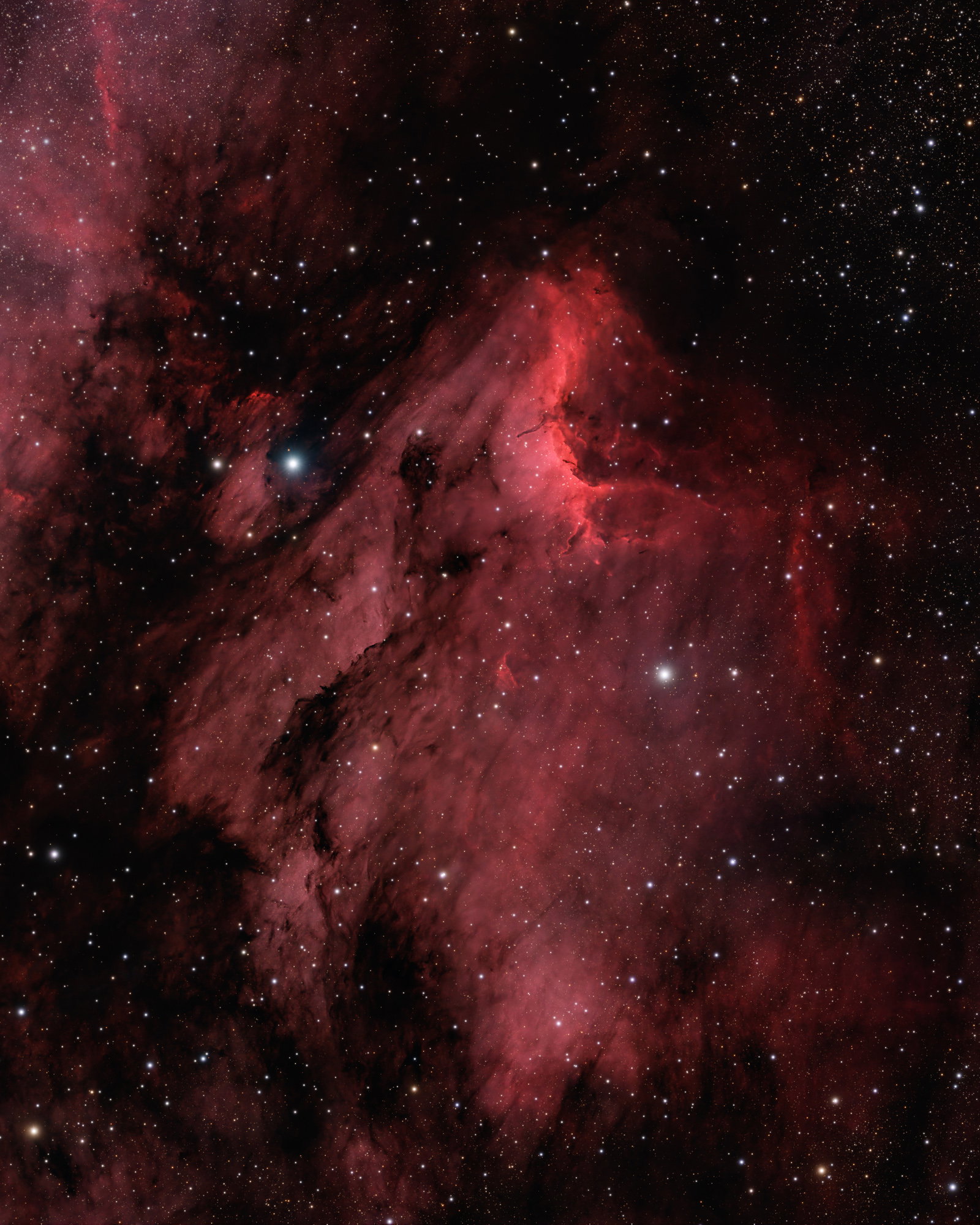
Critique Style Requested: Standard
The photographer is looking for generalized feedback about the aesthetic and technical qualities of their image.
Description
Last Thursday was the last clear, dark night for the foreseeable future, and I got a good set of images out of it.
Specific Feedback
All comments welcome!
Technical Details
I’ll spare you the details. 56 5-minute frames, 4 2/3 hours of exposure, with a little moonlight the first hour or more. No filters. Processed in PixInsight. Slight crop for composition.
Diane, as always, it seems technically perfect. I know very little of deep space photography so had actually no idea what a “good” Pelican Nebula looks like. I had a wander around the Internet and I notice there are a few of vastly different colouring to yours. Assuming you are using an IR modified camera, is the red end of the spectrum swamping the other colours? Given this photo (assumption) is for Human consumption, would it be better if only the Human eye visible spectrum is shown as modified eye colour curve sensitivity? I do like how the stars do not swamp the nebula structure. I hope I have not thrown a cat amongst the pigeons!
Either way, I enjoyed spotting the pelican
Rob
Thanks, @Rob_Sykes ! There is a lot of color variation in general astronomy images, because many amateur astronomers don’t have a good grasp of accurate colors, or poor techniques or bad monitors. My astro camera, the ZWO ASI2600MC Pro, is a color sensitive sensor similar to our daytime cameras that records most of the emission specrta of deep sky objects, which are a set of very precise frequencies emitted by different kinds of atoms excited by cosmic radiation. So it largely matches an IR modified camera in which the longer red wavelength cutoff filter has been removed. That filter is there because longer wavelengths focus at a different-enough distance to the other visible colors to contribute some softness to images. So it is capturing basically the range we can see. In this case the nebula color is predominantly the Hydrogen-alpha line which is 656.28 nanometers. That is within our visible range but it would hardly be seen through a telescope due to its dimness. My processing doesn’t modify the colors, and the star colors are also accurate, although there aren’t many colorful stars here. A few show the warm color of cooler stars and the is a blue one, which is hotter. One of the steps in processing with PixInsight is called SpectrophotometricColorCalibration, and it uses a database of the stars in the actual visual field to neutralize any color cast and give an accurate white balance – so colors are very close to accurate. Some advanced deep sky imaging (including the orbiting telescopes) uses a monochrome sensor and rotates several color filters and combines the result. The resulting image has higher resolution but has very artificial colors. Some light pollution filters also cause unnatural colors. They are accepted as a tradeoff for resolution and contrast but look very strange.
Very cool, Diane. As I looked at it, I was wondering about the color, but your explanation answered my questions.
Downright phenomenal Diane!
I can’t speak to this technically, but I can say your astro images keep getting more and more amazing!
Congrats! Beautiful work.
Thanks, @Don_Peters and @Lon_Overacker ! I guess I should add a bit more to the processing notes to support authenticity. It blows me away that amateurs can do stuff of this level from their back yards.