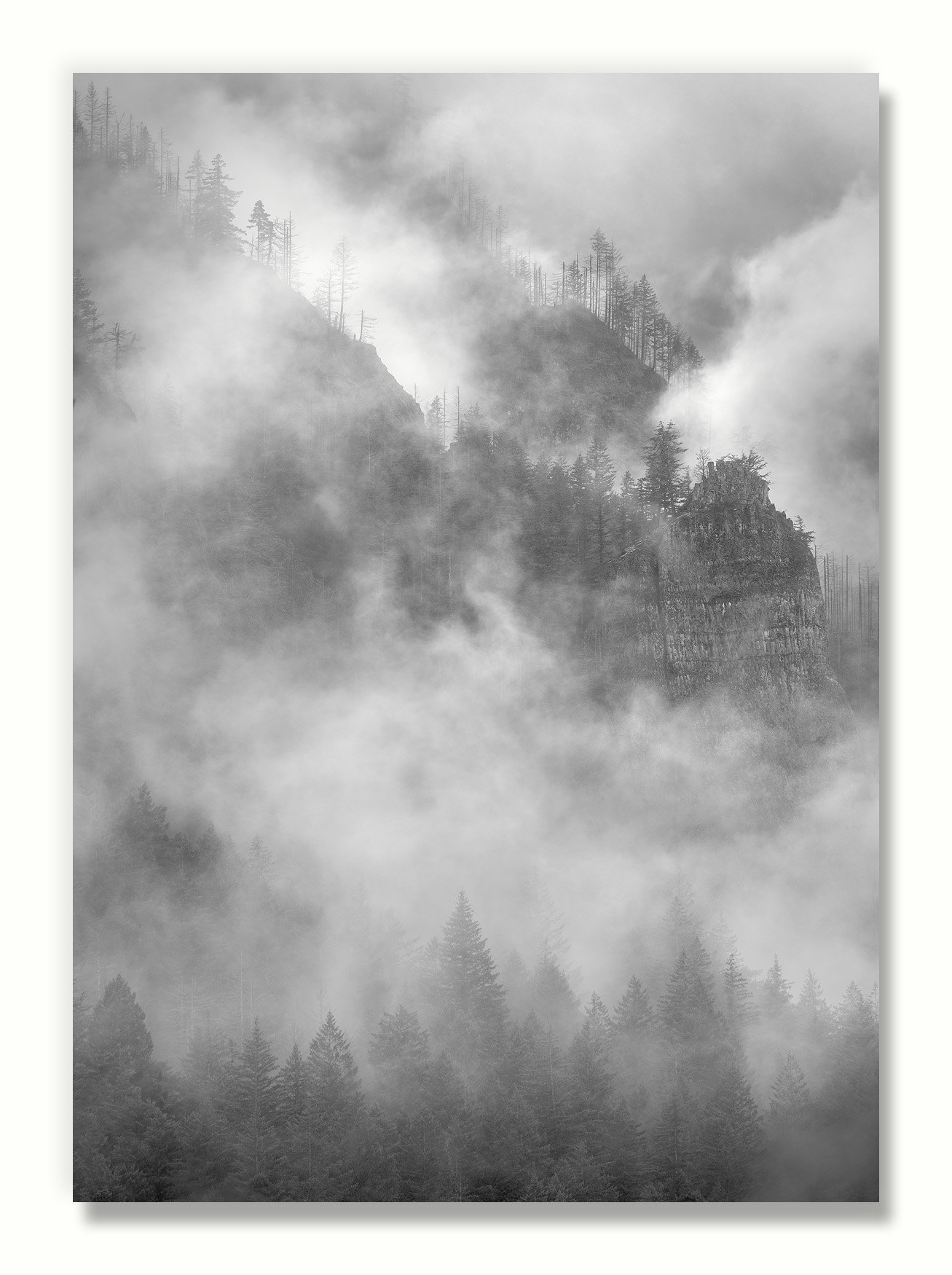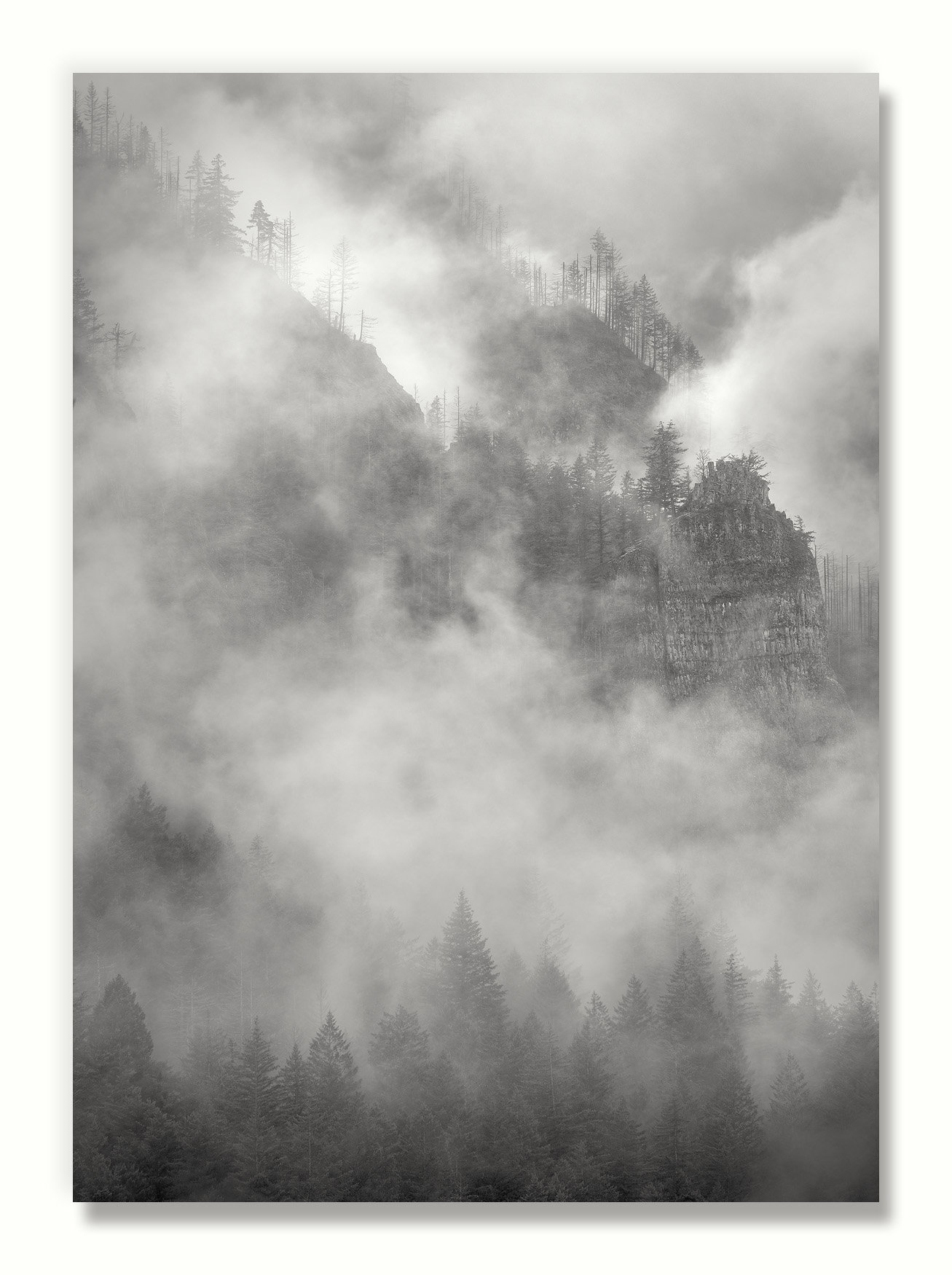
The Ramparts

Edit:

Original:

Critique Style Requested: Standard

The photographer is looking for generalized feedback about the aesthetic and technical qualities of their image.

Description

In February, @James_Lorentson posted information about fog-index.com. Have any of you had a chance to play with it yet? I signed up for the free trial a bit ago, but unfortunately ended up with an upper respiratory infection and wasn’t able to capitalize. James was kind enough to extend that, and I’ve been using it to keep an eye on the Columbia River Gorge. The website gives all kinds of information about fog and clouds, including likelihood, density, what elevation the clouds start at, what elevation is above the clouds, etc. If you check it out, take a look at both the “About” and “Blog” sections. There’s a ton of info in those two.

Anyway, I was finally able to go check it out last week. The walls of the Columbia River Gorge can be mesmerizing when the fog is hanging over the edges. It shows depth and textures that don’t really pop out otherwise, and I was fortunate to spend an afternoon playing with the tapestry that is part of a National Scenic Area.

Specific Feedback

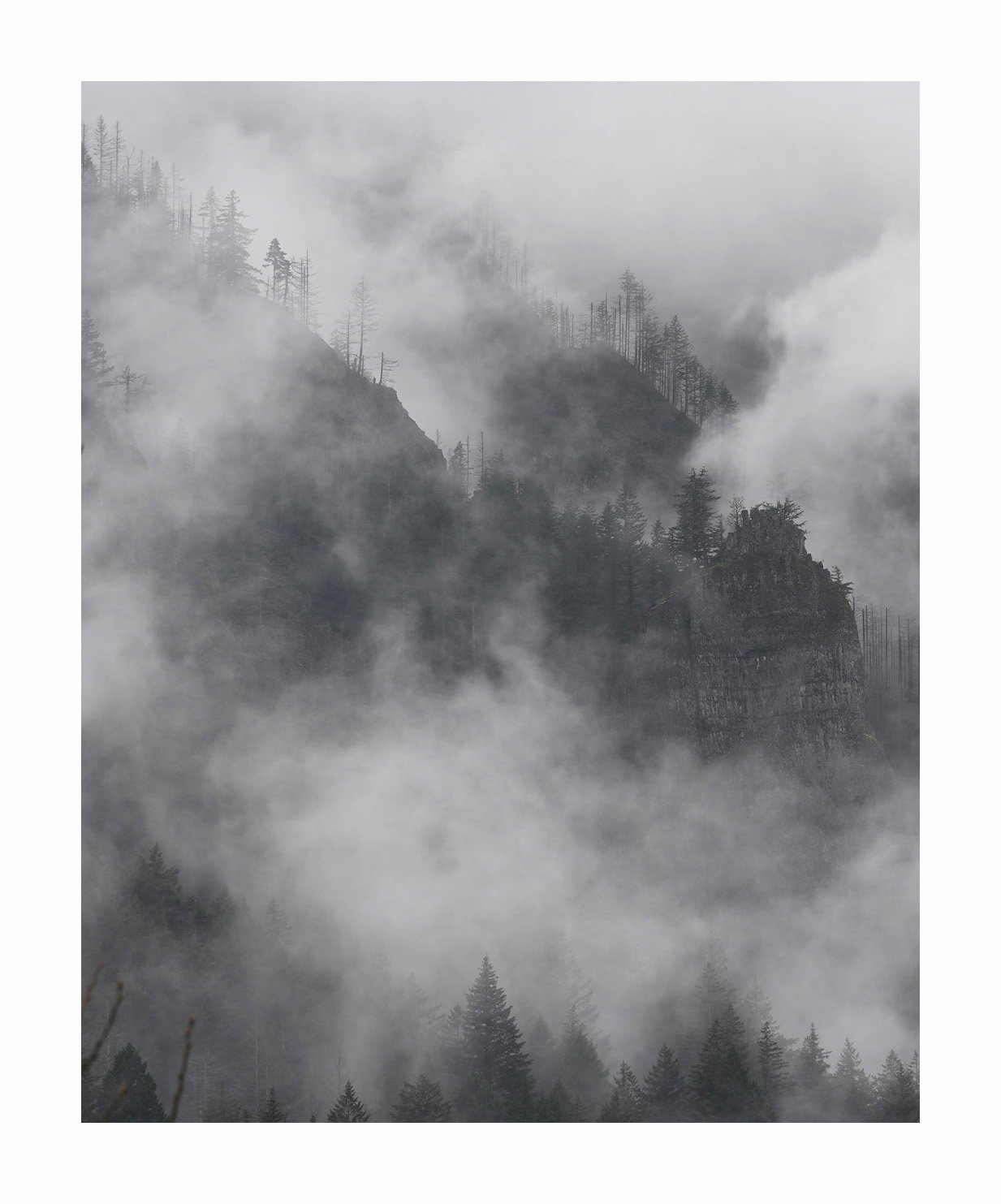
I normally want my images to span the histogram, truly hitting black and white points. However with fog, I find that sometimes removes a lot of the low contrast mystery. I’m curious if you think the contrast here is good (or too much/too little)? I’ll post the sidecar jpg below so you can see what the camera actually captured; that may help in considering that question.

I’ve also slightly (barely) toned this warm, because I thought it added a bit to the mystery of the image. Does that seem to fit?

As always, all suggestions and thoughts are welcome.

I’ve removed several oof thin branches from the lower right corner that I didn’t notice were in the frame when shooting, focused as I was on the canyon wall. (That was a bummer, because I could have walked just a little farther down the road and avoided them.)

Technical Details

NIKON Z 7II
NIKKOR Z 24-200 f/4-6.3 VR at 200 mm
1/80 sec. at f/9.0 and ISO 64
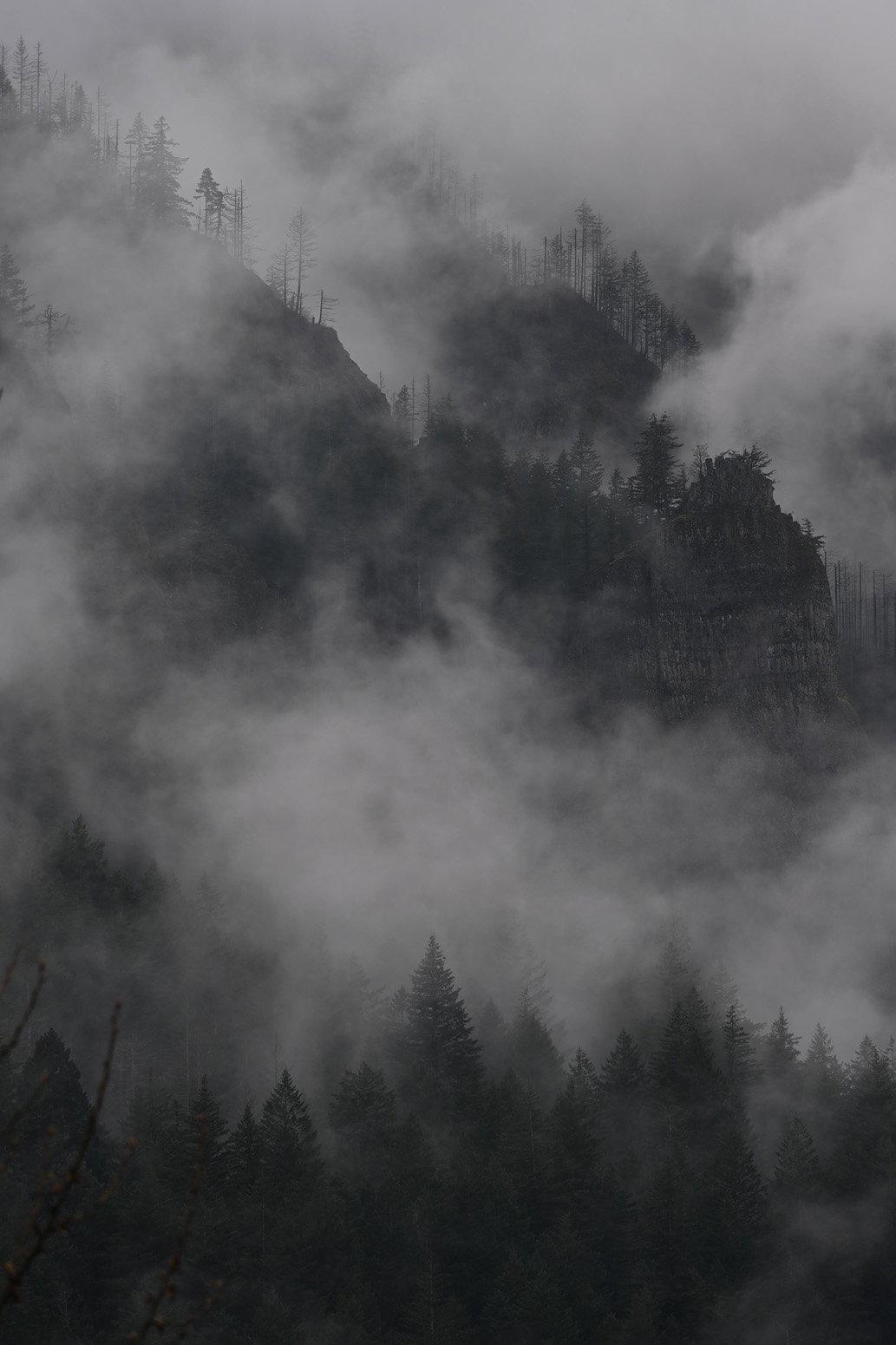
Here’s that sidecar jpg.

John, this is a very mysterious view. I really like the emphasis on the distant ridges. Because of that I would be tempted to either crop out the dark strip across the bottom or, more likely, do some more dodging to keep the darkness down there from pulling attention away from those outstanding ridglines.

David Kingham, introduced me to Windy.com which also can make fog predictions (as well as all other kinds of weather). I don’t know how it compares with f0g-index.com, but it does offer a free version with lots of weather prediction capabilities.

1 Like

@John_Williams what a great image. The repetition of the trees and fog through the frame is so nice to look at. I’m with you, I like a full range in my images. A few small suggestions that might help the overall tone: I’d bring down the darks a little more on the very top trees to the UR and some on the trees at the bottom as well. I think it would give a little more weight to those spots. The other is dodge/lighten some of the really gray fog in the middle of the frame. I think that would help pull out the textures more in that area. I can see it’s almost there. Nice.

I, too, tend to raise the exposure with fog as it fits the mood of the subject. However, in doing so the light usually starts to look flat. Perhaps that is how it should be. Fog light is flat. But even in your underexposed image there is a ‘voluptuousness’ that a smooth transition of tonal range from high to low that has such aesthetic beauty. And no matter how much I try in postproduction I can’t seem to retain it when converting to a lighter image. This aesthetic beauty is really what make Adams work sing, especially with clouds.

I’ve decided that good fog images, like all subjects, is dependent on light. In my opinion side lighting is usually the best light for most sunlight images (because shadows are part of a composition). But with fog the optimum light is when the sun is behind it and passes through the fog. That causes the fog to glow and gives that rich range of tones.

https://community.naturephotographers.network/t/sentries/47912

vs

https://community.naturephotographers.network/t/obstacles/42410

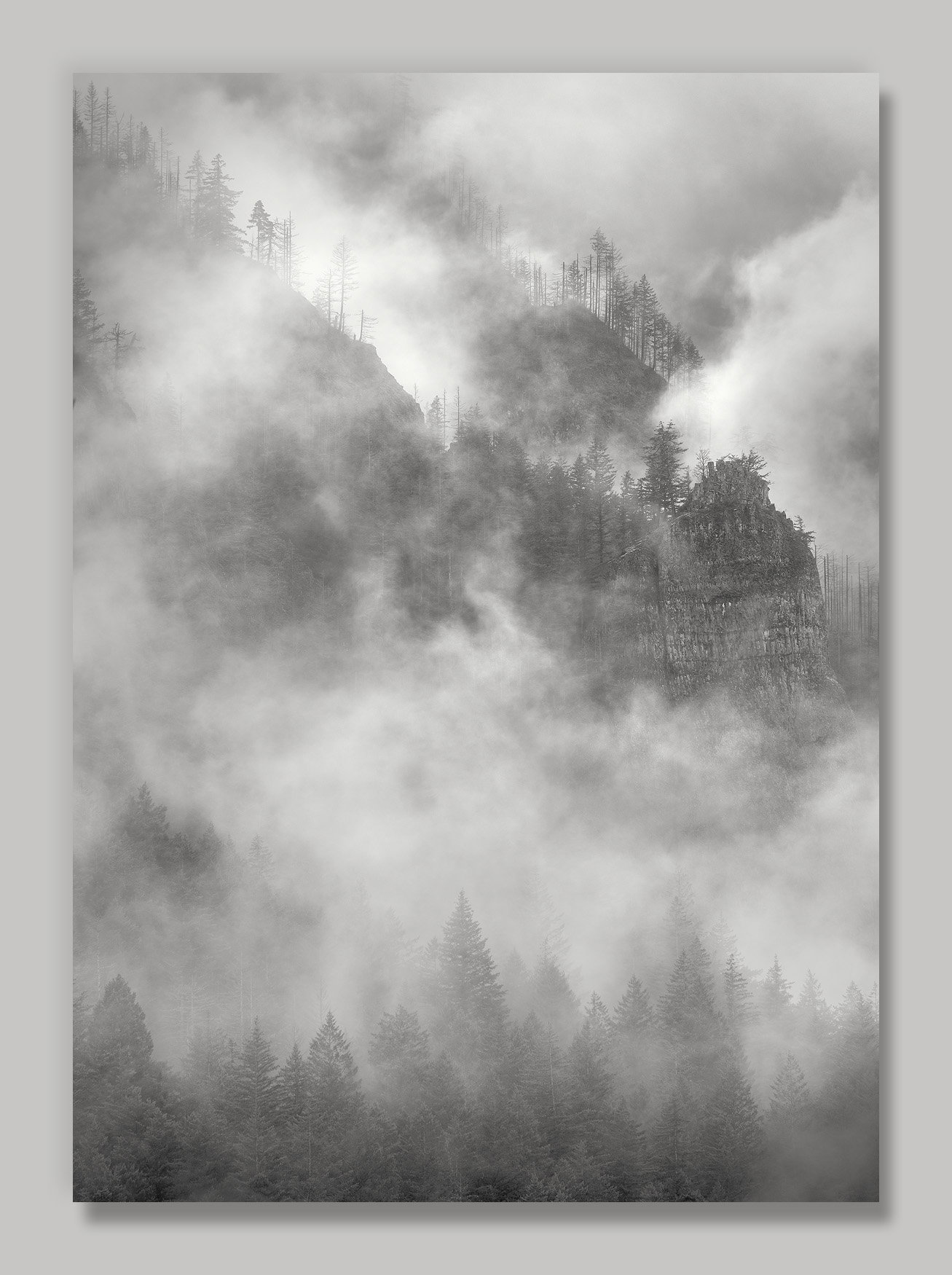
I did try to process your image with my ideas but am not really happy with it. But I’m posting it because I think the composition is an improvement and could be useful to you.

One thing I would do with the fog index app is figure out where the sun will be with respect to the fog and drive to ahead of time to get the backward lighting when the sun is about the break through. In my image I just got lucky but this app could really up a success rate.

Really nice, John. Fog is a challenge, and really, the effect you want to achieve is pretty subjective. I like both your version and Igor’s. I think a little more contrast and brightness overall could be the sweet spot. That said, the mystery and sense of gloom in the original is pretty fantastic.
ML

Thank you @Mark_Seaver ! I’ll comment on Igor’s crop below, but to your point about dodging I think that’s a good idea. Looking back at my steps, I added a vignette and I think that’s overdone down there. I’ll work on that. I have never played with windy.com’s fog predictions. I know James uses Windy, so I suspect fog-index is different. If he catches this thread, maybe he can comment.

@patrick6 , I really appreciate the thoughts and ideas. Do you mean the trees in the UL? (I don’t think there are any in the UR?) With chagrin I have to admit I knocked back the very brightness you suggest for the gray fog in the middle, because I wanted the eye to flow to the ridges above and I found that middle tended to become the focus to my eye. I likely took it too far (or it may have been better to just leave alone).

@Igor_Doncov , thanks for taking the time to work a version of this. I actually went to the Gorge chasing the fog because I have a few photos from prior years and have thoughts of maybe throwing them all together as a project at some point. However, all of them so far are a 4x5 format and I played with cropping similar to your version. I agree it is a worthy version, but enjoyed those trees enough I decided to keep them for the version posted here. I’m glad you prefer the 4x5, because if I ever do that project I’ll use your crop. Your points about light and fog are good ones, and I’ve enjoyed that effect in the past.

@Marylynne_Diggs Thanks for your suggestions.

That’s a point well taken. I find that true with fog, and maybe even more so with black and white. (There seems to be a pretty strong polarization in black and white between those that like lots of deep, dark, black/high contrast and those who prefer less contrast and a bit of shadow detail.) With areas that are so subjective, I find the feedback even more helpful whether I personally agree or not.

Just a stellar image John! One of those images your eye can roam around in endlessly, with all those great elements and detail. I like your choice of processing that you kept a subtleness to the image and didn’t go real contrasty with it, beautifully done! Nothing to change here. I like your original composition with the trees at the bottom, they add another nice layer to the image and provide a hefty base for the rest of the image, which seems to balance the composition better to my eye.

1 Like

This is terrific, John. My only suggestion would be to lighten the bottom a little and you’re onto that.

2 Likes

I like this a lot, John. Personally, I think the contrast is just about perfect. Getting too much would ruin the whole feel of the image. Admittedly, I am generally not a great fan of high contrast black and white to start with. While it is appropriate for some images, I feel that it’s used far too much.

2 Likes

A very nice image, and I do prefer your treatment to the out of camera jpg. Others have already made the man comment I had, which was that I wondered if it could be still better with less weight on the bottom/front. I also wondered if it would help to dodge some of the clouds above the last peak in the middle, to draw the eye there.

1 Like

Hi John, great image! I personally prefer a warm toned black and white image. I think it does add something extra, especially to this image. With very old geologic formations and forests, it gives the feeling that the image could have been taken 50 years ago sitting in a box in the attic or yesterday, and I enjoy that compression of time. I haven’t heard of fog-index.com, so I’ll have to give that a look.

1 Like

Thank you all again! (And welcome to NPN @lynsie !)

I’ve added an edit trying to tweak in the suggested direction of the comments. The changes are small, so maybe not enough, but hopefully it’s an improvement. I really appreciate the feedback.

(I also decided the frame was too bright, so I’ve dropped that a notch too.)

The rather subtle changes made a big difference in this image, John. Well done.

1 Like

The rework is definitely an improvement.

1 Like

@John_Williams, thanks so much for the shoutout for Fog-Index—I’m glad it helped you time that window for the Gorge. Curious if you remember the fog score that morning?

Really enjoy this image. I’ve thought about the possibilities along this stretch of the gorge on many drives and you’ve capture the layers and mood well here. Regarding the contrast: I think you are right to resist the urge to span the whole histogram here. When we’re chasing mood and mystery, the midtones are where the story lives. I usually like some of the fog to be close to white because when it is all mid-tone, it can come across more like smoke than fog. But pushing for a ‘true’ black in fog usually kills the ethereal quality and makes the image feel too clinical IMO. Of course your creative expression, especially with black and white, should dictate, but I think he low contrast here captures that ‘tapestry’ feel you mentioned.

That’s a great point, @Mark_Seaver. Windy is an incredible tool for visualizing raw data, but the core difference with Fog-Index is the move from a ‘pull’ to a ‘push’ workflow.

With Windy, you have to manually check every location, every night, and interpret several layers yourself. Fog-Index acts more like a proactive radar—you save your specific spots, and it taps you on the shoulder with a notification only when the conditions are actually prime.

Technically, the underlying logic is also different. Most generic apps simply display the ‘fog’ code directly from a single weather model like ICON (what Windy uses), which can frequently miss photogenic mist. Fog-Index doesn’t just pull a pre-made code; it runs custom-tuned algorithms designed specifically for photographers and then cross-references multiple models (like ICON, Tomorrow.io, and NWS) to provide a higher-confidence ‘Fog-Index’ score.

It’s less about replacing the raw data and more about automating the search for the specific atmosphere we’re after. Cheers.

1 Like

Thanks James, I appreciate the thoughts and expertise!

My memory is that push notification that came several days prior was a score of 86. I know the actual “day of” score was less, but don’t remember the exact number. (In the 40s?) The good news is I think that meant the fog just climbed a bit, which is what I wanted. If it was full fog in Cascade Locks I wouldn’t have been able to see the walls at all.

Hi @James_Lorentson ,
Is your fog app just for locations in the pacific northwest or will it work for locations on the east coast?

John,

Wonderful composition and the photo does impart a sense of mystery. Would you mind posting the edited version again but with the same brighter border? The darkened border trips up the the other tones in the photo and I can’t tell if it was the edits you made or the border that is causing the apparent visual change.