The photographer has shared comprehensive information about their intent and creative vision for this image. Please examine the details and offer feedback on how they can most effectively realize their vision.
Self Critique
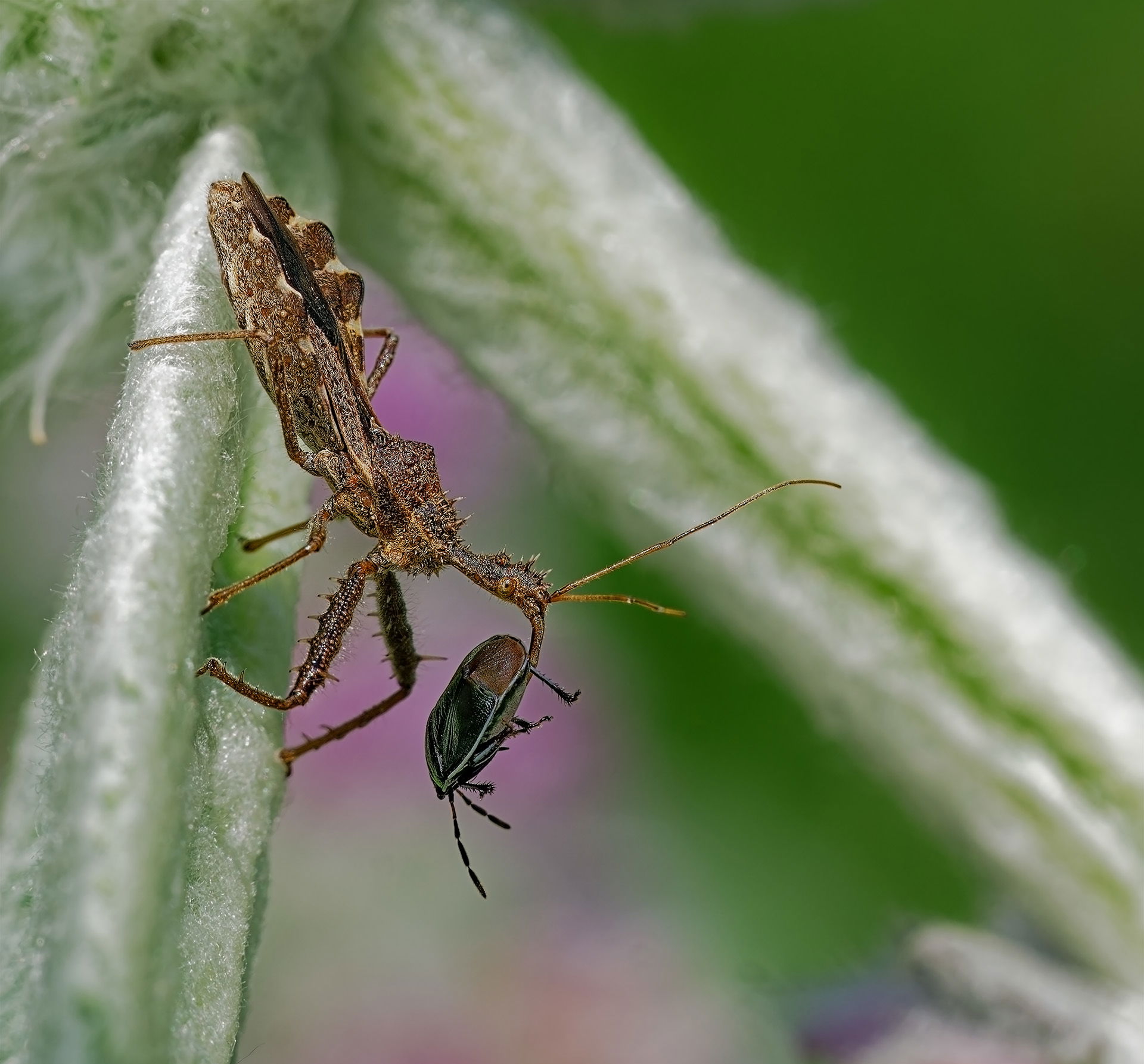
The focus on the bugs seems good. I’m not sure if it’s overly sharp or too tight. It was a larger picture, and I cropped it more tightly based on previous feedback.
Creative direction
I wasn’t aiming for a distinct look, and I didn’t have a clear vision. I came across this assassin bug slowly devouring its prey and wanted to document it as best as I could.
Specific Feedback
I’d appreciate feedback on any aspect of the image.
Technical Details
Fuji X-T5
1/2000 sec, f/5, ISO 1000
80 mm macro lens
DxO Photolab + NIK Color Efex + Photoshop
Description
The assassin bug took its time capturing the little bug, and I took a series of about 20 or so images as it was doing so. This was my favorite of the bunch, as the two bugs were very clearly separated, and it was a peak moment.
Critique Template
Use of the template is optional, but it can help spark ideas.
Vision and Purpose:
Conceptual:
Emotional Impact and Mood:
Composition:
Balance and Visual Weight:
Depth and Dimension:
Color:
Lighting:
Processing:
Technical:
Congrats - you did catch a great moment in the process. That’s how it goes with these kinds of things - nature rarely follows direction. I really like the level of focus fall off before and behind the insects - bonus pink behind them to frame them even more was nice. They stand out well and it doesn’t look too sharp to me.
What a nice find and capture, Canan. It was the perfect moment having the separation from the two stems of the plant they were on, and the nice oof BG. I can see why you asked about the sharpness, as on my screen in the enlarged version it kind of has that feel of over sharpened. It could be from a large crop, but I don’t think so. Recently on someone else’s image someone recommended toning down the highlights just a touch which helped that image. This one reminds me of that one as the tiny highlights on the assassin bug could be what makes it appear a bit over sharp. Just a thought. I would be thrilled if I had captured this shot.
Canan: Welcome to NPN and congrats on a fine first post. Your timing was just right and your DOF management is just about perfect IMO. I don’t think this is oversharpened. One of the telltales of oversharpening is haloing around hard edges which would be evident around the antennae especially and I don’t see any of that. Great to have you aboard and looking forward to more of your work and comments on other member’s images. >=))>
Thanks a lot, Bill, for the welcome and for the feedback. I wasn’t really aware of that oversharpening indicator. I’ll pay more attention to that in the future, as I strive to not go over that fine line between a nicely sharp image and an oversharpened one.
The crop looks good to me, Canan. A very interesting pair of insects and very well photographed. I agree that the slight appearance of excessive sharpening is probably just those highlights. A fine image and I’m looking forward to seeing more of your work and your comments on other folks efforts.
Really love this image. The assassin bug looks almost cute until you realize what it’s doing. I don’t have a problem with the sharpness and the DOF is perfect.
Since I feel like I have to say at least something to improve, I did feel like my eye flicked a few times to the out-of-focus blob in the lower-right corner. I would consider cropping it out, assuming you haven’t already cropped a bunch and are running out of megapixels.
( A gear question for you, as I also shoot with the X-T5. I have their 60 mm macro. Is it possible to make good insect photos with that lens, or should I spring for the 80 mm? Would an extension tube help? )
Hi Rich and fellow X-T5 user! Thanks for the critique. I’ve already cropped this image three times because it took me a long time to part with the pretty flowers in the background, but I’ll see if I can crop it even tighter.
As for the gear, the only macro lens I’ve ever owned is the 80 mm, so I can’t answer the question about the relative merits of the 60 mm vs. the 80 mm. I love the 80 mm, but it’s been a real challenge to get the focus right. I got three extension tubes but find that they make focusing with the macro lens extremely difficult, unless you photograph static subjects on a tripod. Otherwise, it’s very hit and miss, but it’s possible to get very dreamy pictures with a razor-thin depth of field using the extension tubes. Have you taken advantage of the free one-on-one consultations that Fuji offers (https://shopusa.fujifilm-x.com/tech-time)? I’ve found them very useful. This might be a good question for one of those consultations. There are also helpful Fuji and macro groups on Facebook that you could take advantage of.
Rich: I’m not an X-T5 user but I will offer some insights on insect photography and gear. I started my macro journey with a 100mm lens and found it terrific for floral and static subjects and for slow moving bugs like this. But I wanted to shoot butterflies and dragonflies and often could not get close enough unless I was willing to crop a lot. I pulled the trigger on a 200mm macro in 2001 and have used it as my primary macro rig ever since. For flying critters length matters. Now with that said, over the past couple of years I’ve shifted from the 200mm to using my 70-200 with extension tubes. All the tubes do is give you closer focus with a standard lens. I used to hate using tubes on a zoom lens because changing the zoom would also change the focus and my subjects would often tire of me fiddling around and fly away. . Now the autofocus is so good and quick that it gets me really close to where I want to be and if I have to make refinements they’re usually small and easy to dial in. I can also put a 2xTC on the 70-200 giving me a potential 400mm reach. So the short answer regarding insect photography is generally longer focal length is better. If you are interested in butterflies/dragonflies you might try tubes on any longer lens you have. You will lose the ability to focus at infinity though when the tube is aboard. Hope this helps and if you want any further info please let me know. >=))>
A very nice first post, Canan! The insects are so sharp and well-detailed with a very pleasant BG. I look forward to more of your work and your comments on other images. And congratulations on the EP!!
Welcome and thanks for a super shot. You could remove that blob in the LRC with the Clone tool, but it’s not a big deal. Recently I’ve been having a lot of fun with a 60mm macro lens. It depends on the insect - Bill is absolutely right about a longer macro lens for flighty critters, but you could often catch them at dawn, asleep, or at dusk when going to roost, with the 80mm. And there are so many bugs, spiders, etc. which don’t run away that fast, especially when you’ve got good stalking skills. The minimum focusing distance is also important for the more sluggish things. You might also consider the Raynox 250 close-up lens which easily pops on the end of any lens if you want to get right up to and magnify tiny insects. And maybe you’re into flowers too; again your 80mm lens could be great for these.
Thanks, Mike I wasn’t the one who asked the question about the focal length, so I hope Rich Ruh reads your comments. For now, I’m happy with the 80mm lens & not thinking of getting any other macro lenses.
I have been doing macro photography for about 2 years now (mostly during critter season) & I have actually grown to like not getting super close to the subject. I’ve come to think of macro shots as kind of like landscapes with wildlife in them, except all on a tiny scale in nature. It’s interesting to see the individual cells in a fly’s eye, but I think that’s more about the insect than about photography as an art form. I think having a slightly wider field of view challenges one’s photography skills more. So I can see why one might have a lot of fun with the 60 mm lens, too!


 . Now the autofocus is so good and quick that it gets me really close to where I want to be and if I have to make refinements they’re usually small and easy to dial in. I can also put a 2xTC on the 70-200 giving me a potential 400mm reach. So the short answer regarding insect photography is generally longer focal length is better. If you are interested in butterflies/dragonflies you might try tubes on any longer lens you have. You will lose the ability to focus at infinity though when the tube is aboard. Hope this helps and if you want any further info please let me know. >=))>