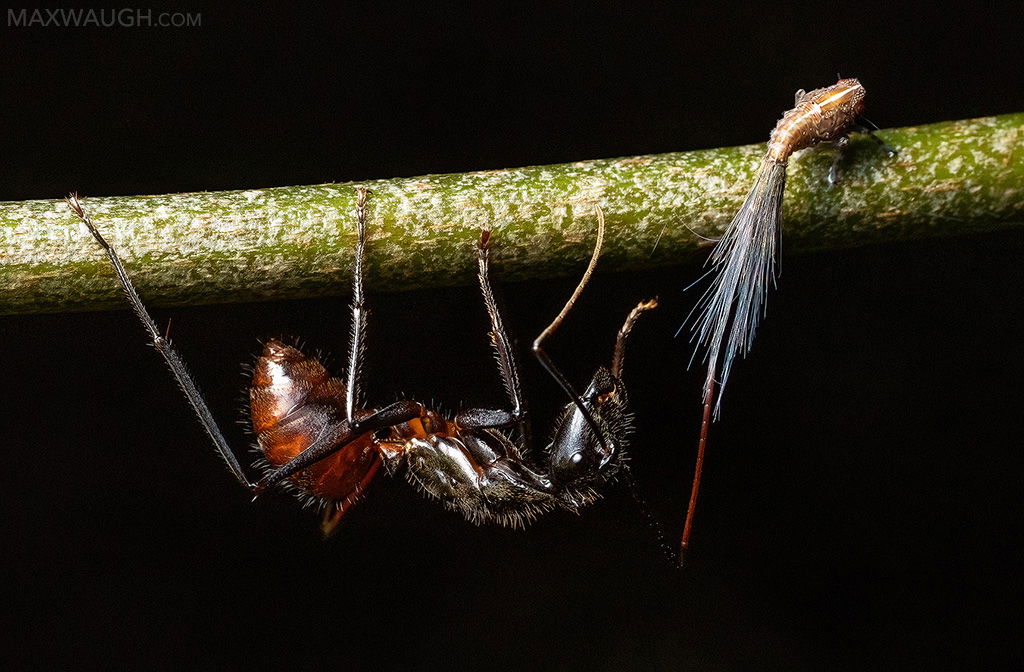
When I compiled my list of 2025 favorites, this ended up being my top image. In large part, it’s because I still don’t feel entirely comfortable and skilled as a macro photographer, but I’m slowly getting better, and get happy when I see I can occasionally take a proper macro photo.
This was also part of a series of fantastic night walks we enjoyed during my Borneo tour. There were plenty of small and fascinating finds. And since macro is something I do infrequently, many of the subjects are new to me (and therefore perhaps more interesting), but on this trip we were also fortunate to witness a lot of interesting behaviors on a tiny level. This was one such case.
There are many rainforest ants that have a symbiotic relationship with planthoppers, which secrete a sweet honey-like substance the ants like to eat. In exchange, the ants may provide protection to the planthoppers… essentially treating them like livestock. This is not that situation. Here we have a giant forest ant (nearly an inch long) approaching a planthopper nymph. The nymph wants nothing to do with the ant, and it’s using its waxy tail filaments to defend itself. Every time the ant tried a new approach vector, the planthopper angled its butt wax to fend it off. Eventually, the ant gave up and moved on.
Pertinent Technical Details
Canon R3
Canon 100mm macro
ISO 1600
1/100th
f/13
Off-camera flash with softbox
No video. Our guide spotted this mid-interaction, so I did my best to grab what photos I could. It didn’t last very long, unfortunately, but video would’ve been fun to show how that nymph kept quickly flashing its butt one way and then the other.
Oh wow, Max, this is really great! I can see why this is one of your favorite photos of 2025. That’s interesting the interaction of ants with plant-hoppers. I’m sure this was fun to capture and a thrill when you found it turned out so good.
Max, like you I do macro / close-ups very infrequently. I can see why this was one of your favorites for 2025. A wonderful image. Glad you shared the symbiotic relationship here too. At first glance I thought maybe this was a poster for the movie “Them” from 1954…
Max: Great lighting and fantastic detail in both critters. I also really enjoy the natural history lesson that makes the image even more exceptional. My only tiny suggestion has nothing to do with the image itself but on my screen the site BG is black so there is no way to discriminate the edges of your frame. I put a 3 pixel white stroke on the inside of my shots to give the images some separation from the BG. Do that and it takes the image to 11+/10 instead of a mere 11/10. >=))>
A very nice image, although one improvement to consider is to try to but a little flash on the BG which will enable you to get better separation of subject from the BG. Highlights are nicely controlled and help to define the structural features of ant and to a lesser extent, the plant hopper. Focus and comp are spot on and I think that this is worthy of being one of your favorites. Well done…Jim
With a black ant, I can see how this is a bit of an issue. Thank goodness it’s hairy.
My only counter argument is that inevitably in such scenes, the mish-mash of leaves and vines behind these tiny animals more often ruin a shot if they’re lit up due to random splashes of color and bright lines. Rarely is there a situation where the angle provided at close range (and with the flash angle) presents a uniform background that actually enhances the scene. I have plenty of examples of messy macro backgrounds, so I always lean toward black and isolation—if a single leaf doesn’t provide adequate background coverage—if I can light it for that.
Certainly, background clutter can be an issue. However, at macro magnifications background clutter becomes less of a problem due to the extreme limited DOF at higher magnification. I will 99% of the time set my exposure to under-expose the BG by 2/3rds to a full stop. This usually mutes out any starkness in background features and eliminate totally black backgrounds. In a lot of situations with macro, black BG’s are used for artistic purposes and it can work wonderfully. And this is shown in your photo where there’s enough light captured by those hairs and a bit of rim light helps define the outline of the ant.
Max: The issue only shows up when I enlarge it to full size. On the default gray BG of the original post the edges show up fine. On my iPad the site BG is dark grey for both the standard view and the enlarged image.
Very interesting observation, Max. In Korea we have a butterfly larva known to live inside ants’ nests and feed on their regurgitations. One of the great things about macro is that one can find completely new subjects outside the back door - or even inside the house (mine at least!).
Mike, that’s really cool. Another interesting find on our trip was “weaver ants,” which hold their silk-emitting offspring aloft to built a tent canopy!