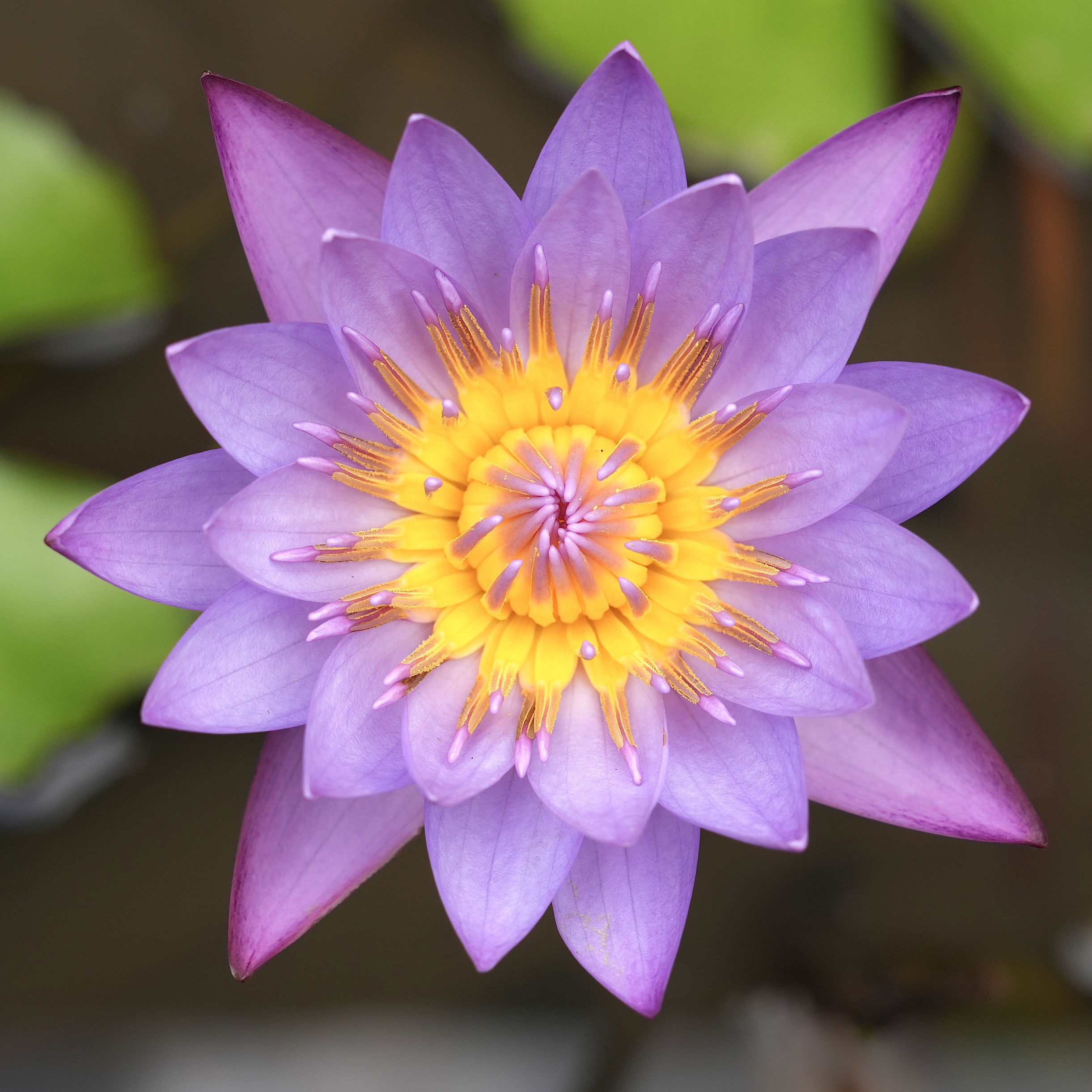
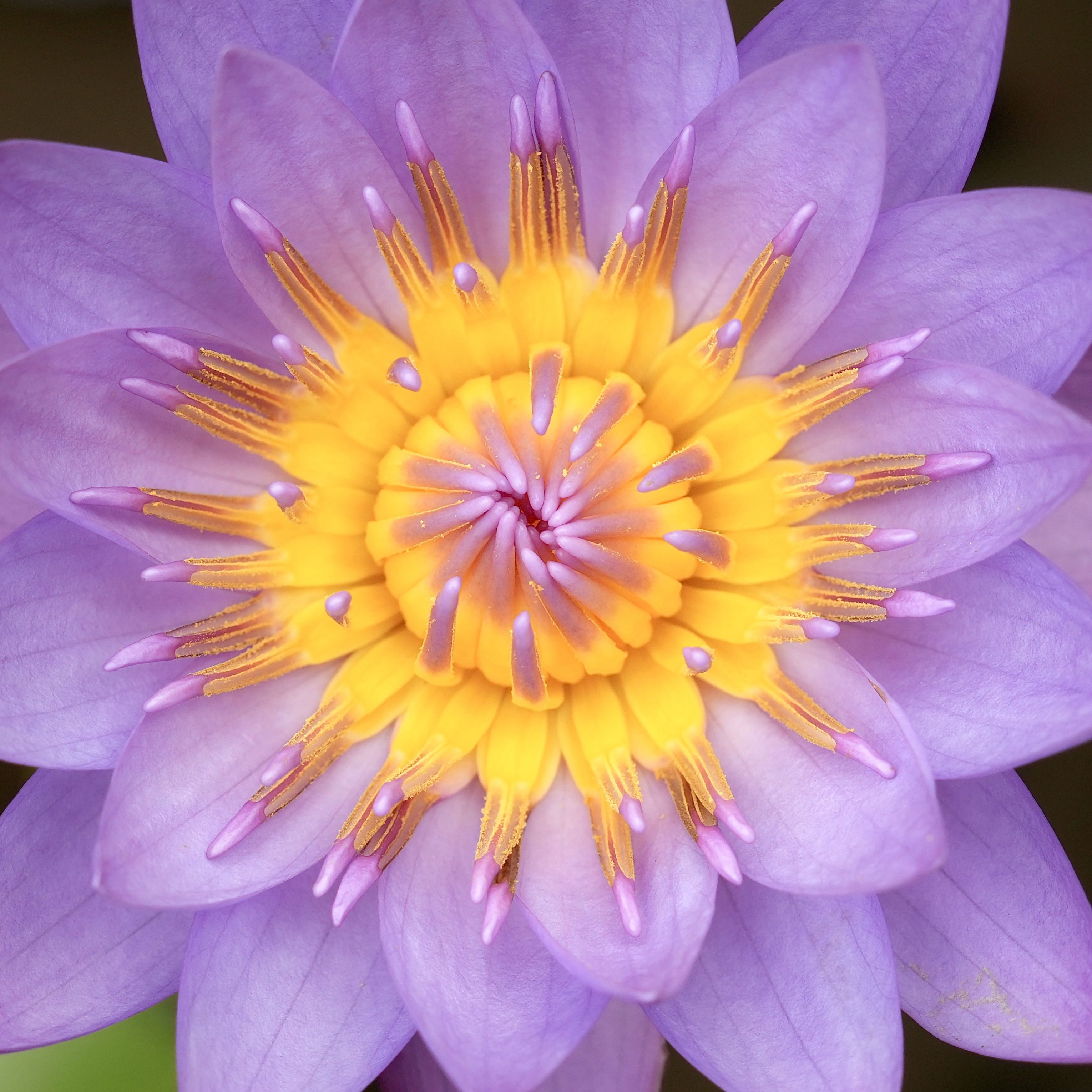
Opening up ….


Opening up … closer

Critique Style Requested: In-depth

The photographer has shared comprehensive information about their intent and creative vision for this image. Please examine the details and offer feedback on how they can most effectively realize their vision.

Self Critique

Pursuing my work on fitting flowers elegantly, or artistically, into a square format…Not as easy as I thought though. On these two, I was charmed by observing the opening of the waterlily, in between close and wide open…I have been shared between the two framing, the closest give more details and focus on the center, but creates some black/green corners. The larger framing is showing some water reflection, as I did not think about using the pola filter ! (Lesson learned!)
Curious to know what your perspectives are, none of them really show the surrounding …to put the flower into its environment…

Creative direction

I loved the details of the stamens, and how I could notice the nectar. The intense yellow and the purple colors seem to be such in great harmony… I actually never noticed that flower into the process of opening, but seen them either close or open…Hence the title: “Opening up … “(“to the sun”shall I say?)

Specific Feedback

Well, these close up make me wanting to get more into macro (Sony 90mm Macro lense?), or is it acceptable to keep shooting with the standard Sony 2.8 zoom?

I am still shared between shooting flowers (and animal) showing their environment, and focusing on the details of the beauty, removing the BG with bokeh and blacked/shadowed BG…

Technical Details

I would love to take a similar picture with impression of movement of the stamens, only. I am still new with the Sony 7R5, and not a master in post production. Should I take several shots with the intervalometer? Or/and combine with the stacking feature, if possible? Then could I really superpose all the images to keep the flower sharp and still get the movement on the stamens?

Description

Switching to a new camera, I took a challenge to take a collection of flowers pictures in a square format….These flowers are so patient with me, as I am learning all the features of this camera!
With 61MP, there is quite a bit of room to crop and still see a lot of details. However I wish to eventually print in very large format. I also just really started to get into post production, learning about using affinity, as technology evolves, I still have much to learn, so exciting!


Critique Template

Use of the template is optional, but it can help spark ideas.

Vision and Purpose:
Conceptual:
Emotional Impact and Mood:
Composition:
Balance and Visual Weight:
Depth and Dimension:
Color:
Lighting:
Processing:
Technical:

1 Like

I like the close-up version the best–lots of details and the flower’s center is stunning. I might darken the green in the lower LH corner as it looks different from the rest of the BG to pull my eye away from the center. Nice colors and this flower fits a square comp nicely…Jim

Hi Fabrice. These are both gorgeous images. Like @Jim_Zablotny I tend to favor the closer one, mostly just for the impact of it. Use of a macro lens is pretty optional and largely depends on whether you can get close enough to fill the frame with the subjects you’re shooting with the lenses you have. For subjects this large, a macro lens isn’t really needed. Stacking can be interesting and produce some awesome images, but again, it’s just a matter of taste. Since you have the auto focus bracketing, I’d give it a try. Note that you will want to have your camera on a tripod to do it.

Fabrice: Count me with @Jim_Zablotny and @Dennis_Plank in preferring the second tighter crop. On the first the green BG are grabbing a lot of unwanted attention. I would either desaturate them considerably or make them go away altogether. I would definitely make the green in the LLC of the second go away. The capture of the center is great on both images and the detail you can achieve with the big sensor is pretty impressive.

As for lens choice, I bagan my macro journey many years ago with a 100mm macro lens, which I still own and is one of the sharpest lenses in my bag. The Sony 90mm would be its equivalent. I like to shoot butterflies and dragonflies and found that for most cases I could not get close enough without the subject flying off. I eventually got a 200mm macro lens which ended up being my standard bearer for many years. The reach and narrower field of view were much better for moving critters. Unfortunately, no major camera maker is producing a 200mm macro for mirrorless systems. My macro lenses are old Minolta versions and I can use them on my A7rIII with an adapter but lose much of the functionality of the system, especially in manual focus mode. I still use the 200 but most often I just pair it with my A77II DSLR and use it for tiny stationary stuff. My go to rig now is a Sony 70-200 f2.8 GM-II which is a spectacular lens and I get pretty good near performance using extension tubes with it. I will often pair it with a 2x TeleConverter for even more reach. You can’t get to 1:1 but again, with a big sensor you may not need to.

As for creating a sense of movement, if the subject is perfectly stationary you could do a series of shots and blend them somehow to mimic the effect of a slow shutter speed, When shooting moving water for instance you can keep the land forms sharp while the water goes silky but because the water is usually moving quickly you may only need a SS of a second or so. For an opening flower that may take two or three hours to open fully you would need an incredibly dense neutral density filter to allow a super long exposure for one frame.

Stacking is fun and would be relatively easy with the A7r5 and it’s auto focus bracketing. My A7rIII doesn’t have that feature so I have to take the frames manually which means it will only work on fixed stationary subjects. Mark Seaver uses a Canon system with auto focus bracketing and will often be able to take multiple images of dragonflies and other temporarily stationary subjects. Dennis Plank has a 7r5 and could give you some specific help. I’m very much enjoying your work. Keep 'em coming.>=))>

Another vote for the closer shot, with wonderful advice above! You have captured delightful color and detail. A macro lens opens up so much of interest! Until you start stacking, don’t hesitate to go with a very small aperture for more DOF. And noise is very well-controlled with the newest software. I would advise the longest macro that looks practical, as you can get more magnification from a longer working distance – needed for things that will spook or things you just can’t get close to.

I applaud your flower project and hope to see more results!

I have to fall right in line and also prefer the closer image, although both are so beautiful.

I too don’t have a macro lens, and so don’t play with that end of the photography spectrum much. I’ll look forward to the details of your journey.

On focus stacking, I do have more experience with that in landscapes and use it quite a bit. It gets addictive to be able to “cheat” physics and choose how you want the focus to be. (Now if I could just figure out how to better control the wind :grinning:)

Woah! What a beauty. It’s so rich in color and the bloom appears to be so fresh and untouched. I think a lot of the ideas and feedback given so far is right on the money in terms of stretching your creative muscles. Technically speaking, a polarizer can help in certain situations, but will increase your shutter speeds which can make stacking even more impossible if that’s your goal. If you’d like to take a stab, there’s a whole thread dedicated to it here -

Please feel free to chime in with questions - this project of yours is certainly a worthy one!

Fabrice, I really like both views. The first one shows off the full flower and just a hint of it’s surroundings. The tighter view does an excellent job of showing off the details in the flower’s center with the square format emphasizing the radial symmetry of the flower.

Bill’s advice about macro is good and mimics much of my own macro history. When you’re just getting started, you get the most value for you purchase with extension tubes as they give you more magnification with very little loss of optical quality. (A caveat is that extension tubes increase the magnification as the ratio of extension tube length divided by the focal length so they give the largest magnification increase with shorter lenses.) After that, a dedicated macro lens is the best. Most camera companies sell a very high quality macro near the 100 mm focal length and these are great for stationary subjects, like flowers but as Bill points out, they don’t let you get close for subjects that can fly or run away.