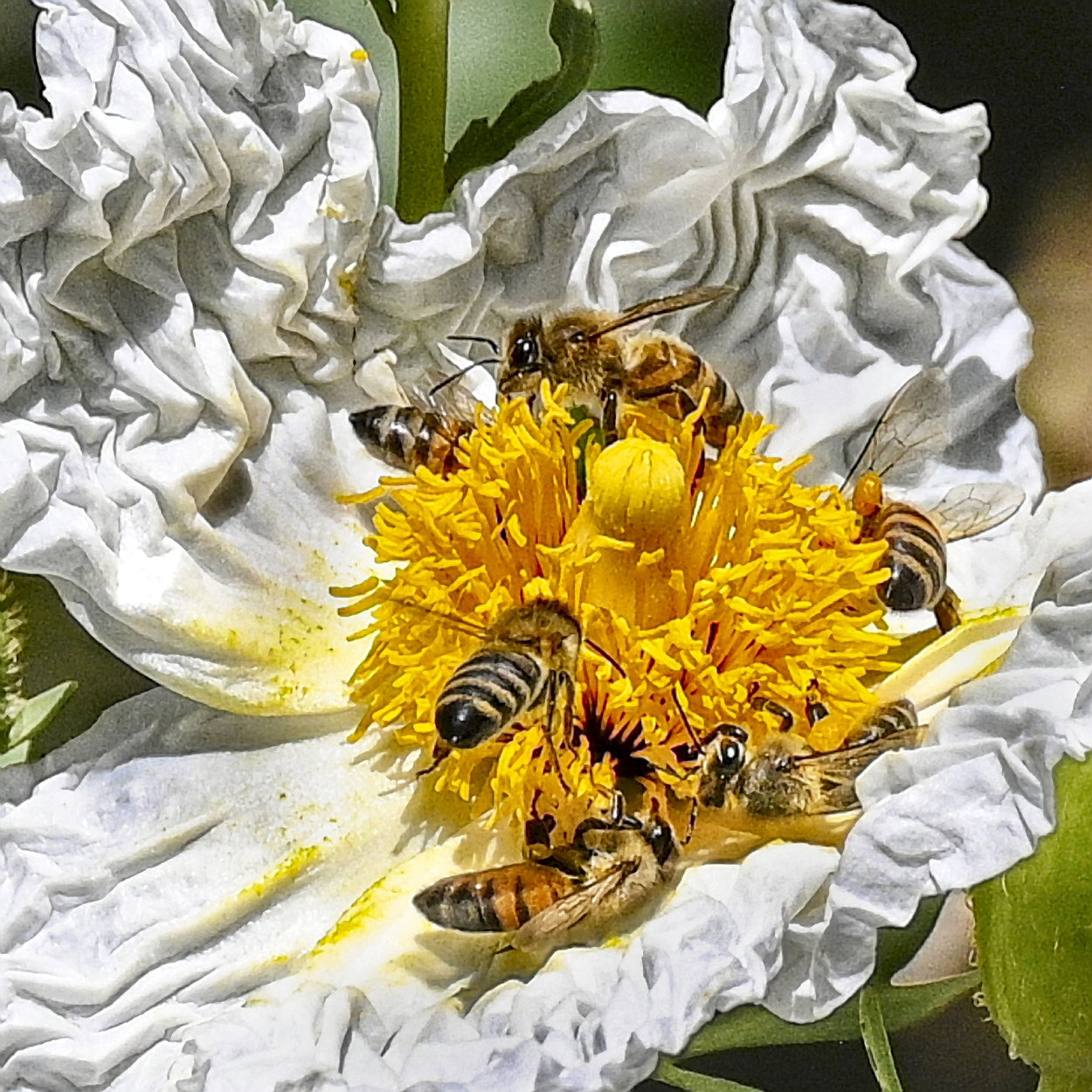
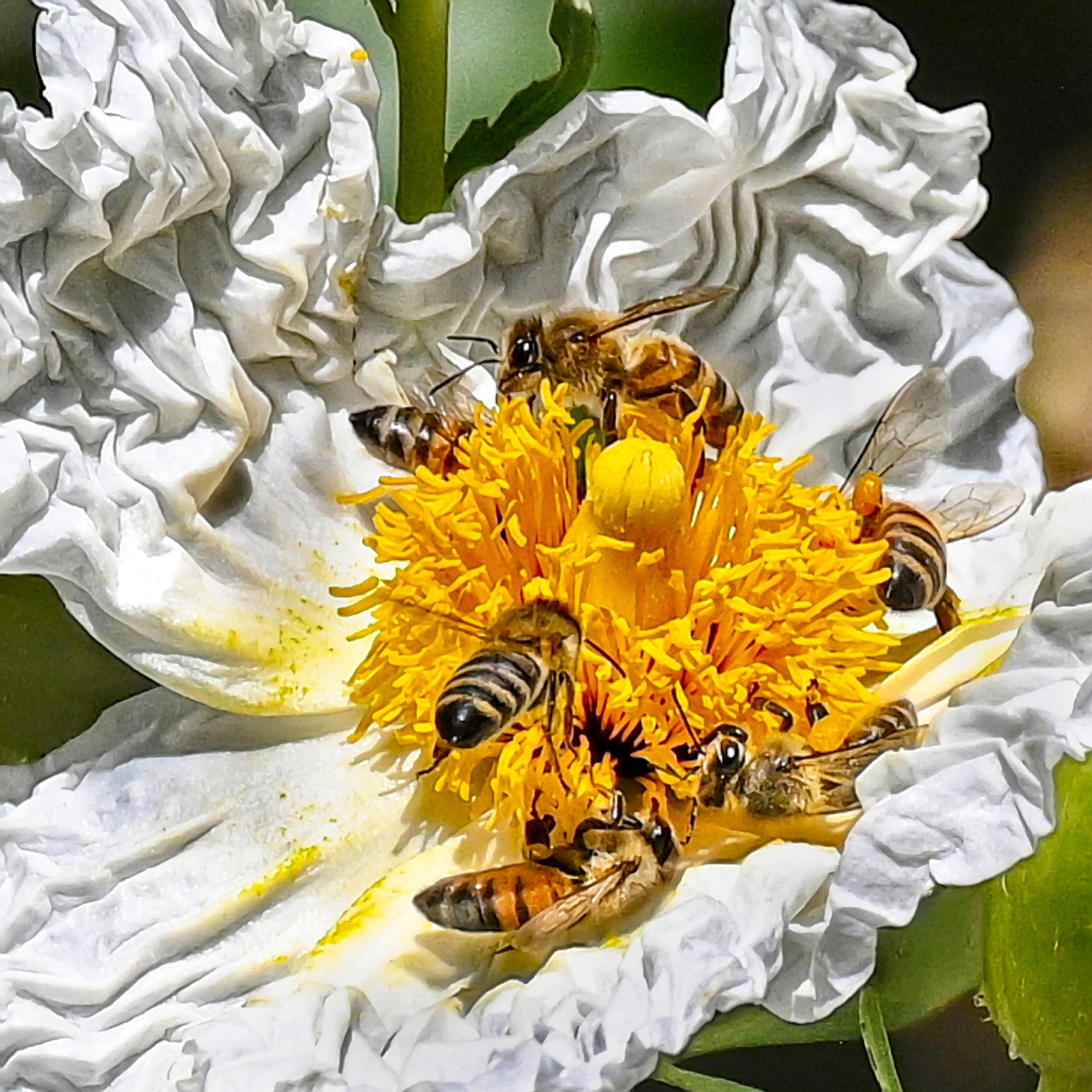
The photographer is looking for generalized feedback about the aesthetic and technical qualities of their image.
Description
After enjoying praise from fellow shooters for a similar shot with four bees in focus, I set out to do better. I knew the odds were with me since the blooms are nearby and the bees fond of mobbing one flower at a time.
Specific Feedback
I feel this one does a better job of handling the bright whites, blown out a bit in the earlier post, but might have toned down the flower too much. Tight crop seemed best.
Technical Details
Nikon Z6II, Z100-400MM lens, ISO 800, 1/3200th, F9
James: This kind of defines busy bees in a good way. I like the comp and the action especially and the pollen scattered on the petals. Sloppy workers. My recommendations for improvement are to reduce the noise and remove the grayish triangle in the RLC and the partial stuff on the left edge. Really good plane of focus management to get everyone in focus at f9. Nicely done. >=))>
I’m not sure how to describe this, but the photo lacks crisp detail. The hairs on the bees are smeared probably due to heavy noise suppression and a very tight crop. My guess is that you cropped before doing noise suppression? The comp is very interesting and the circle of bees in the flower works for me. …Jim
Well maybe six beats five but your shot beats mine – sharper, macro lens and the bees are shaded by the petals, making a richer image. I’m going back to get seven in the shade with a shorter lens.
What I really like about it however is that you shot it with an Olympus. I love my EM1 and enjoyed it for years before surrendering to the full-frame Nikon Z6II.
Good luck with seven - I might just get back to the peonies to try too. Funnily enough, I switched mostly from the great Nikon D500 and the super 105mm macro last year for 2 reasons: first. the OM1 allows for focus bracketing, and second, the set-up is lighter. But I still love the Nikons and won’t part with them.
James, I find the collection of bees, pollen and the crinkly flower delightful. @Bill_Fach’s removal of the greens along the left is a nice improvement. While modern zooms let you get reasonably close, they make you crop significantly to get a good tight look at critters as small as these bees. The key feature is what’s the close focus limit. Most non-macro lenses are limited to about 1/3 lifesize. A shorter, non-macro lens is likely to have a similar close focus limit.
Nice grouping of bees - I can imagine their lovely buzzing and activity. Do wish you had a diffuser held over for some more even light. It’s part of my normal kit with macro, just a cheap folding type, but it works really well.
Thanks Mark.
Wondering whether DOF makes much of a difference when working close? Would F16 give me more bees in focus?
I also have a great Olympus 12-40 F2.8 (24-80 equivalent with micro 4/3 sensor) lens which focuses as close as 4 inches, so might have to pull that and my EM-1 body out for the next bee shoot.
Yes I love my Z6II but can’t help feeling that Nikon is rather stingy with features – no 360 rotating screen, no in-camera focus stack, mere 2-stop auto HDR setting, etc. I’m especially irritated that my Oly EM1 Mark II has that delightful Pro Capture feature but the much-hailed Z6II does not. Got some amazing BIFs using Oly Pro Capture.
James, when working close, how limited dof is, quickly becomes the whole story. There are a variety of online dof calculators where you put in your camera, lens and distance to the subject and they will tell you what the dof is for a given aperature. Check your Oly 12-40 maximum magnification specification, my guess is that it’s about the same as your Nikon zoom (which I looked up and see that it’s 0.36). If that’s true, you’re won’t get much (or any) optical improvement and you would have to get a lot closer, which may disturb the bees.
James, a true macro lens cannot solve the limited dof problem. The inverse relationship between dof and magnification is a limit of optical physics. On stationary subjects, this can be surmounted via focus stacking. To get this many moving critters in a single frame, you have to work at a modest magnification and then do a large crop.